
[Paper Review] Distributed Representations of Entities in Open-World Knowledge Graphs
This paper proposes decentRL, a decentralized knowledge graph representation learning method that learns entity embeddings solely from neighbor embeddings using a graph attention mechanism (DAN), without relying on self-features. It introduces an auto-distiller for knowledge distillation to optimize output representations, achieving state-of-the-art performance on entity alignment and entity prediction, especially under inductive settings with only structural data.
Graph neural network (GNN)-based methods have demonstrated remarkable performance in various knowledge graph (KG) tasks. However, most existing approaches rely on observing all entities during training, posing a challenge in real-world knowledge graphs where new entities emerge frequently. To address this limitation, we introduce Decentralized Attention Network (DAN). DAN leverages neighbor context as the query vector to score the neighbors of an entity, thereby distributing the entity semantics only among its neighbor embeddings. To effectively train a DAN, we introduce self-distillation, a technique that guides the network in generating desired representations. Theoretical analysis validates the effectiveness of our approach. We implement an end-to-end framework and conduct extensive experiments to evaluate our method, showcasing competitive performance on conventional entity alignment and entity prediction tasks. Furthermore, our method significantly outperforms existing methods in open-world settings.
Motivation & Objective
- To address the limitation of existing GNN-based KG embedding models that require input features for unseen entities, which are often unavailable in open-world settings.
- To develop a method that learns entity representations exclusively from neighborhood information, enabling inductive representation learning in structure-only KGs.
- To design an effective optimization mechanism that allows output embeddings to continuously learn from original entity representations without direct feature supervision.
- To demonstrate the superiority of decentralized learning over centralized aggregation in terms of robustness and performance on downstream tasks.
Proposed method
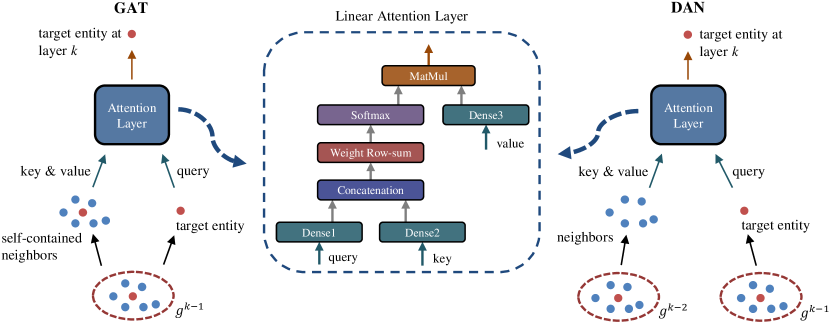
- Proposes a decentralized attention network (DAN), a variant of GAT, that computes entity embeddings by aggregating only neighbor embeddings, excluding the entity's own representation.
- Designs an auto-distiller algorithm that alternately optimizes output embeddings and their targets by maximizing mutual information between original and distilled representations.
- Uses knowledge distillation to refine output embeddings such that they continuously learn from original entity embeddings across training batches.
- Applies the auto-distiller to align the output representation of each entity with its original embedding, avoiding direct L1/L2 minimization due to potential dimension misalignment.
- Employs a symmetric attention mechanism where neighbors serve as both context and query, enhancing expressiveness and robustness.
- Integrates DAN with knowledge distillation into an end-to-end framework for inductive representation learning on open-world KGs.
Experimental results
Research questions
- RQ1Can entity representations be effectively learned from only neighbor embeddings, without relying on self-features or input features?
- RQ2How can output embeddings be optimized when original entity representations are not directly used as input?
- RQ3Does decentralized aggregation via neighbor-only attention improve performance on entity alignment and prediction compared to conventional GNNs?
- RQ4Can knowledge distillation from original embeddings to output representations enhance model generalization and inductive bias?
Key findings
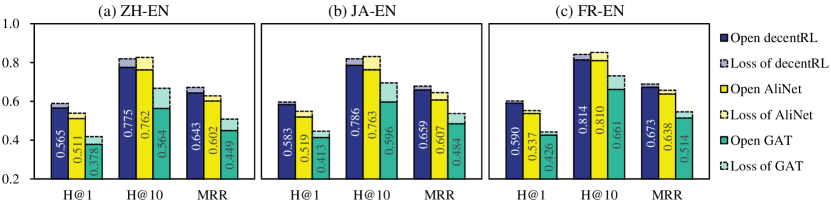
- decentRL achieved state-of-the-art performance on entity alignment across all three DBP15K language pairs (ZH-EN, JA-EN, FR-EN), with MRR scores of 0.672, 0.678, and 0.689 respectively.
- On entity prediction, decentRL + DistMult outperformed all baselines on FB15K-237, achieving the highest MRR and significantly improving MR (mean rank) for long-tail entities.
- In the open-world setting, decentRL + DistMult surpassed CompGCN + ConvE and other SOTA models, demonstrating strong inductive bias with only structural data.
- The auto-distiller significantly improved performance over baselines using L2 or InfoNCE loss, with H@1 scores increasing by up to 0.01 compared to L2 and 0.015 compared to InfoNCE.
- decentRL outperformed the centralized variant (centRL) by a clear margin, indicating that excluding self-features improves representation quality and avoids interference.
- Layer-wise analysis showed that decentRL consistently outperformed AliNet across all layers, with performance gains increasing when stacking layers, unlike AliNet which degraded after two layers.
Read this paper
Open the full text in the Nubint reader and ask about any passage as you read.
Read this paper on NubintThis review was generated by AI from the original paper. Please check the paper before citing it.