
[Paper Review] Dite-HRNet: Dynamic Lightweight High-Resolution Network for Human Pose Estimation
Dite-HRNet proposes a dynamic, lightweight high-resolution network for human pose estimation that enhances feature extraction and long-range spatial dependency through Dynamic Split Convolution (DSC) and Adaptive Context Modeling (ACM). By embedding these into specialized dynamic blocks, the model achieves state-of-the-art accuracy with lower FLOPs and parameters than existing lightweight networks on COCO and MPII datasets.
A high-resolution network exhibits remarkable capability in extracting multi-scale features for human pose estimation, but fails to capture long-range interactions between joints and has high computational complexity. To address these problems, we present a Dynamic lightweight High-Resolution Network (Dite-HRNet), which can efficiently extract multi-scale contextual information and model long-range spatial dependency for human pose estimation. Specifically, we propose two methods, dynamic split convolution and adaptive context modeling, and embed them into two novel lightweight blocks, which are named dynamic multi-scale context block and dynamic global context block. These two blocks, as the basic component units of our Dite-HRNet, are specially designed for the high-resolution networks to make full use of the parallel multi-resolution architecture. Experimental results show that the proposed network achieves superior performance on both COCO and MPII human pose estimation datasets, surpassing the state-of-the-art lightweight networks. Code is available at: https://github.com/ZiyiZhang27/Dite-HRNet.
Motivation & Objective
- To address the limitations of static, input-independent blocks in lightweight high-resolution networks for human pose estimation.
- To improve long-range spatial dependency modeling in lightweight HRNets without increasing computational complexity.
- To design dynamic, adaptive components that optimize the trade-off between model capacity and efficiency.
- To achieve superior accuracy and efficiency on standard benchmarks (COCO and MPII) compared to existing lightweight architectures.
Proposed method
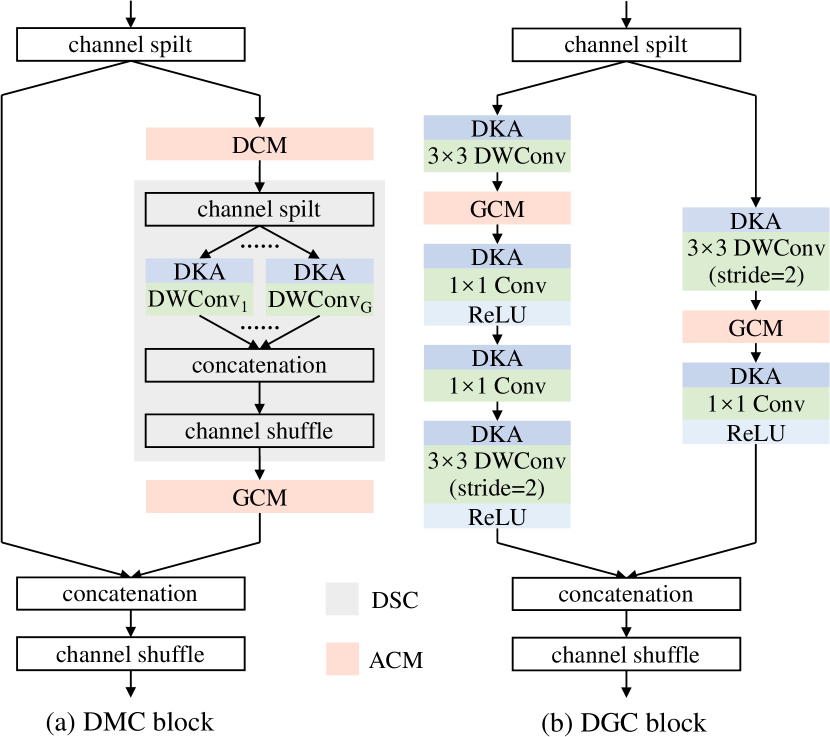
- Proposes Dynamic Split Convolution (DSC), a learnable, input-adaptive convolution mechanism that dynamically splits channels and adjusts kernel numbers to balance multi-scale feature extraction and computational cost.
- Introduces Adaptive Context Modeling (ACM), a learnable module that captures both local and global spatial patterns by attending to long-range dependencies across feature maps.
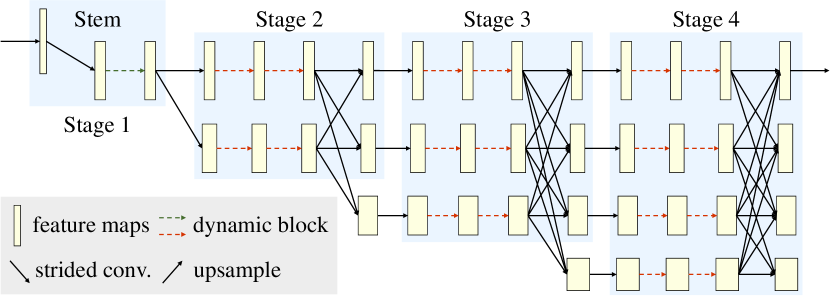
- Designs two novel dynamic lightweight blocks—Dynamic Multi-Scale Context Block and Dynamic Global Context Block—by integrating DSC and ACM into the parallel multi-resolution branches of HRNet.
- Configures DSC with two hyper-parameters: number of kernels (N) and number of groups (G), optimized per resolution branch to maximize efficiency and accuracy.
- Employs a progressive ablation strategy to validate the contribution of DSC and ACM individually and jointly on COCO and MPII datasets.
- Uses a modified HRNet backbone with dynamic blocks replacing standard residual blocks, enabling input-dependent feature learning while preserving high-resolution representation.
Experimental results
Research questions
- RQ1Can input-adaptive convolution mechanisms improve the efficiency and accuracy of lightweight high-resolution networks in human pose estimation?
- RQ2How can long-range spatial dependencies be effectively modeled in lightweight HRNets without increasing FLOPs?
- RQ3Does combining dynamic multi-scale feature extraction with adaptive global context modeling lead to better performance than static block designs?
- RQ4Can dynamic blocks achieve superior accuracy with lower computational cost compared to state-of-the-art lightweight networks like Lite-HRNet?
Key findings
- Dite-HRNet-18 achieves 65.9 AP on COCO val2017 and 87.0 PCKh on MPII, outperforming Lite-HRNet-18 (64.8 AP, 86.1 PCKh) with only 1.1M parameters and 209.8 MFLOPs.
- The model with ACM and DSC combined achieves 65.6 AP on COCO and 86.7 PCKh on MPII, showing significant accuracy gains with minimal additional FLOPs.
- Dite-HRNet-18 achieves the best performance among all lightweight networks on COCO with 87.6 PCKh@0.5, surpassing Lite-HRNet-30 despite having fewer parameters and FLOPs.
- The ablation study confirms that DSC and ACM are both effective: DSC improves multi-scale feature learning, while ACM enhances long-range spatial modeling.
- The optimal DSC configuration uses N = 4,4,2,1 and G = 1,1,2,4 across high-to-low resolution branches, balancing accuracy and efficiency.
- Dite-HRNet-18 outperforms MobileNetV2, MobileNetV3, ShuffleNetV2, and Small HRNet with significantly lower FLOPs and parameters.
Read this paper
Open the full text in the Nubint reader and ask about any passage as you read.
Read this paper on NubintThis review was generated by AI from the original paper. Please check the paper before citing it.