
[Paper Review] Diverse, but Divisive: LLMs Can Exaggerate Gender Differences in Opinion Related to Harms of Misinformation
This study investigates whether large language models (LLMs) like GPT-3.5-Turbo reflect or amplify gender differences in perceptions of misinformation harms. Using the TopicMisinfo dataset of 160 fact-checked claims and 1,592 human annotations, it finds that LLMs not only reflect observed gender differences in opinion but systematically exaggerate them, especially in gender-neutral prompts that disproportionately align with male perspectives on issues like abortion. The work underscores risks of bias in AI-assisted fact-checking prioritization and calls for ethical, inclusive design in LLM applications.
The pervasive spread of misinformation and disinformation poses a significant threat to society. Professional fact-checkers play a key role in addressing this threat, but the vast scale of the problem forces them to prioritize their limited resources. This prioritization may consider a range of factors, such as varying risks of harm posed to specific groups of people. In this work, we investigate potential implications of using a large language model (LLM) to facilitate such prioritization. Because fact-checking impacts a wide range of diverse segments of society, it is important that diverse views are represented in the claim prioritization process. This paper examines whether a LLM can reflect the views of various groups when assessing the harms of misinformation, focusing on gender as a primary variable. We pose two central questions: (1) To what extent do prompts with explicit gender references reflect gender differences in opinion in the United States on topics of social relevance? and (2) To what extent do gender-neutral prompts align with gendered viewpoints on those topics? To analyze these questions, we present the TopicMisinfo dataset, containing 160 fact-checked claims from diverse topics, supplemented by nearly 1600 human annotations with subjective perceptions and annotator demographics. Analyzing responses to gender-specific and neutral prompts, we find that GPT 3.5-Turbo reflects empirically observed gender differences in opinion but amplifies the extent of these differences. These findings illuminate AI's complex role in moderating online communication, with implications for fact-checkers, algorithm designers, and the use of crowd-workers as annotators. We also release the TopicMisinfo dataset to support continuing research in the community.
Motivation & Objective
- To examine whether LLMs can accurately reflect diverse group perspectives when assessing the harms of misinformation, focusing on gender as a key variable.
- To investigate whether gender-specific prompts elicit more representative gender differences in opinion compared to gender-neutral prompts.
- To evaluate the risk of LLMs amplifying or distorting gender-based disparities in public opinion about misinformation harms.
- To support ethical, fair, and representative use of LLMs in fact-checking pipelines by identifying biases in model outputs.
- To release the TopicMisinfo dataset to enable further research on socio-technical dimensions of claim prioritization in misinformation detection.
Proposed method
- Constructed the TopicMisinfo dataset with 160 recently fact-checked claims from the Google Fact-Check API across diverse topics.
- Collected 1,592 human annotations with demographic information (including gender) to capture subjective perceptions of harm.
- Evaluated GPT-3.5-Turbo using two prompt types: gender-specific (e.g., 'How would a man feel about this?') and gender-neutral (e.g., 'How would someone feel about this?').
- Compared model responses to empirical gender differences observed in human annotations to assess accuracy and bias amplification.
- Used statistical analysis to measure the extent of gender differences in LLM outputs and compared them to observed human differences.
- Conducted qualitative and quantitative analysis to assess whether neutral prompts disproportionately reflect male perspectives on sensitive topics like abortion.
Experimental results
Research questions
- RQ1To what extent do prompts with explicit gender references reflect empirically observed gender differences in opinion on the harms of misinformation in the U.S.?
- RQ2To what extent do gender-neutral prompts align with gendered viewpoints on topics of social relevance, particularly those affecting gendered groups?
- RQ3How does the LLM’s response amplify or distort observed gender differences in public opinion about misinformation harms?
- RQ4In what ways do LLMs fail to represent the perspectives of marginalized groups, especially women, in harm assessment tasks?
- RQ5How do LLM outputs compare to human-annotated perceptions when assessing group-level harm from misinformation?
Key findings
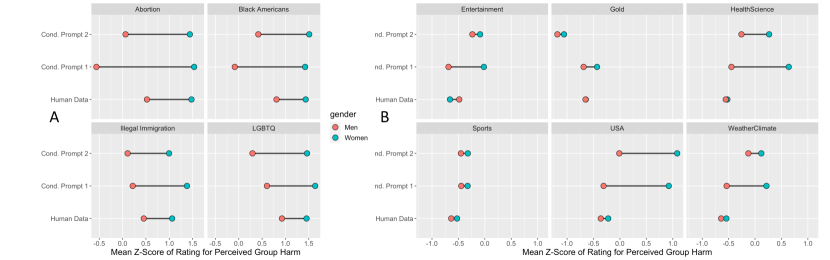
- LLMs such as GPT-3.5-Turbo reflect empirically observed gender differences in opinion about misinformation harms, but consistently exaggerate the magnitude of these differences.
- Even in topics where no significant gender differences were observed in human annotations, gender-conditioned prompts led the LLM to generate responses that amplified perceived disparities.
- Gender-neutral prompts produced outputs that disproportionately aligned with male perspectives, particularly on issues like abortion, where women’s viewpoints are uniquely relevant.
- The LLM’s responses showed a systematic bias toward male-identified perspectives, suggesting a risk of underrepresenting or distorting women’s concerns in automated prioritization systems.
- The study found that LLMs may misrepresent the diversity of public opinion, especially when used in claim prioritization for fact-checking, due to amplification of existing societal biases.
- The TopicMisinfo dataset reveals that LLMs are not neutral tools and can perpetuate or exacerbate social inequities in AI-assisted decision-making.
Read this paper
Open the full text in the Nubint reader and ask about any passage as you read.
Read this paper on NubintThis review was generated by AI from the original paper. Please check the paper before citing it.