
[Paper Review] Does Circuit Analysis Interpretability Scale? Evidence from Multiple Choice Capabilities in Chinchilla
This paper investigates the scalability of circuit analysis techniques to the 70B-parameter Chinchilla language model, focusing on multiple-choice question answering in the MMLU benchmark. Using logit attribution, attention visualization, and activation patching, the authors identify 'correct letter' attention heads that attend to the correct answer label (A, B, C, or D), compress them to low-rank subspaces without performance loss, and find that query and key subspaces encode a general 'Nth item in an enumeration' feature, though this explanation is only partially valid on broader distributions.
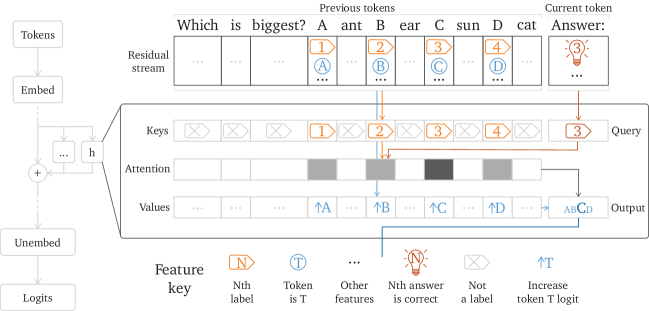
\emph{Circuit analysis} is a promising technique for understanding the internal mechanisms of language models. However, existing analyses are done in small models far from the state of the art. To address this, we present a case study of circuit analysis in the 70B Chinchilla model, aiming to test the scalability of circuit analysis. In particular, we study multiple-choice question answering, and investigate Chinchilla's capability to identify the correct answer \emph{label} given knowledge of the correct answer \emph{text}. We find that the existing techniques of logit attribution, attention pattern visualization, and activation patching naturally scale to Chinchilla, allowing us to identify and categorize a small set of `output nodes' (attention heads and MLPs). We further study the `correct letter' category of attention heads aiming to understand the semantics of their features, with mixed results. For normal multiple-choice question answers, we significantly compress the query, key and value subspaces of the head without loss of performance when operating on the answer labels for multiple-choice questions, and we show that the query and key subspaces represent an `Nth item in an enumeration' feature to at least some extent. However, when we attempt to use this explanation to understand the heads' behaviour on a more general distribution including randomized answer labels, we find that it is only a partial explanation, suggesting there is more to learn about the operation of `correct letter' heads on multiple choice question answering.
Motivation & Objective
- To test whether established circuit analysis techniques—logit attribution, attention visualization, and activation patching—scale effectively to large language models like Chinchilla (70B parameters).
- To identify and categorize specific attention heads and MLPs responsible for selecting the correct answer label in multiple-choice questions.
- To investigate whether the functional semantics of 'correct letter' heads generalize beyond the MMLU distribution, particularly when answer labels are randomized.
- To use dimensionality reduction (SVD) to extract interpretable subspaces in query, key, and value projections of attention heads, and validate their semantic coherence.
- To assess the robustness and completeness of circuit explanations by testing them on perturbed inputs, identifying limitations in current interpretability methods at scale.
Proposed method
- Applied logit attribution and attention pattern visualization to locate attention heads in Chinchilla that contribute to correct answer label selection in MMLU.
- Used activation patching to validate causal contributions of identified heads to the final output logits.
- Employed singular value decomposition (SVD) to identify 3-dimensional subspaces in query, key, and value projections of 'correct letter' heads that capture variation in MMLU inputs.
- Compressed the query, key, and value subspaces of the heads to low-rank representations while preserving performance on the MMLU benchmark.
- Evaluated the semantic interpretability of the identified subspaces by probing their behavior on mutated prompts, including randomized answer labels.
- Compared the performance of the low-rank compressed heads to the original heads to verify no loss in accuracy on the original MMLU distribution.
Experimental results
Research questions
- RQ1Can standard circuit analysis techniques such as logit attribution and activation patching be successfully applied to a 70B-parameter language model like Chinchilla?
- RQ2Do 'correct letter' attention heads in Chinchilla exhibit consistent and interpretable behavior across different input distributions, including randomized answer labels?
- RQ3What features are encoded in the query, key, and value subspaces of 'correct letter' heads, and do they reflect generalizable patterns like 'Nth item in an enumeration'?
- RQ4To what extent does the identified low-rank subspace representation explain the head's behavior on a broader distribution beyond the MMLU test set?
- RQ5How robust and complete are current interpretability tools when applied to large-scale models, and what limitations emerge in real-world, high-parameter settings?
Key findings
- The techniques of logit attribution, attention visualization, and activation patching successfully scale to the 70B Chinchilla model, enabling identification of 'correct letter' attention heads and MLPs involved in multiple-choice answer selection.
- The 'correct letter' heads can be compressed to low-rank subspaces in query, key, and value projections without performance loss on the MMLU benchmark, indicating structural simplicity.
- The query and key subspaces of the heads encode a general 'Nth item in an enumeration' feature, suggesting they detect the position of the correct answer in a list of options.
- The value subspace primarily encodes the identity of the answer token (e.g., 'A', 'B', 'C', 'D'), enabling the head to boost the corresponding logit.
- The identified 'Nth item' feature only partially explains the head's behavior on randomized or out-of-distribution inputs, indicating that the mechanism is not fully captured by this explanation.
- The results highlight the limitations of current interpretability methods at scale, showing that explanations can be noisy, incomplete, or context-dependent, even when techniques appear to work well on standard benchmarks.
Read this paper
Open the full text in the Nubint reader and ask about any passage as you read.
Read this paper on NubintThis review was generated by AI from the original paper. Please check the paper before citing it.