
[Paper Review] Dolma: an Open Corpus of Three Trillion Tokens for Language Model Pretraining Research
Dolma is an open English pretraining corpus of three trillion tokens from diverse sources, accompanied by an open-source curation toolkit to enable reproduction and research on data effects in language modeling.
Information about pretraining corpora used to train the current best-performing language models is seldom discussed: commercial models rarely detail their data, and even open models are often released without accompanying training data or recipes to reproduce them. As a result, it is challenging to conduct and advance scientific research on language modeling, such as understanding how training data impacts model capabilities and limitations. To facilitate scientific research on language model pretraining, we curate and release Dolma, a three-trillion-token English corpus, built from a diverse mixture of web content, scientific papers, code, public-domain books, social media, and encyclopedic materials. We extensively document Dolma, including its design principles, details about its construction, and a summary of its contents. We present analyses and experimental results on intermediate states of Dolma to share what we have learned about important data curation practices. Finally, we open-source our data curation toolkit to enable reproduction of our work as well as support further research in large-scale data curation.
Motivation & Objective
- Promote openness and transparency in language model pretraining data.
- Provide a large, diverse English corpus to support open LM research and reproducibility.
- Offer a high-performance toolkit to curate and reproduce pretraining datasets.
Proposed method
- Assemble a 3T-token English corpus from web, papers, code, books, social media, and encyclopedic sources.
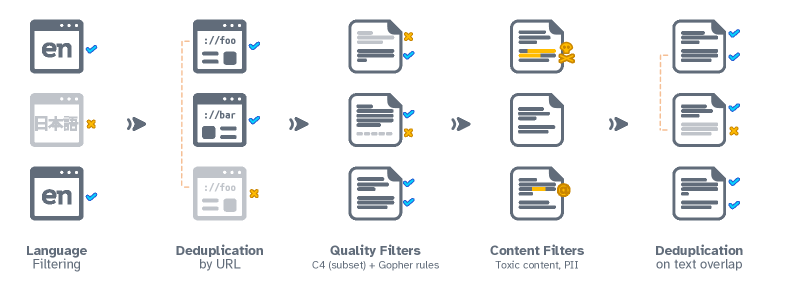
- Apply language, quality, content, and deduplication filters to produce a clean pretraining dataset.
- Use a multi-source mixing approach and enable downstream evaluation to guide data decisions.
Experimental results
Research questions
- RQ1How does the composition of pretraining data affect language model capabilities and limitations?
- RQ2What data curation practices (filters, deduplication, source mixing) maximize downstream task performance and language fit?
- RQ3Can an open, reproducible pipeline yield a dataset that matches or exceeds alternative open corpora in quality and diversity?
- RQ4What is the impact of various content filters (toxicity, PII) and deduplication on model performance and safety?
Key findings
- Dolma provides a 3 trillion token English corpus drawn from seven data sources, available publicly with a data curation toolkit.
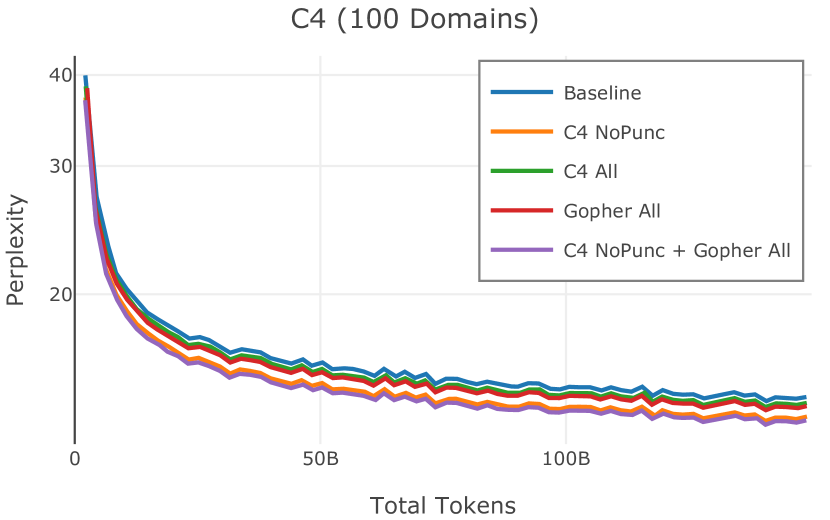
- A combination of Gopher and C4 style quality filters yields better language fit and downstream performance than using CCNet quality scores alone.
- Toxic content filtering using hate and NSFW detectors, with a higher threshold, improves downstream tasks at a cost of some data removal.
- PII removal strategies showed no discernible impact on model performance in their experiments.
- Deduplication at URL, document, and paragraph levels is used to improve token efficiency, with substantial document removal at URL deduplication (53.2%).
- A combined pipeline of deduplication, quality filtering, and content filtering yields the best downstream performance in their ablation studies.
Read this paper
Open the full text in the Nubint reader and ask about any passage as you read.
Read this paper on NubintThis review was generated by AI from the original paper. Please check the paper before citing it.