
[Paper Review] DORIS-MAE: Scientific Document Retrieval using Multi-level Aspect-based Queries
DORIS-MAE introduces a novel scientific document retrieval task using multi-level aspect-based queries to handle complex, multifaceted research questions. It proposes a human-annotated dataset of 100 complex queries in computer science, each with 100 relevant abstracts and hierarchical aspect/sub-aspect structure, enabling 4,000+ sub-query test cases. The framework achieves 500x cost reduction via LLM-based annotation (Anno-GPT) without quality loss, and reveals significant performance drops in existing retrieval models, highlighting the need for more robust methods.
In scientific research, the ability to effectively retrieve relevant documents based on complex, multifaceted queries is critical. Existing evaluation datasets for this task are limited, primarily due to the high cost and effort required to annotate resources that effectively represent complex queries. To address this, we propose a novel task, Scientific DOcument Retrieval using Multi-level Aspect-based quEries (DORIS-MAE), which is designed to handle the complex nature of user queries in scientific research. We developed a benchmark dataset within the field of computer science, consisting of 100 human-authored complex query cases. For each complex query, we assembled a collection of 100 relevant documents and produced annotated relevance scores for ranking them. Recognizing the significant labor of expert annotation, we also introduce Anno-GPT, a scalable framework for validating the performance of Large Language Models (LLMs) on expert-level dataset annotation tasks. LLM annotation of the DORIS-MAE dataset resulted in a 500x reduction in cost, without compromising quality. Furthermore, due to the multi-tiered structure of these complex queries, the DORIS-MAE dataset can be extended to over 4,000 sub-query test cases without requiring additional annotation. We evaluated 17 recent retrieval methods on DORIS-MAE, observing notable performance drops compared to traditional datasets. This highlights the need for better approaches to handle complex, multifaceted queries in scientific research. Our dataset and codebase are available at https://github.com/Real-Doris-Mae/Doris-Mae-Dataset.
Motivation & Objective
- To address the lack of high-quality, complex query benchmarks in scientific document retrieval.
- To design a hierarchical, aspect-based query structure that improves annotation efficiency and retrieval model interpretability.
- To reduce the cost of expert-level annotation through a scalable LLM validation framework (Anno-GPT).
- To evaluate the performance of existing retrieval models on complex, multi-intent queries and reveal their limitations.
- To enable the generation of over 4,000 sub-query test cases from 100 original queries without additional annotation.
Proposed method
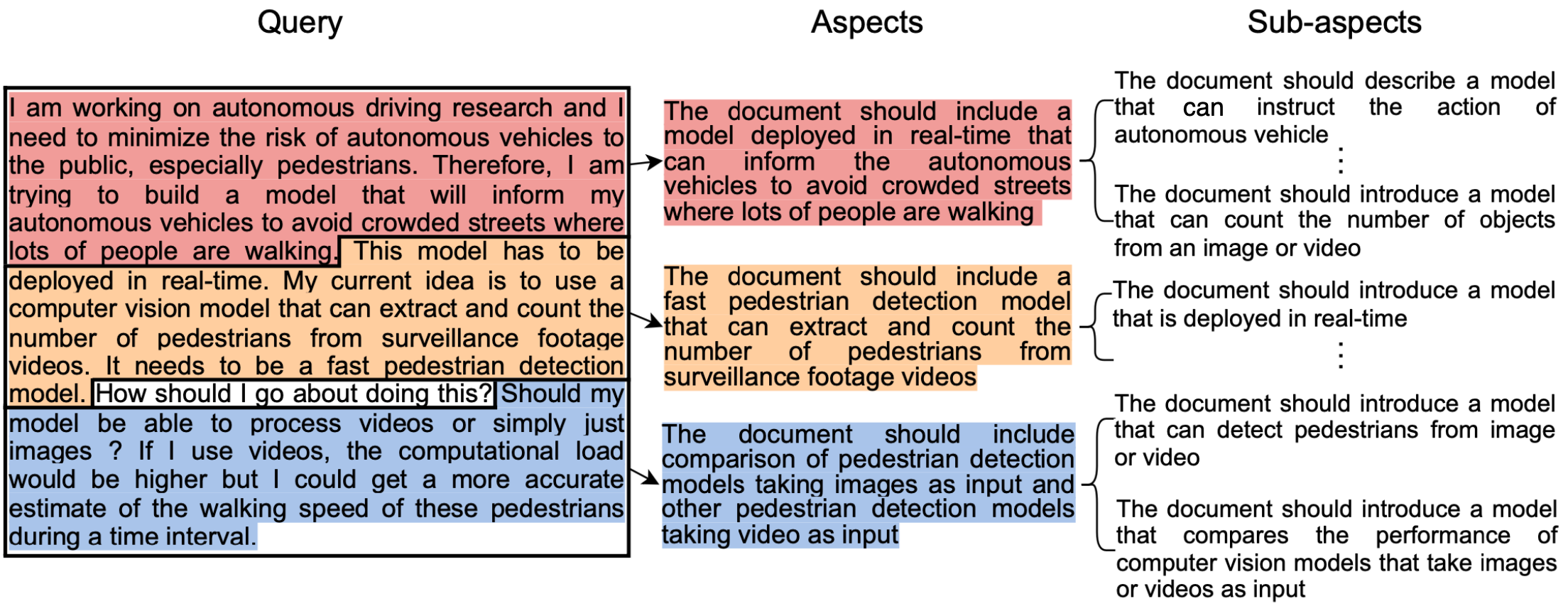
- The DORIS-MAE task structures complex scientific queries into hierarchical aspects and sub-aspects to capture multifaceted research questions.
- A benchmark dataset of 100 complex queries was manually created by experts, each paired with a pool of 100 relevant CS abstracts from arXiv (2011–2021).
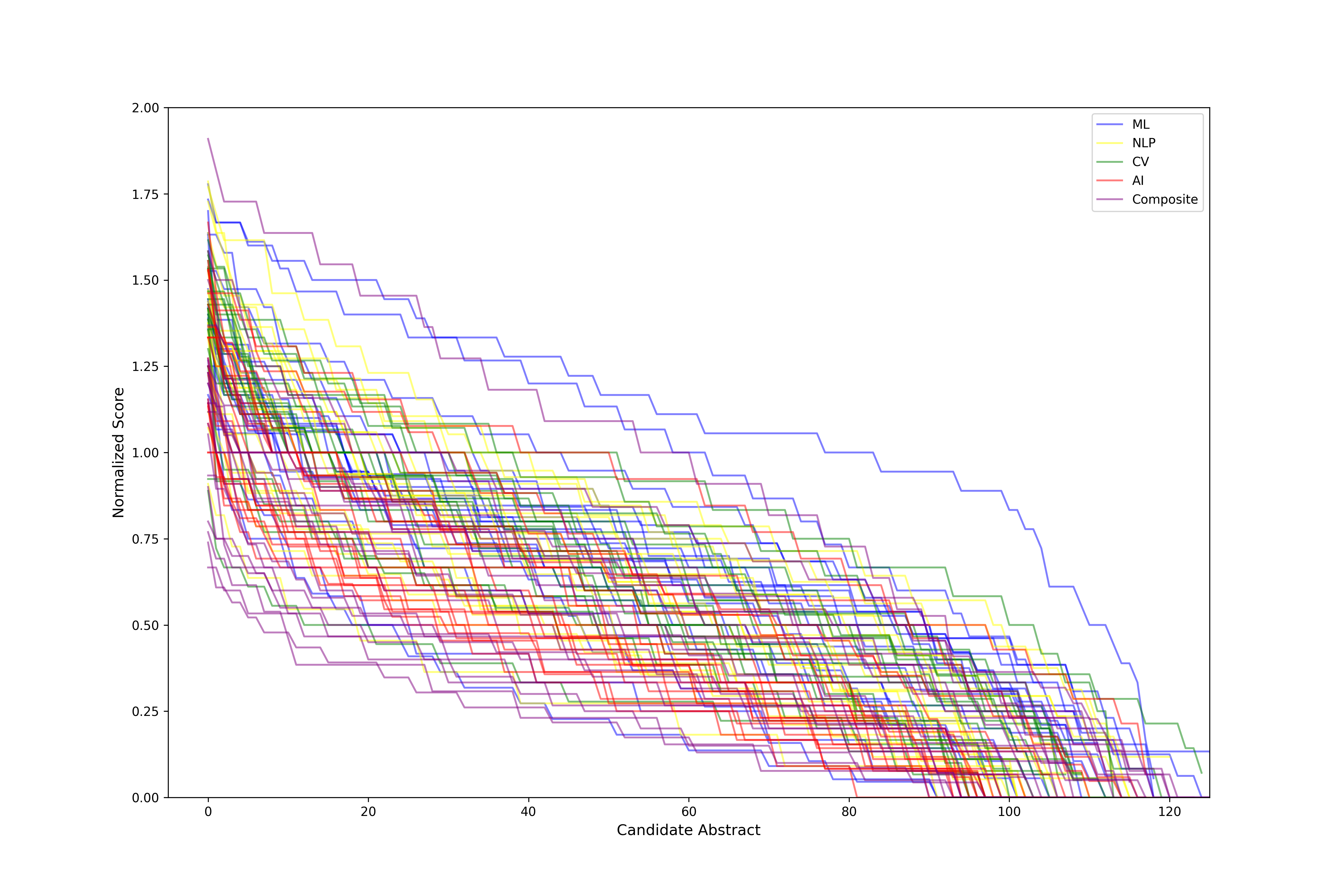
- Relevance scores for each (aspect/sub-aspect, abstract) pair were annotated by human experts, forming a ranked test set of 83,591 pairs.
- Anno-GPT is a pipeline that validates LLM-generated annotations using statistical methods, ensuring quality comparable to human experts.
- LLMs (ChatGPT-3.5-turbo) were used to generate annotations, reducing annotation cost by 500x compared to full human annotation.
- The hierarchical structure enables automatic expansion of test cases into over 4,000 sub-queries without new annotation.
Experimental results
Research questions
- RQ1Can a hierarchical, aspect-based query structure improve the accuracy and scalability of scientific document retrieval?
- RQ2To what extent can LLMs replace human experts in annotating complex, expert-level document relevance?
- RQ3How do existing retrieval models perform on complex, multi-intent queries compared to traditional benchmarks?
- RQ4Can the hierarchical structure of queries be leveraged to generate a large number of sub-query test cases without additional annotation?
- RQ5What is the cost-quality trade-off of using LLMs for expert-level annotation in scientific retrieval datasets?
Key findings
- The DORIS-MAE dataset contains 100 complex queries, each with 100 relevant abstracts, forming a total of 83,591 annotated (aspect/sub-aspect, abstract) pairs.
- LLM-based annotation via Anno-GPT achieved quality on par with human experts, reducing annotation cost by 500x.
- The hierarchical aspect structure enabled the generation of over 4,000 sub-query test cases from the original 100 queries without additional annotation.
- When evaluated on DORIS-MAE, 17 recent retrieval models showed significant performance drops compared to traditional benchmarks, indicating their limitations on complex queries.
- The dataset is self-contained, publicly released under CC-BY-NC license, and hosted on GitHub and Zenodo with DOI 10.5281/zenodo.8035110.
- The dataset is maintained by the authors and will be updated to correct errors, with versioning preserved via DOIs.
Read this paper
Open the full text in the Nubint reader and ask about any passage as you read.
Read this paper on NubintThis review was generated by AI from the original paper. Please check the paper before citing it.