
[Paper Review] Double Half-Heusler Alloys X$_2$Ni$_2$InSb (X= Zr/Hf) with promising Thermoelectric Performance: Role of varying structural phases
This study uses first-principles calculations to investigate double half-Heusler alloys X₂Ni₂InSb (X = Zr/Hf) across tetragonal, cubic, and solid solution phases, revealing that the tetragonal phase exhibits superior thermoelectric performance due to low lattice thermal conductivity and high electronic transport. Zr₂Ni₂InSb achieves a peak ZT of 2.46 for n-type conduction at 900 K, indicating strong potential for high-efficiency thermoelectric materials.
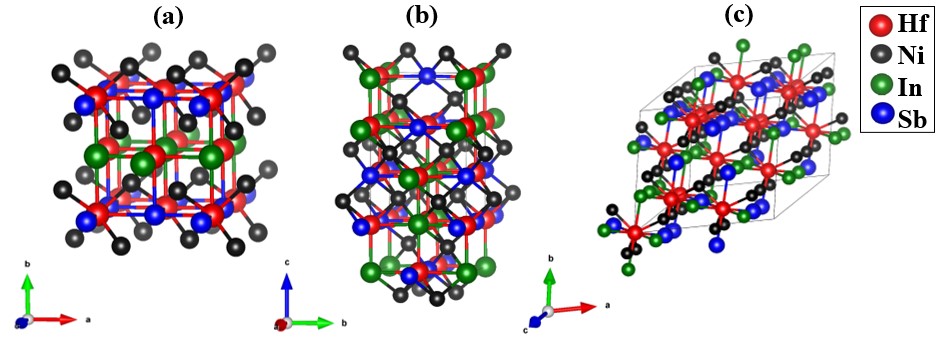
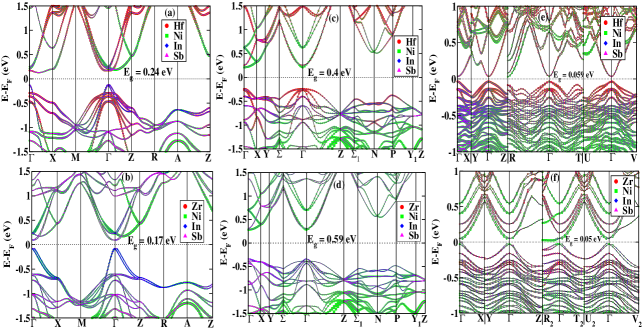
Double half-heusler alloys are the new class of compounds which can be seen as transmuted version of two single half-heusler with higher flexibility of tuning their properties. Here, we report a detailed study of thermoelectric (TE) properties of two double half-heusler (HH) alloys X$_2$Ni$_2$InSb (X=Hf/Zr), using first-principles calculation. These alloys exhibit a rich phase diagram with the possibility of tetragonal, cubic and solid solution phase at different temperature range. As such, a comparative study of TE properties of all these phases is performed. The ordered phases show quite favorable electronic transport as compared to the disordered ones in both compounds. Lattice thermal conductivity of double HH alloys is lower than their ternary counter-part, making them most promising for TE application. Simulated band gap, obtained using hybrid functional, of ordered phases of Hf$_2$Ni$_2$InSb and Zr$_2$Ni$_2$InSb lie in the range 0.24-0.4 eV and 0.17-0.59 eV respectively, while for disordered phase, it is 0.05- 0.06 eV. Hf$_2$Ni$_2$InSb shows a reasonably high ZT value of $\sim$ 2.19, while Zr$_2$Ni$_2$InSb yields 2.46 at high temperature for n-type conduction in tetragonal phase. The ZT value for p-type conduction is also quite promising ($\sim$ 1.35 and $\sim$ 2.19 for Hf- and Zr-based compounds). In both the compounds, electronic transport (Seebeck and electrical conductivity) plays the dominant role for the high ZT-value. Keeping in mind the promising TE performance, we propose immediate attention from experimentalists to synthesize and cross validate our findings for these new candidate materials.
Motivation & Objective
- To investigate the thermoelectric properties of double half-Heusler alloys X₂Ni₂InSb (X = Zr/Hf) across multiple structural phases.
- To evaluate the role of structural phase (tetragonal, cubic, solid solution) in tuning electronic and thermal transport properties.
- To identify the optimal phase and doping level for maximizing the thermoelectric figure of merit (ZT).
- To compare the performance of Zr- and Hf-based compounds and assess their potential for experimental synthesis.
Proposed method
- Employed density functional theory (DFT) with HSE06 hybrid functional to accurately compute band gaps.
- Calculated electronic transport properties (Seebeck coefficient, electrical conductivity, power factor) using the BoltzTraP2 code.
- Computed lattice thermal conductivity (κL) via the Wiedemann-Franz law and phonon group velocity analysis.
- Used the rigid band approximation to simulate carrier concentration dependence of ZT.
- Performed structural relaxation and phonon dispersion calculations to assess phase stability and anharmonicity.
- Incorporated spin-orbit coupling to account for band splitting due to heavy Sb atoms.
Experimental results
Research questions
- RQ1How do the thermoelectric properties of X₂Ni₂InSb (X = Zr/Hf) vary across tetragonal, cubic, and solid solution phases?
- RQ2What is the role of lattice thermal conductivity in determining the ZT performance of double half-Heusler alloys?
- RQ3How does electronic transport (Seebeck coefficient and power factor) contribute to high ZT values in these materials?
- RQ4Which phase and doping level yield the highest ZT for both n-type and p-type conduction in Zr₂Ni₂InSb and Hf₂Ni₂InSb?
- RQ5To what extent does spin-orbit coupling influence the electronic band structure and thermoelectric response?
Key findings
- The tetragonal phase of Zr₂Ni₂InSb achieves a peak ZT of 2.46 for n-type conduction at 900 K, the highest among all phases and compositions studied.
- Hf₂Ni₂InSb exhibits a ZT of 2.19 for n-type conduction at 900 K in the tetragonal phase, also indicating excellent performance.
- The tetragonal phase shows the lowest lattice thermal conductivity (κL), which is a key factor in enhancing ZT despite similar power factors.
- For p-type conduction, the tetragonal phase of Zr₂Ni₂InSb reaches a ZT of 2.19 at 900 K, while Hf₂Ni₂InSb reaches 1.35.
- The simulated band gap for ordered tetragonal Zr₂Ni₂InSb ranges from 0.17 to 0.59 eV using HSE06 functional, indicating a favorable semiconducting behavior.
- Electronic transport dominates the high ZT values, with power factor reaching up to 29.7 mWm⁻¹K⁻² for n-type Zr₂Ni₂InSb in the tetragonal phase.
Read this paper
Open the full text in the Nubint reader and ask about any passage as you read.
Read this paper on NubintThis review was generated by AI from the original paper. Please check the paper before citing it.