
[Paper Review] Dynamic Sparse No Training: Training-Free Fine-tuning for Sparse LLMs
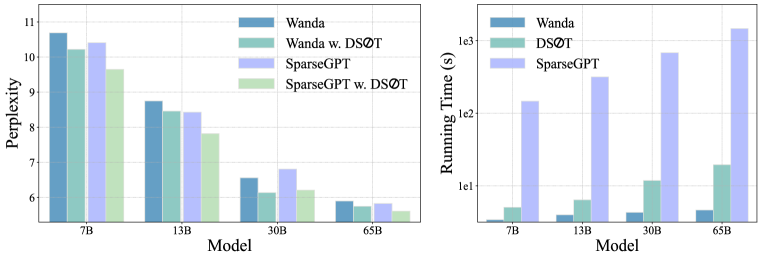
This paper proposes Dynamic Sparse No Training (DS No T), a training-free fine-tuning method for sparse large language models (LLMs) that enhances performance through iterative, gradient-free weight pruning and growing. By minimizing reconstruction error between dense and sparse LLM outputs using expectation- and variance-aware criteria, DS No T achieves state-of-the-art results—outperforming Wanda by 26.79 perplexity at 70% sparsity on LLaMA-7B—while operating in linear time without backpropagation.
The ever-increasing large language models (LLMs), though opening a potential path for the upcoming artificial general intelligence, sadly drops a daunting obstacle on the way towards their on-device deployment. As one of the most well-established pre-LLMs approaches in reducing model complexity, network pruning appears to lag behind in the era of LLMs, due mostly to its costly fine-tuning (or re-training) necessity under the massive volumes of model parameter and training data. To close this industry-academia gap, we introduce Dynamic Sparse No Training (DSnoT), a training-free fine-tuning approach that slightly updates sparse LLMs without the expensive backpropagation and any weight updates. Inspired by the Dynamic Sparse Training, DSnoT minimizes the reconstruction error between the dense and sparse LLMs, in the fashion of performing iterative weight pruning-and-growing on top of sparse LLMs. To accomplish this purpose, DSnoT particularly takes into account the anticipated reduction in reconstruction error for pruning and growing, as well as the variance w.r.t. different input data for growing each weight. This practice can be executed efficiently in linear time since its obviates the need of backpropagation for fine-tuning LLMs. Extensive experiments on LLaMA-V1/V2, Vicuna, and OPT across various benchmarks demonstrate the effectiveness of DSnoT in enhancing the performance of sparse LLMs, especially at high sparsity levels. For instance, DSnoT is able to outperform the state-of-the-art Wanda by 26.79 perplexity at 70% sparsity with LLaMA-7B. Our paper offers fresh insights into how to fine-tune sparse LLMs in an efficient training-free manner and open new venues to scale the great potential of sparsity to LLMs. Codes are available at https://github.com/zyxxmu/DSnoT.
Motivation & Objective
- Address the high computational cost of fine-tuning sparse LLMs, which remains a barrier to on-device deployment despite model compression.
- Close the gap between academic research and industry deployment by enabling efficient, training-free adaptation of sparse LLMs.
- Overcome the limitations of existing pruning methods like SparseGPT and Wanda, which degrade in performance at high sparsity levels.
- Develop a method that improves sparse LLM performance without backpropagation or weight updates, leveraging reconstruction error minimization.
- Ensure robustness to limited calibration data and high sparsity, enabling practical deployment of sparse LLMs on resource-constrained devices.
Proposed method
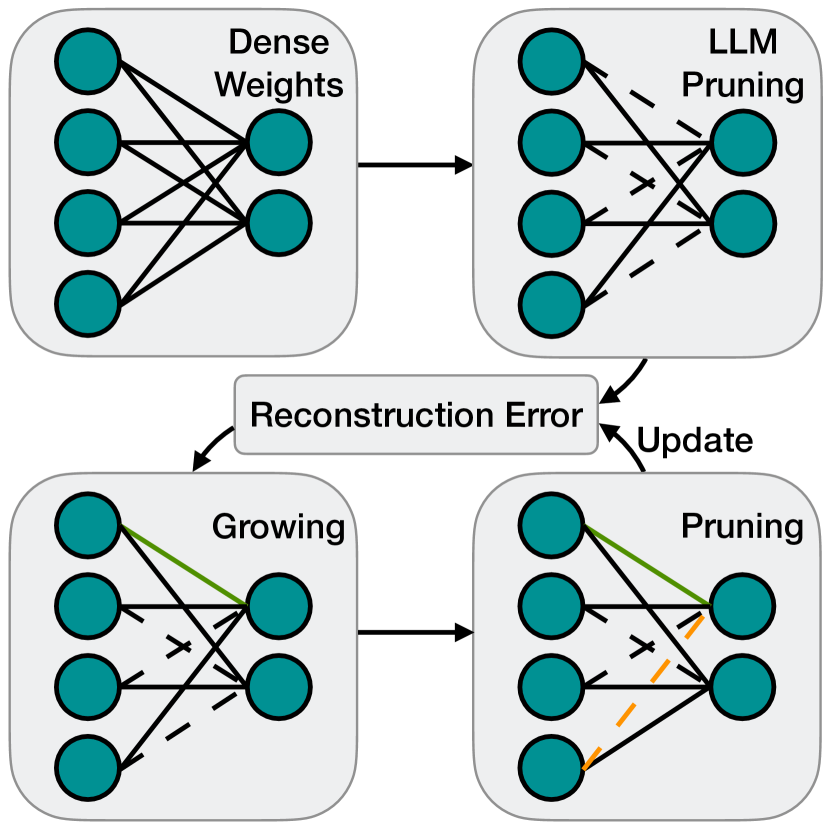
- Adapt the principles of Dynamic Sparse Training (DST) to sparse LLMs by performing iterative, gradient-free weight pruning and growing to minimize reconstruction error between dense and sparse model outputs.
- Introduce a novel pruning criterion that selects weights for removal based on their expected reduction in reconstruction error, avoiding removal of critical outlier weights.
- Propose a growing criterion that prioritizes weights with high expected reconstruction error reduction and low variance across input sequences, ensuring stable and effective updates.
- Use a calibration phase with a small set of input sequences to estimate the impact of growing each weight on reconstruction error, enabling efficient, data-driven decisions.
- Execute the algorithm in linear time by avoiding backpropagation and relying only on forward pass statistics, making it scalable to large models.
- Formulate the reconstruction error minimization as a dynamic optimization problem where the sparse topology evolves iteratively based on the expected and variance-aware impact of each weight.
Experimental results
Research questions
- RQ1Can a training-free method significantly improve the performance of sparse LLMs without backpropagation or weight updates?
- RQ2How does the proposed DS No T method compare to existing pruning methods like Wanda and SparseGPT in terms of performance at high sparsity levels?
- RQ3To what extent does DS No T improve robustness to limited calibration data compared to Hessian-based or magnitude-based methods?
- RQ4What is the optimal update schedule and stopping criterion for iterative pruning and growing in sparse LLMs?
- RQ5Can expectation- and variance-aware criteria for pruning and growing lead to better performance than magnitude-only or second-order methods?
Key findings
- DS No T outperforms Wanda by 26.79 perplexity at 70% sparsity on LLaMA-7B, demonstrating state-of-the-art performance in training-free fine-tuning.
- At 60% sparsity, DS No T improves the average zero-shot accuracy on seven downstream tasks by 1.6 percentage points over SparseGPT, with consistent gains across all tasks.
- The method maintains strong performance even with only 10 calibration sequences, significantly outperforming SparseGPT, which degrades sharply under low-data conditions.
- The optimal update schedule uses 50 cycles with a 0.1 threshold for reconstruction error reduction, avoiding underfitting or overfitting to calibration data.
- Pruning weights based on expected reconstruction error reduction yields better results than magnitude-based pruning, highlighting the importance of preserving outlier channel weights.
- The proposed growing criterion, which balances expected error reduction and variance, achieves the best performance, confirming its effectiveness in guiding dynamic topology evolution.
Read this paper
Open the full text in the Nubint reader and ask about any passage as you read.
Read this paper on NubintThis review was generated by AI from the original paper. Please check the paper before citing it.