
[Paper Review] Dynamical Friction Modeling of Massive Black Holes in Cosmological Simulations and Effects on Merger Rate Predictions
This paper develops and validates a dynamical friction (DF) model for massive black holes (MBHs) in large-scale cosmological hydrodynamical simulations, showing that DF from collisionless particles (stars and dark matter) dominates over gas drag, especially for MBHs >10⁷ M⊙. The model increases the predicted MBH merger rate by a factor of ~2 compared to no-DF runs, reaching ~2 mergers per year for z > 1.1, consistent with prior simulations and enhancing central black hole capture by >40%.
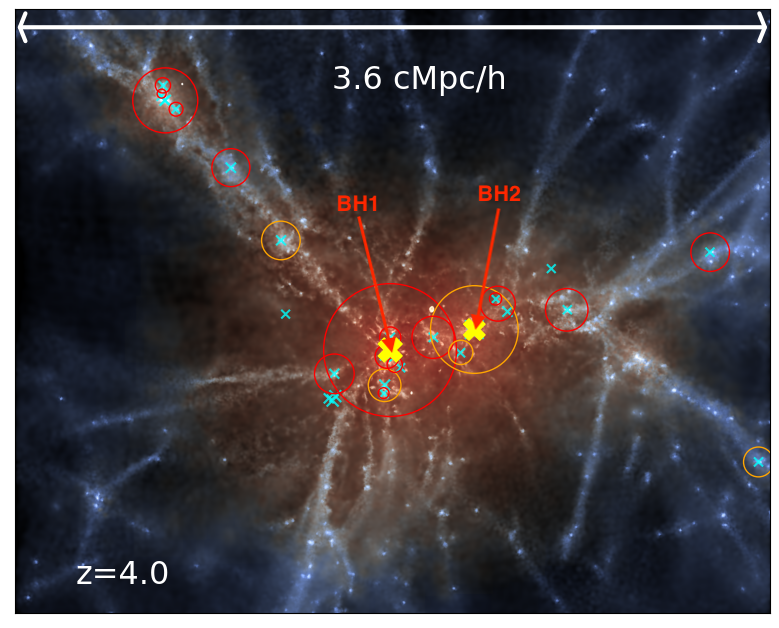
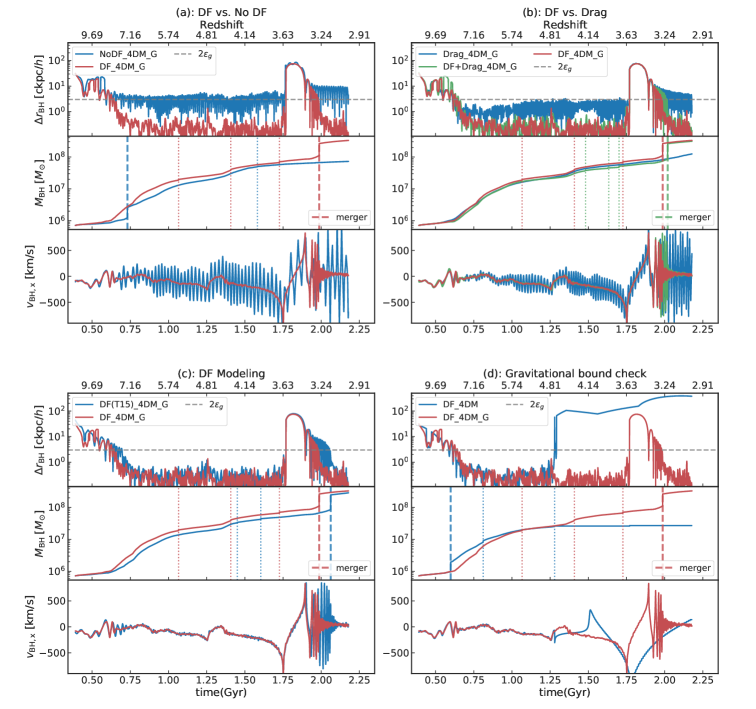
In this work we establish and test methods for implementing dynamical friction for massive black hole pairs that form in large volume cosmological hydrodynamical simulations which include galaxy formation and black hole growth. We verify our models and parameters both for individual black hole dynamics and for the black hole population in cosmological volumes. Using our model of dynamical friction (DF) from collisionless particles, black holes can effectively sink close to the galaxy center, provided that the black hole's dynamical mass is at least twice that of the lowest mass resolution particles in the simulation. Gas drag also plays a role in assisting the black holes' orbital decay, but it is typically less effective than that from collisionless particles, especially after the first billion years of the black hole's evolution. DF from gas becomes less than $1\%$ of DF from collisionless particles for BH masses $> 10^{7}$ M$_{\odot}$. Using our best DF model, we calculate the merger rate down to $z=1.1$ using an $L_{ m box}=35$ Mpc$/h$ simulation box. We predict $\sim 2$ mergers per year for $z>1.1$ peaking at $z\sim 2$. These merger rates are within the range obtained in previous work using similar-resolution hydro-dynamical simulations. We show that the rate is enhanced by factor of $\sim 2$ when DF is taken into account in the simulations compared to the no-DF run. This is due to $>40\%$ more black holes reaching the center of their host halo when DF is added.
Motivation & Objective
- To develop a physically motivated dynamical friction model for massive black holes in large-volume cosmological simulations with galaxy formation.
- To test the model’s accuracy in reproducing individual black hole dynamics and population-level merger rates.
- To quantify the relative contributions of collisionless particles and gas to dynamical friction and orbital decay.
- To assess how dynamical friction affects the predicted merger rate of supermassive black holes in cosmological volumes.
- To enable more realistic tracking of black hole dynamics down to the resolution limit, moving beyond the repositioning approximation.
Proposed method
- Implement a modified dynamical friction force model using the Chandrasekhar formula, adapted for low-resolution simulations with unresolved sub-kpc dynamics.
- Use a fiducial model with a minimum black hole mass threshold of twice the lowest mass resolution particle to ensure numerical stability and physical consistency.
- Include both collisionless particle DF (stars and dark matter) and gas drag contributions, with gas drag modeled using a modified drag force based on local gas density and velocity.
- Apply a gravitational binding check at the time of black hole pair formation to ensure physical consistency and prevent unphysical momentum injection.
- Validate the model by comparing simulated sinking timescales with analytical predictions and by analyzing force magnitudes across different redshifts and black hole masses.
- Calculate the cumulative merger rate down to z = 1.1 using a 35 Mpc/h simulation box, comparing results with and without dynamical friction.
Experimental results
Research questions
- RQ1How does dynamical friction from collisionless particles compare to gas drag in driving the orbital decay of massive black holes in cosmological simulations?
- RQ2What is the minimum black hole mass required for dynamical friction to effectively operate in low-resolution cosmological simulations?
- RQ3To what extent does including dynamical friction increase the predicted merger rate of supermassive black holes compared to simulations without it?
- RQ4How well do the simulated black hole sinking timescales match analytical predictions across different redshifts and environments?
- RQ5How do uncertainties in dynamical friction parameters (e.g., b_max, M_dyn,seed) affect merger rate predictions?
Key findings
- Dynamical friction from collisionless particles dominates over gas drag, contributing more than 99% of the total DF force for black holes with masses >10⁷ M⊙.
- The fiducial dynamical friction model increases the number of black holes reaching the center of their host halo by over 40% compared to the no-DF run.
- The predicted merger rate reaches approximately 2 mergers per year for redshifts z > 1.1 when dynamical friction is included, compared to ~1 merger per year without it.
- The model successfully reproduces analytical dynamical friction timescales, though individual black hole timescales show large variance due to environmental differences.
- The model is robust at low resolution, with the fiducial implementation showing less noisy force corrections than the reference model from Tremmel et al. (2015).
- Reducing the dynamical seed mass (M_dyn,seed) below the dark matter particle mass reduces the merger rate by a factor of two or more, highlighting parameter sensitivity.
Read this paper
Open the full text in the Nubint reader and ask about any passage as you read.
Read this paper on NubintThis review was generated by AI from the original paper. Please check the paper before citing it.