
[논문 리뷰] Dynamics and Resilience of the Charge Density Wave in a bilayer kagome metal
본 논문은 ARPES, DFT, 및 시간분해 광학 분광법을 사용하여 bilayer ScV6Sn6의 CDW가 주로 격자 구동이며 전자적 격차는 미미하고, 약 1.42 THz의 진폭 모드가 강한 광여음에도 지속되는 것을 보여준다.
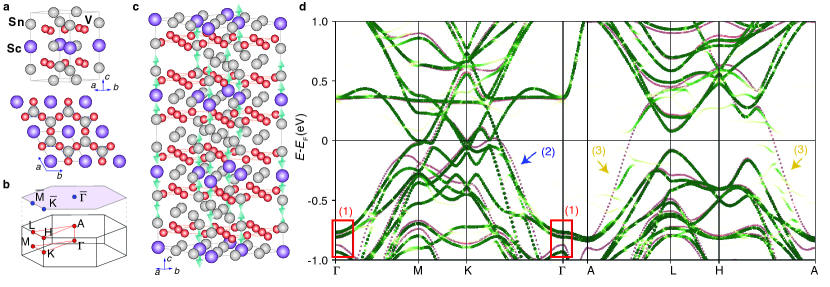
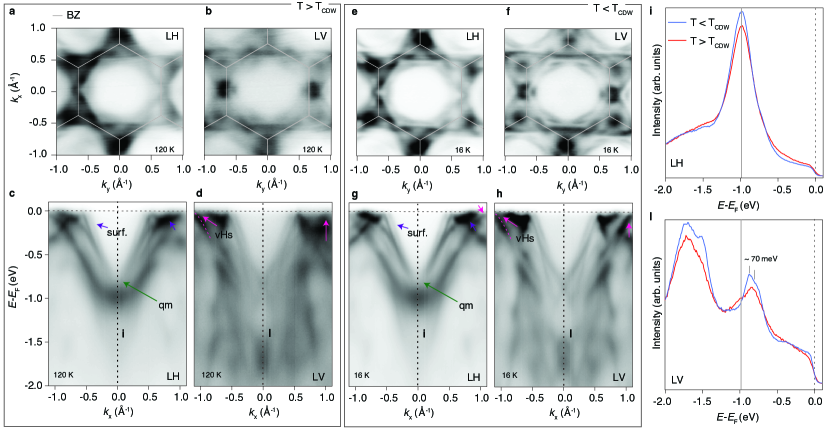
Long-range electronic order descending from a metallic parent state constitutes a rich playground to study the intricate interplay of structural and electronic degrees of freedom. With dispersive and correlation features as multifold as topological Dirac-like itinerant states, van-Hove singularities, correlated flat bands, and magnetic transitions at low temperature, kagome metals are located in the most interesting regime where both phonon and electronically mediated couplings are significant. Several of these systems undergo a charge density wave (CDW) transition, and the van-Hove singularities, which are intrinsic to the kagome tiling, have been conjectured to play a key role in mediating such an instability. However, to date, the origin and the main driving force behind this charge order is elusive. Here, we use the topological bilayer kagome metal ScV6Sn6 as a platform to investigate this puzzling problem, since it features both kagome-derived nested Fermi surface and van-Hove singularities near the Fermi level, and a CDW phase that affects the susceptibility, the neutron scattering, and the specific heat, similarly to the siblings AV3Sb5 (A = K, Rb, Cs) and FeGe. We report on our findings from high-resolution angle-resolved photoemission, density functional theory, and time-resolved optical spectroscopy to unveil the dynamics of its CDW phase. We identify the structural degrees of freedom to play a fundamental role in the stabilization of charge order. Along with a comprehensive analysis of the subdominant impact from electronic correlations, we find ScV6Sn6 to feature an instance of charge density wave order that predominantly originates from phonons. As we shed light on the emergent phonon profile in the low-temperature ordered regime, our findings pave the way for a deeper understanding of ordering phenomena in all CDW kagome metals.
연구 동기 및 목표
- 이중층 카고메 금속 ScV6Sn6에서 CDW의 기원과 구동 원인을 조사한다.
- CDW 형성 및 동역학 동안 구조적(격자) 및 전자 차원의 자유도 간의 결합을 특성화한다.
- 페르미 준위에서 전자적 격차가 열린다 여부를 결정하고 CDW 전이 전후의 스펙트럴 가중치 변화를 평가한다.
제안 방법
- 고해상도 ARPES로 TCDW 위/아래에서 고대칭 방향을 따라 전자 구조를 맵핑한다.
- 밴드 구조, van-Hove 특이점 및 CDW에 의한 간격을 예측하기 위한 밀도 범함수 이론(DFT) 계산.
- 시간분해 광학 분광법으로 전자 및 격자 응답의 동역학을 탐지하고 이완 시간과 진폭을 추출한다.
- DFT 기반 포논 분석으로 CDW 진폭 모드 주파수와 온도 의존성을 추정한다.
- 유도된 TR-OS의 플루언스 의존성으로 진폭 모드의 포화, 잔향, 주파수 변이를 관찰하여 전자 기여와 격자 기여를 분리한다.
실험 결과
연구 질문
- RQ1ScV6Sn6가 CDW 형성 시 페르미 준위에서 상당한 갭을 보이는지, 아니면 CDW가 주로 격자 자유도에 의해 매개되는지?
- RQ2이 이중층 카고메 시스템에서 포논 및 전자-포논 결합이 CDW를 안정화하는 데 어떤 역할을 하는가?
- RQ3광여ู้응답 이후 전자 및 격자 응답이 시간적으로 어떻게 디커플링되며, 이것이 구동 메커니즘에 대해 무엇을 시사하는가?
- RQ4CDW에 가장 많이 결합된 전자 상태의 에너지 스케일은 무엇이며, 이것이 관찰된 광학 및 ARPES 특징과 어떻게 관련되는가?
주요 결과
- DFT 및 ARPES는 EF 근처의 디랙 유사 상태 및 van-Hove 특이점이 CDW에 의해 크게 영향을 받지 않는 것으로 보이며, 주요 변화는 특정 k-경로를 따라 EF에서 벗어난 영역에서 나타난다.
- CDW는 A-H 및 A-L 방향으로 여러 에너지 갭을 유도하지만, CDW 전이 전의 밴드 극에서의 스펙트럴 가중치는 여전히 남아 있어 갭을 실험적으로 해상도 있게 확인하기 어렵다.
- TR-OS는 약 1.45 THz의 진폭 모드를 나타내며, TCDW에 접근할수록 약 6%의 소프트닝과 증가하는 댐핑이 관측되어 CDW AM 거동과 일치한다.
- 비정상적 전자 이완(τ1)은 온도가 올라갈수록 증가하고 TCDW에서 발산하지 않아, 비전형적이고 격자-강인한 CDW 기전을 시사한다.
- 플루언스 의존 측정은 전자적 부분이 중간 플루언스에서 포화되는 반면 AM 진동은 대략 700 μJ/cm2까지 지속되고 약 1000 μJ/cm2 근처에서만 사라지며, 강한 격자 탄력성을 시사한다.
더 나은 연구,지금 바로 시작하세요
연구 설계부터 논문 작성까지, 연구 시간을 획기적으로 줄여보세요.
카드 등록 없음 · 무료 플랜 제공
이 리뷰는 AI가 만들고, 인간 에디터가 검토했습니다.