
[Paper Review] Effects of Symmetry in a Diffusive Energy Balance Model
This paper investigates how meridional symmetry in a diffusive Energy Balance Model (EBM) affects climate multistability through analytical and numerical methods. Using the Boundary Integral Method and finite difference schemes, it demonstrates that symmetric continental placement increases fold bifurcations and equilibrium states, revealing heightened sensitivity of climate dynamics to continental geometry and ice-albedo feedback.
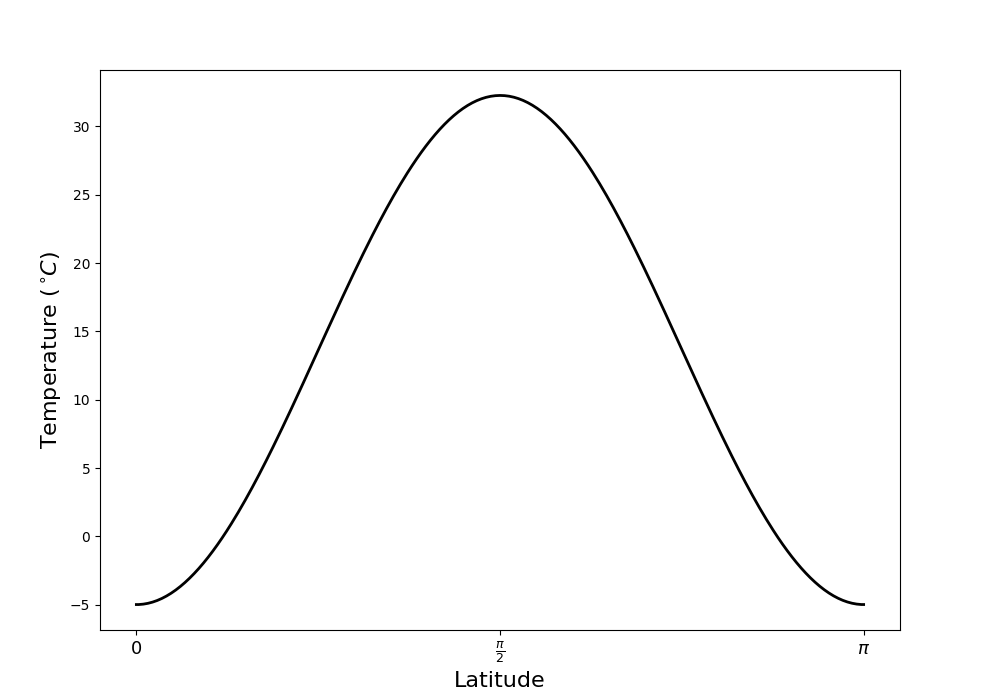
In this paper, we solve a North-type Energy Balance Model (EBM) using an analytical method, the Boundary Integral Method. This approach is discussed in light of existing analytical techniques for this type of equation. We use the method to demonstrate that the placement of a zonally symmetric continent, with an altered ice-albedo feedback dynamic, introduces new equilibrium states. A finite difference algorithm is implemented to solve the time-dependent equation and assess the stability of the equilibrium states, along with a numerical perturbation scheme. Bifurcation diagrams are drawn and we show that the bifurcation curve is extremely sensitive to the placement of a continent. The continent is initially configured with meridional symmetry, and we investigate how the system dynamics respond to a gradual reduction of the system's symmetry properties. We find that meridional symmetry increases the number of fold bifurcations and equilibria. Additionally, we discuss how the emerging bifurcation structures may provide insights into the complex dynamics involved as one ascends the climate model hierarchy.
Motivation & Objective
- To analyze the impact of zonally symmetric continental placement on equilibrium states and bifurcation structure in a diffusive Energy Balance Model (EBM).
- To investigate how symmetry reduction in continental geometry alters the number and stability of climate equilibria.
- To apply the Boundary Integral Method (BIM) to analytically solve the time-independent EBM with spatially varying albedo and continental boundaries.
- To validate analytical results with a finite difference algorithm and assess equilibrium stability via numerical perturbation.
- To explore how bifurcation structures in simplified models inform the dynamics of more complex climate models in the hierarchy.
Proposed method
- Employs the Boundary Integral Method (BIM) to solve the steady-state diffusive EBM with discontinuous albedo feedback and continental boundaries.
- Derives integral equations using Green’s functions and integral identities to handle discontinuities at critical latitudes (e.g., ice cap edges).
- Implements a finite difference algorithm to solve the time-dependent EBM, enabling numerical simulation of transient dynamics.
- Applies a numerical perturbation scheme to test the stability of equilibrium states, using the slope-stability theorem for validation.
- Constructs bifurcation diagrams by varying a control parameter (e.g., solar insolation), tracking equilibrium solutions across symmetry-breaking configurations.
- Uses analytical expressions for the differential operator via centered, forward, and backward difference approximations to ensure numerical accuracy.
Experimental results
Research questions
- RQ1How does meridional symmetry in continental placement influence the number of equilibrium states in a diffusive EBM?
- RQ2What is the effect of symmetry reduction on the number and location of fold bifurcations in the climate system?
- RQ3How does the ice-albedo feedback interact with continental geometry to generate multistable climate states?
- RQ4To what extent does the boundary integral method enable analytical treatment of discontinuous albedo and boundary conditions in EBMs?
- RQ5How do bifurcation structures in symmetric vs. asymmetric continental configurations compare in terms of stability and complexity?
Key findings
- Meridional symmetry in continental placement increases the number of fold bifurcations and equilibrium states in the EBM.
- The bifurcation curve is highly sensitive to continental placement, with symmetric configurations yielding more complex bifurcation structures.
- Analytical solutions via the Boundary Integral Method successfully capture discontinuities at critical latitudes, such as ice cap edges.
- Numerical simulations confirm that equilibrium states are stable when the slope of the bifurcation curve is negative, consistent with the slope-stability theorem.
- The inclusion of a continent with altered albedo feedback introduces new equilibrium states not present in the aquaplanet configuration.
- Bifurcation diagrams reveal that symmetry-breaking leads to significant qualitative changes in system dynamics, even with small geometric perturbations.
Read this paper
Open the full text in the Nubint reader and ask about any passage as you read.
Read this paper on NubintThis review was generated by AI from the original paper. Please check the paper before citing it.