
[Paper Review] Efficient Classification of Student Help Requests in Programming Courses Using Large Language Models
This study evaluates GPT-3.5 and GPT-4 for zero-shot and fine-tuned classification of student help requests in programming courses, demonstrating that fine-tuning GPT-3.5 on minimal labeled data achieves human-level accuracy, enabling scalable, personalized educational assistance with low cost and high feasibility for integration into learning systems.
The accurate classification of student help requests with respect to the type of help being sought can enable the tailoring of effective responses. Automatically classifying such requests is non-trivial, but large language models (LLMs) appear to offer an accessible, cost-effective solution. This study evaluates the performance of the GPT-3.5 and GPT-4 models for classifying help requests from students in an introductory programming class. In zero-shot trials, GPT-3.5 and GPT-4 exhibited comparable performance on most categories, while GPT-4 outperformed GPT-3.5 in classifying sub-categories for requests related to debugging. Fine-tuning the GPT-3.5 model improved its performance to such an extent that it approximated the accuracy and consistency across categories observed between two human raters. Overall, this study demonstrates the feasibility of using LLMs to enhance educational systems through the automated classification of student needs.
Motivation & Objective
- To assess the feasibility of using large language models (LLMs) for classifying student help requests in programming courses without extensive labeled data.
- To evaluate zero-shot performance of GPT-3.5 and GPT-4 on predefined classification categories for student queries.
- To investigate whether fine-tuning GPT-3.5 with a small amount of labeled data improves classification accuracy and consistency.
- To determine the cost-effectiveness and practical viability of deploying LLMs for real-time query classification in educational systems.
- To explore how automated classification can enhance personalized responses and provide actionable insights to instructors.
Proposed method
- Utilized GPT-3.5 and GPT-4 via API for zero-shot classification using prompt instructions derived from human rater coding guidelines.
- Fine-tuned GPT-3.5 on a small dataset of 100 labeled student requests to improve classification performance.
- Employed prompt engineering to prevent model explanations and ensure direct classification output.
- Compared model performance against human raters using standard metrics like F1-score and Cohen’s kappa.
- Evaluated inference costs using token-based pricing models for both zero-shot and fine-tuned deployment scenarios.
- Designed a pipeline where classification results inform tailored response generation or user interface prompts in an educational assistant system.
Experimental results
Research questions
- RQ1RQ1: How accurately can GPT-3.5 and GPT-4 perform zero-shot classification of student help requests based on coding instructions originally designed for human raters?
- RQ2RQ2: To what extent can classification performance be improved by fine-tuning using a limited amount of data?
- RQ3RQ3: How does the performance of fine-tuned GPT-3.5 compare to human raters in terms of accuracy and consistency across categories?
- RQ4RQ4: What are the cost implications of deploying zero-shot and fine-tuned LLMs for real-time query classification in educational settings?
Key findings
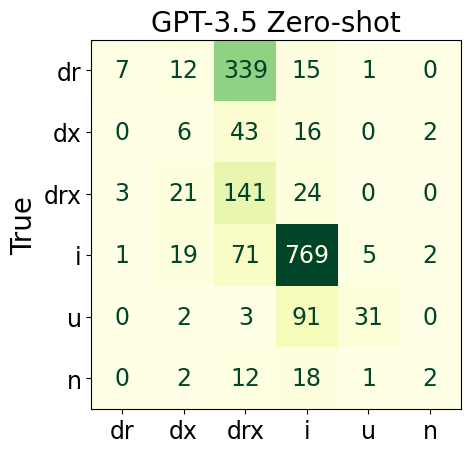
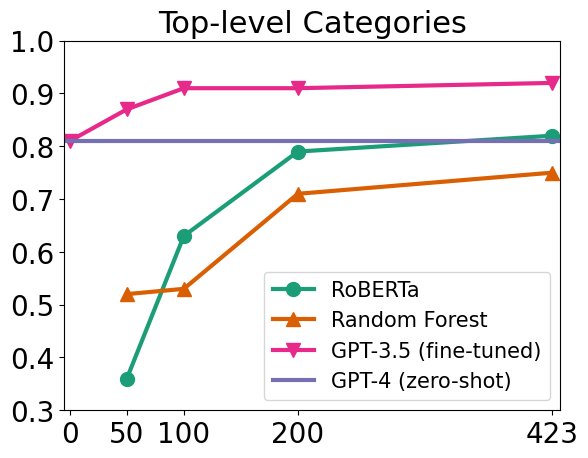
- GPT-4 outperformed GPT-3.5 in zero-shot classification for sub-categories related to debugging, while both models showed comparable performance on most main categories.
- Fine-tuning GPT-3.5 on just 100 labeled examples improved its performance to match the accuracy and inter-rater consistency observed between two human raters.
- The cost of using a fine-tuned GPT-3.5 model for classifying 2,591 student requests over a semester was less than $30, compared to $80 for GPT-4 and under $4 for zero-shot GPT-3.5.
- Zero-shot GPT-3.5 and GPT-4 achieved reasonable classification accuracy without any labeled data, suggesting strong zero-shot generalization for educational query classification.
- The study demonstrates that LLMs can automate classification tasks with minimal data and infrastructure, enabling scalable, personalized educational assistance systems.
- Fine-tuned LLMs can guide chatbots to deliver context-aware responses and help instructors detect problematic student behaviors through aggregated query pattern analysis.
Read this paper
Open the full text in the Nubint reader and ask about any passage as you read.
Read this paper on NubintThis review was generated by AI from the original paper. Please check the paper before citing it.