
[Paper Review] Efficient reference-less transmission matrix retrieval for a multimode fiber using fast Fourier transform
This paper proposes a fast, reference-less method to retrieve the transmission matrix (TM) of a multimode fiber using a Fourier transform-based probing matrix and a parallel nonlinear optimization algorithm. By leveraging fast Fourier transforms (FFT), the method achieves a 1200× speed-up, recovering a 2286×8192 TM in 124.9 seconds on 32 CPU cores, while correcting phase offset errors using defocused intensity images for accurate 3D pattern generation.
Transmission matrix (TM) linearly maps the incident and transmitted complex fields, and has been used widely due to its ability to characterize scattering media. It is computationally demanding to reconstruct the TM from intensity images measured by a reference-less experimental setup. Removing reference beam for interference gains the advantage of simple experimental setup. However, the long computational time still limits its practical application. We propose an efficient reference-less TM retrieval method for multimode fiber (MMF). Our method adopts a data acquisition scheme which employs Fourier transform matrix in the design of the incident fields. We develop a nonlinear optimization algorithm to solve the TM retrieval problem in a parallel manner. The data acquisition scheme allows the algorithm to be implemented with fast Fourier transform (FFT), and hence achieves great efficiency improvement. Further, our method acquires intensity images at a defocus plane and correct the error of relative phase offset of TM recovered from the intensity images measured at one fixed plane. We validate the proposed TM retrieval method with both simulations and experiments. By using FFT, our TM retrieval algorithm achieves 1200x speed-up in computational time, and recovers $2286 imes 8192$ TM of a 0.22 NA and $50 \ μm$ diameter MMF with 124.9 seconds by a computer of 32 CPU cores. With the advantages of efficiency and the correction of phase offset, our method paves the way for the application of reference-less TM retrieval in real practice.
Motivation & Objective
- To address the computational bottleneck in reference-less transmission matrix (TM) retrieval for multimode fibers (MMF), which currently limits practical applications.
- To eliminate the need for external or internal reference beams, simplifying experimental setups and improving stability.
- To correct the relative phase offset error in TMs recovered from intensity-only measurements at a single plane, which otherwise prevents 3D light pattern generation.
- To enable efficient, high-throughput TM retrieval suitable for real-time applications in endoscopic imaging and optical communications.
- To develop a method compatible with long fibers where external reference beams are impractical to obtain.
Proposed method
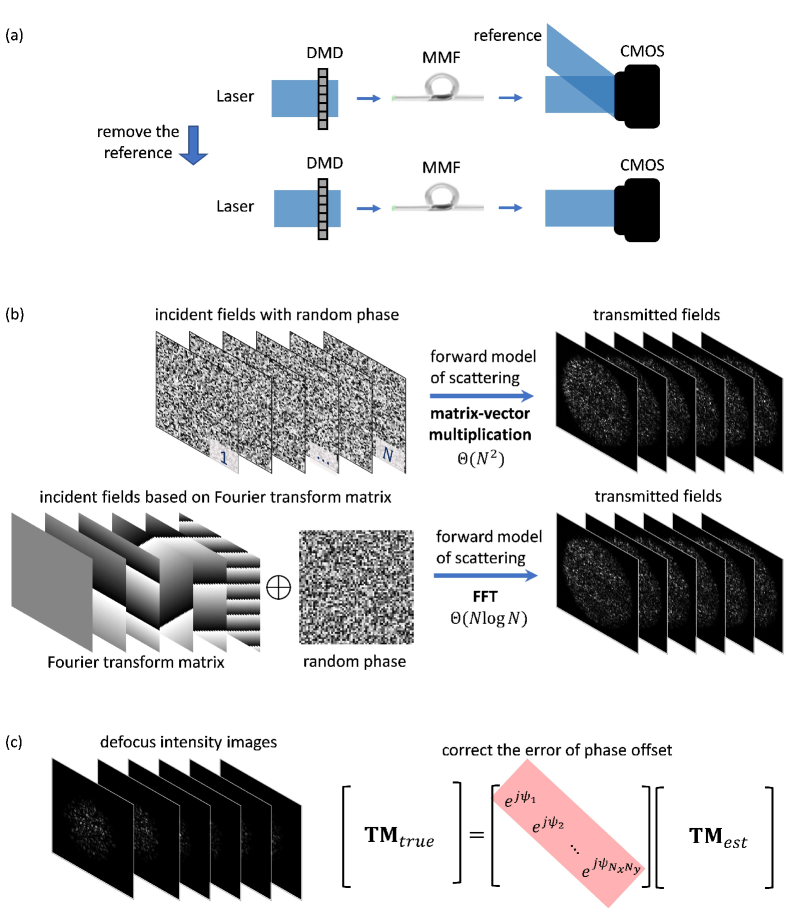
- The method uses a Fourier transform matrix as the probing field generator, enabling efficient computation via fast Fourier transforms (FFT).
- A nonlinear optimization algorithm is developed to retrieve the TM from measured intensity images, with the structure of the probing matrix allowing FFT-based inversion.
- The algorithm is parallelized across multiple CPU cores to accelerate computation, reducing time from hours to under 2 minutes for large TMs.
- Defocus intensity images are acquired and used to correct the relative phase offset in the recovered TM, which is critical for generating 3D light patterns.
- The phase correction is formulated as an optimization problem over a global phase shift, solved iteratively using gradient descent with analytical derivatives.
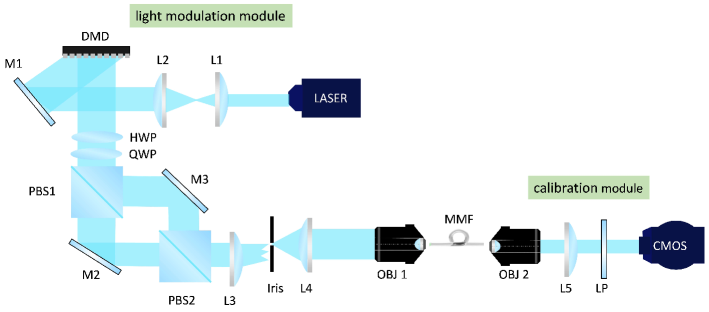
- The method is validated experimentally on a 0.22 NA, 50 µm diameter MMF using a DMD-based setup and intensity measurements from a camera.
Experimental results
Research questions
- RQ1Can a reference-less TM retrieval method for multimode fibers achieve high computational efficiency without sacrificing accuracy?
- RQ2How can the phase offset error in intensity-only TM recovery be corrected to enable 3D light pattern generation?
- RQ3Can the use of a Fourier transform-based probing matrix enable FFT-based inversion and thus drastically reduce computational time?
- RQ4To what extent can the method scale to large TMs typical of practical MMF applications?
- RQ5Can the method be applied to long fibers in optical communications where reference beams are difficult to implement?
Key findings
- The proposed method achieves a 1200× speed-up in computational time compared to conventional reference-less TM retrieval methods, reducing the time to recover a 2286×8192 TM to 124.9 seconds on 32 CPU cores.
- The use of a Fourier transform-based probing matrix enables the optimization algorithm to be implemented with fast Fourier transforms (FFT), significantly reducing computational complexity.
- The method successfully corrects the relative phase offset in the recovered TM using defocus intensity images, enabling the generation of 3D foci in experiments.
- The TM recovery error is minimized, with the corrected TM accurately predicting both amplitude and phase of the transmitted field, essential for 3D pattern control.
- The method is experimentally validated for a 50 µm diameter, 0.22 NA multimode fiber, demonstrating feasibility for endoscopic and imaging applications.
- The algorithm is scalable and can be further accelerated on systems with more parallel CPU cores, making it suitable for real-time applications.
Read this paper
Open the full text in the Nubint reader and ask about any passage as you read.
Read this paper on NubintThis review was generated by AI from the original paper. Please check the paper before citing it.