
[Paper Review] Emergence of Debye scaling in the density of states of liquids under nanoconfinement
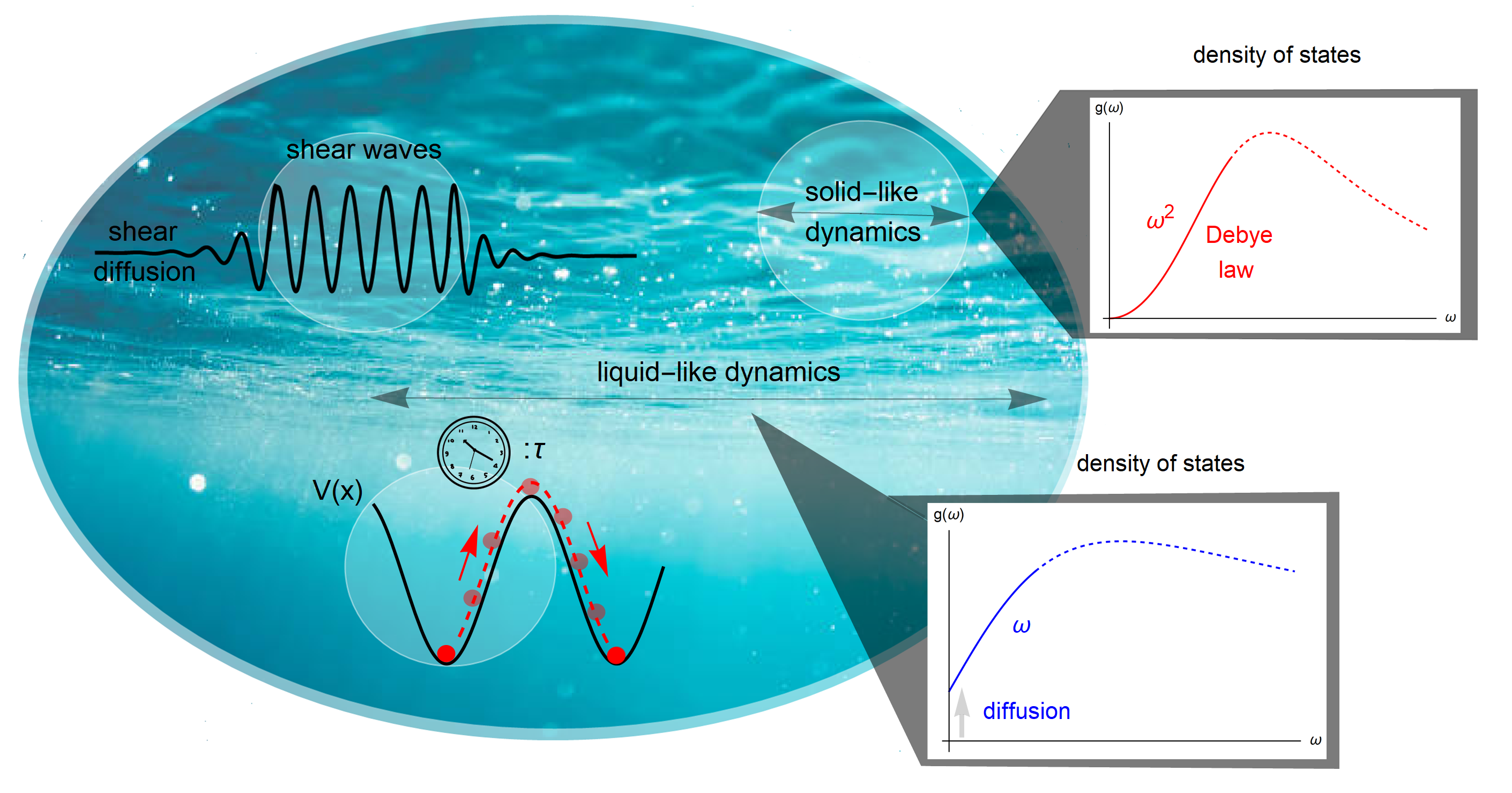
This study demonstrates experimentally and via molecular dynamics simulations that nanoconfinement induces solid-like Debye scaling ($g(\omega) \propto \omega^2$) in the vibrational density of states (VDOS) of liquids like water and glycerol at low frequencies (1–4 meV), transitioning from liquid-like $\omega$-scaling. The emergence of this behavior correlates with the onset of underdamped collective shear waves and reduced self-diffusion, linking it to the Frenkel criterion and k-gap theory, thus providing direct evidence for the continuity between liquids and solids at short length scales.
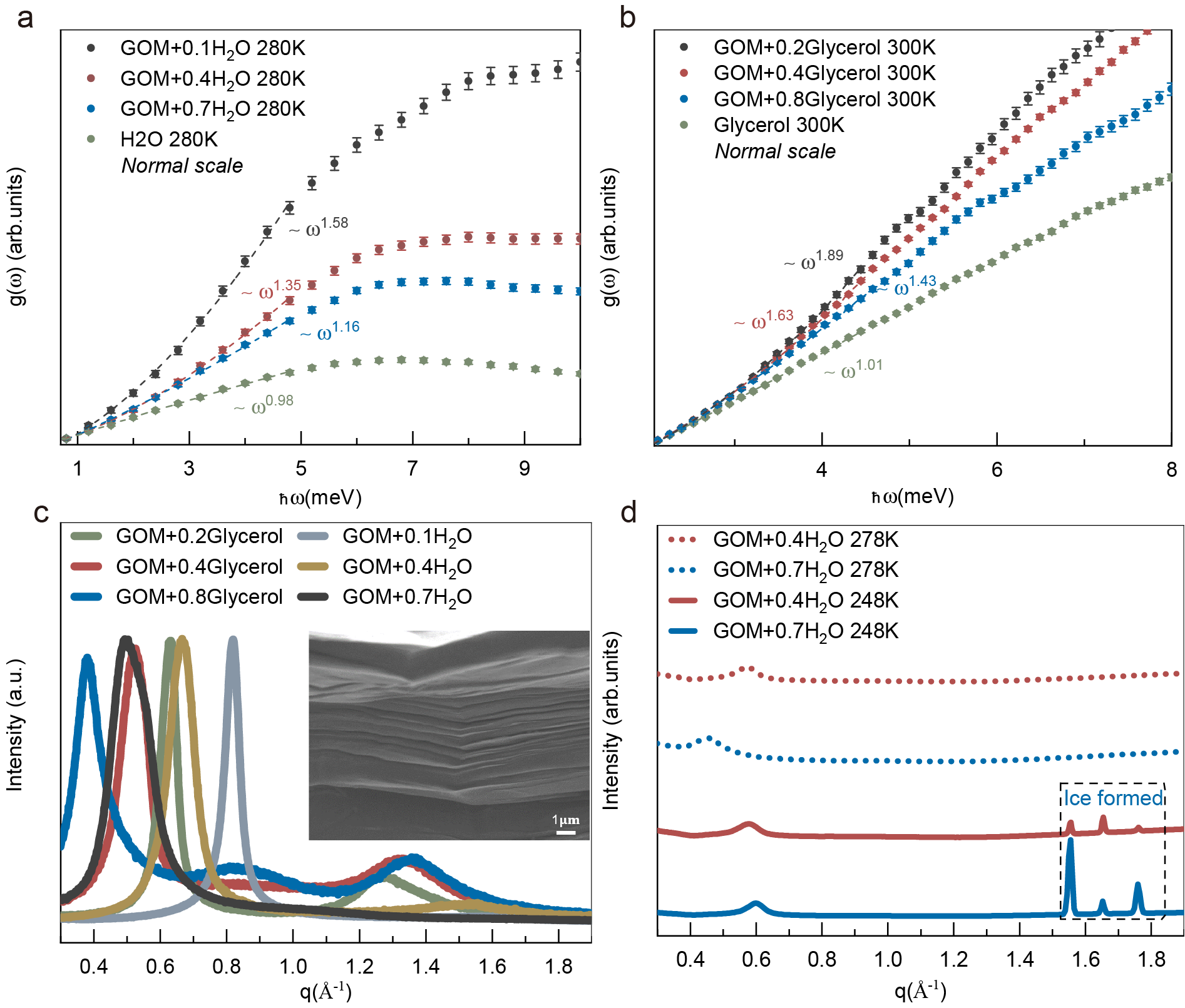
In the realm of nanoscience, the dynamic behaviors of liquids at scales beyond the conventional structural relaxation time, $τ$, unfold a fascinating blend of solid-like characteristics, including the propagation of collective shear waves and the emergence of elasticity. However, in classical bulk liquids, where $τ$ is typically of the order of 1 ps or less, this solid-like behavior remains elusive in the low-frequency region of the density of states (DOS). Here, we provide evidence for the emergent solid-like nature of liquids at short distances through inelastic neutron scattering measurements of the low-frequency DOS in liquid water and glycerol confined within graphene oxide membranes. In particular, upon increasing the strength of confinement, we observe a transition from a liquid-like DOS (linear in the frequency $ω$) to a solid-like behavior (Debye law, $\simω^2$) in the range of $1$-$4$ meV. Molecular dynamics simulations confirm these findings and reveal additional solid-like features, including propagating collective shear waves and a reduction in the self-diffusion constant. Finally, we show that the onset of solid-like dynamics is pushed towards low frequency along with the slowing-down of the relaxation processes upon confinement. This nanoconfinement-induced transition, aligning with k-gap theory, underscores the potential of leveraging liquid nanoconfinement in advancing nanoscale science and technology, building more connections between fluid dynamics and materials engineering.
Motivation & Objective
- To investigate whether nanoconfinement can induce solid-like dynamics in liquids, particularly in their low-frequency vibrational density of states (VDOS).
- To test the hypothesis that the Frenkel criterion ($\omega > 1/\tau$) governs the emergence of solid-like behavior in confined liquids.
- To determine whether the transition from liquid-like ($g(\omega) \propto \omega$) to solid-like ($g(\omega) \propto \omega^2$) VDOS scaling occurs under confinement, as predicted by k-gap theory and the telegrapher equation model.
- To establish a quantitative link between structural relaxation time ($\tau$), collective shear wave dynamics, and the emergence of Debye-like behavior in confined liquids.
Proposed method
- Inelastic neutron scattering (INS) measurements were performed on liquid water and glycerol confined within graphene oxide membranes to probe the low-frequency VDOS.
- Molecular dynamics (MD) simulations were used to model the dynamics of confined liquids, including shear wave propagation and self-diffusion coefficients.
- The dispersion relation of collective shear waves was extracted from MD data and fitted to a telegrapher equation model to describe underdamped and overdamped dynamics.
- The VDOS was computed from the wave dispersion using the Debye sphere approximation in k-space, yielding $g(\omega) \propto \omega \sqrt{4\omega^2 + \gamma^2}/v^3$ with $\gamma = 1/\tau_g$.
- The Frenkel frequency $\omega_F = 1/\tau_g$ was used as a crossover scale to identify the transition from relaxational to oscillatory dynamics.
- Theoretical analysis linked the onset of Debye scaling to the condition $\omega \gg 1/\tau$, where $\tau$ is the structural relaxation time, and compared results with k-gap theory.
Experimental results
Research questions
- RQ1Does nanoconfinement induce a transition from liquid-like ($\omega$-scaling) to solid-like ($\omega^2$-scaling) vibrational density of states in liquids?
- RQ2At what frequency scale does the crossover from overdamped to underdamped collective shear waves occur in confined liquids, and how does it relate to the Frenkel criterion?
- RQ3Can the emergence of Debye scaling in the VDOS be quantitatively linked to the slowing down of structural relaxation and the appearance of propagating waves?
- RQ4To what extent do molecular dynamics simulations reproduce the experimental INS data and confirm the presence of collective shear modes under confinement?
- RQ5Is the length scale at which solidity emerges compatible with predictions from k-gap theory and the concept of gapped momentum states?
Key findings
- Inelastic neutron scattering revealed a clear transition from liquid-like $g(\omega) \propto \omega$ to solid-like $g(\omega) \propto \omega^2$ scaling in confined water and glycerol within the 1–4 meV frequency range.
- The onset of Debye scaling coincided with the emergence of underdamped collective shear waves, as confirmed by MD simulations and dispersion analysis.
- The structural relaxation time $\tau$ increased under confinement, shifting the Frenkel frequency $\omega_F = 1/\tau$ to lower values, thereby enabling observation of solid-like behavior at experimentally accessible frequencies.
- MD simulations showed a significant reduction in the self-diffusion constant under confinement, indicating suppressed long-range transport and enhanced local order.
- The crossover frequency from liquid-like to Debye-like VDOS matched the Frenkel criterion $\omega \approx 1/\tau_g$, supporting the theoretical model based on the telegrapher equation.
- The observed scale for the emergence of solid-like dynamics was qualitatively consistent with k-gap theory, suggesting a fundamental connection between gapped momentum states and the liquid-to-solid crossover in confined systems.
Better researchstarts right now
From reading papers to final review, dramatically reduce your research time.
No credit card · Free plan available
This review was created by AI and reviewed by human editors.