
[Paper Review] End-to-end Speech Translation via Cross-modal Progressive Training
This paper proposes XSTNet, a cross-modal end-to-end speech translation model that jointly trains speech-to-text translation (ST), automatic speech recognition (ASR), and machine translation (MT) using a shared Transformer architecture. By leveraging self-supervised Wav2vec2.0 representations, multi-task learning with parallel text data, and a progressive training strategy, XSTNet achieves state-of-the-art performance with a 28.8 average BLEU on MuST-C, outperforming prior methods by 3.2 BLEU points.
End-to-end speech translation models have become a new trend in research due to their potential of reducing error propagation. However, these models still suffer from the challenge of data scarcity. How to effectively use unlabeled or other parallel corpora from machine translation is promising but still an open problem. In this paper, we propose Cross Speech-Text Network (XSTNet), an end-to-end model for speech-to-text translation. XSTNet takes both speech and text as input and outputs both transcription and translation text. The model benefits from its three key design aspects: a self-supervised pre-trained sub-network as the audio encoder, a multi-task training objective to exploit additional parallel bilingual text, and a progressive training procedure. We evaluate the performance of XSTNet and baselines on the MuST-C En-X and LibriSpeech En-Fr datasets. In particular, XSTNet achieves state-of-the-art results on all language directions with an average BLEU of 28.8, outperforming the previous best method by 3.2 BLEU. Code, models, cases, and more detailed analysis are available at https://github.com/ReneeYe/XSTNet.
Motivation & Objective
- To address data scarcity in end-to-end speech translation by leveraging unlabeled and parallel text data.
- To improve model generalization and reduce error propagation by jointly training ST, ASR, and MT tasks.
- To design an effective training strategy that progressively utilizes pre-training and multi-task fine-tuning.
- To demonstrate the effectiveness of self-supervised audio representations and external MT data in low-resource ST settings.
Proposed method
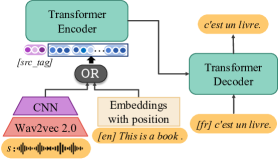
- XSTNet uses a self-supervised Wav2vec2.0 sub-network as the audio encoder to produce contextualized speech representations.
- The model shares a single Transformer encoder and decoder across speech-to-text translation, ASR, and MT tasks, enabling multi-task learning.
- It incorporates external MT parallel data (e.g., WMT, OpenSubtitles) to pre-train the model and improve generalization.
- A progressive multi-task training procedure is employed, where pre-training on external MT data is followed by joint fine-tuning on ST, ASR, and MT supervision.
- The model accepts either audio or text input and outputs both transcription and translation, enabling joint optimization of all tasks.
- Two 1D convolutional layers are added after Wav2vec2.0 to reduce sequence length and align audio and text sequence dimensions.
Experimental results
Research questions
- RQ1Can joint multi-task learning of ST, ASR, and MT improve performance in low-resource speech translation?
- RQ2How effective is self-supervised pre-training with Wav2vec2.0 in reducing data requirements for end-to-end ST?
- RQ3Does progressive training with external MT data lead to better convergence and generalization in ST models?
- RQ4To what extent does incorporating large-scale external MT data improve ST performance?
Key findings
- XSTNet achieves a new state-of-the-art average BLEU score of 28.8 on the MuST-C dataset, outperforming the previous best method by 3.2 BLEU points.
- The model improves by 1.2 BLEU when pre-training on external WMT data, demonstrating the effectiveness of large-scale MT pre-training.
- Progressive training that retains data from earlier stages during fine-tuning leads to better performance, confirming the benefit of staged training.
- Multi-task fine-tuning (simultaneously training ST, ASR, and MT) yields better results than ST-only fine-tuning, indicating improved robustness.
- Increasing the size of external MT data (e.g., from WMT to OpenSubtitles) boosts ST BLEU from 27.1 to 27.8 on MuST-C En-De, showing data scale impact.
- XSTNet converges faster and generalizes better than models trained only on ST data, especially in low-resource settings.
Read this paper
Open the full text in the Nubint reader and ask about any passage as you read.
Read this paper on NubintThis review was generated by AI from the original paper. Please check the paper before citing it.