
[Paper Review] Enhancing Energy Efficiency for Reconfigurable Intelligent Surfaces with Practical Power Models
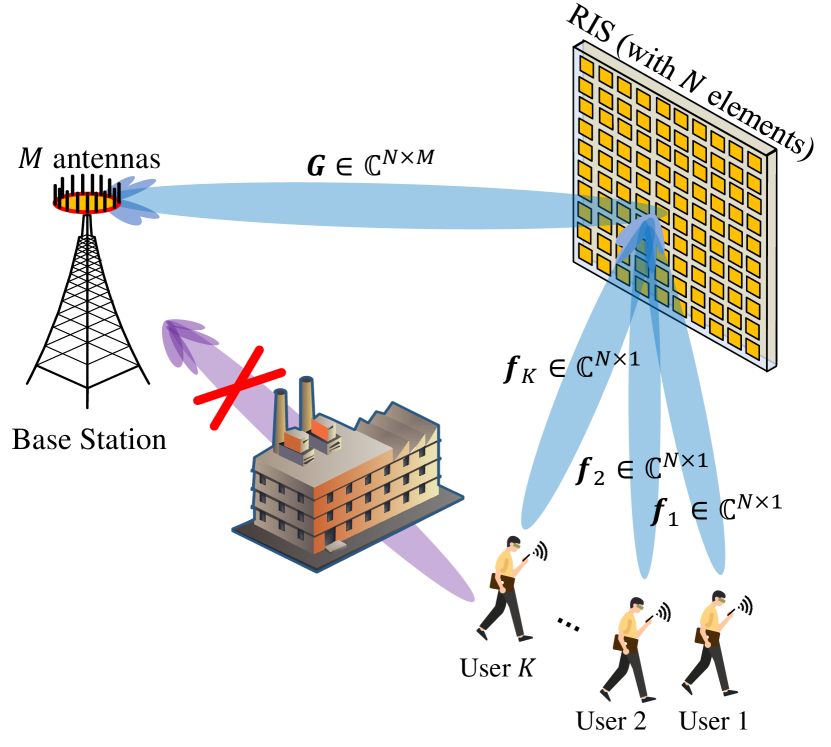
This paper proposes a practical power model for reconfigurable intelligent surfaces (RIS) that accounts for the dynamic power consumption of PIN diodes in ON/OFF states, enabling accurate energy efficiency (EE) optimization in RIS-assisted multi-user MISO systems. By integrating this model into a non-convex mixed-integer EE optimization framework and solving it via an alternating optimization algorithm with maximum gradient search and SDP relaxation, the proposed method achieves significant EE gains across diverse scenarios, reducing computational complexity from exponential to polynomial.
Reconfigurable intelligent surfaces (RISs) are widely considered a promising technology for future wireless communication systems. As an important indicator of RIS-assisted communication systems in green wireless communications, energy efficiency (EE) has recently received intensive research interest as an optimization target. However, most previous works have ignored the different power consumption between ON and OFF states of the PIN diodes attached to each RIS element. This oversight results in extensive unnecessary power consumption and reduction of actual EE due to the inaccurate power model. To address this issue, in this paper, we first utilize a practical power model for a RIS-assisted multi-user multiple-input single-output (MU-MISO) communication system, which takes into account the difference in power dissipation caused by ON-OFF states of RIS's PIN diodes. Based on this model, we formulate a more accurate EE optimization problem. However, this problem is non-convex and has mixed-integer properties, which poses a challenge for optimization. To solve the problem, an effective alternating optimization (AO) algorithm framework is utilized to optimize the base station and RIS beamforming precoder separately. To obtain the essential RIS beamforming precoder, we develop two effective methods based on maximum gradient search and SDP relaxation respectively. Theoretical analysis shows the exponential complexity of the original problem has been reduced to polynomial complexity. Simulation results demonstrate that the proposed algorithm outperforms the existing ones, leading to a significant increase in EE across a diverse set of scenarios.
Motivation & Objective
- To address the inaccuracy of existing energy efficiency (EE) optimization in RIS-aided systems by accounting for the variable power consumption of PIN diodes in ON and OFF states.
- To develop a more realistic power model that reflects the actual hardware behavior of RIS elements, particularly the dynamic dissipation due to phase-shift configurations.
- To formulate a non-convex mixed-integer EE optimization problem that incorporates the practical power model for improved system accuracy.
- To design an efficient algorithmic framework—based on alternating optimization and two effective RIS beamforming precoder methods—to solve the complex optimization problem.
Proposed method
- Introduces a practical RIS power model that differentiates between ON and OFF states of PIN diodes, incorporating state-dependent power dissipation into the total system power budget.
- Formulates a non-convex mixed-integer EE optimization problem where the objective is to maximize spectral efficiency per unit total power, including dynamic RIS hardware consumption.
- Applies an alternating optimization (AO) framework to decouple base station and RIS beamforming optimization, enabling iterative refinement of both precoders.
- Develops two methods for RIS beamforming precoder design: one based on maximum gradient search and another using semi-definite programming (SDP) relaxation to handle the non-convexity.
- Uses Lagrangian duality and Karush-Kuhn-Tucker (KKT) conditions to derive an analytical solution for the power allocation subproblem, ensuring convergence.
- Establishes equivalence between the original non-convex problem and a relaxed SDP formulation via matrix lifting and rank-one constraint enforcement, preserving optimality under specific conditions.
Experimental results
Research questions
- RQ1How does the dynamic power consumption of PIN diodes in ON and OFF states affect the actual energy efficiency of RIS-aided communication systems?
- RQ2What is the impact of using an inaccurate constant-power RIS model on the performance of EE-optimized systems?
- RQ3Can a practical power model that accounts for state-dependent PIN diode dissipation lead to measurable improvements in system energy efficiency?
- RQ4How can the resulting non-convex mixed-integer EE optimization problem be solved efficiently with reduced computational complexity?
- RQ5To what extent does the proposed AO-based algorithm with SDP relaxation outperform existing EE-optimization methods in terms of spectral and energy efficiency?
Key findings
- The proposed practical power model significantly improves the accuracy of energy efficiency estimation by accounting for the variable power dissipation of PIN diodes in different states.
- The proposed algorithm achieves a notable increase in energy efficiency across diverse system scenarios, outperforming existing methods that assume constant RIS power consumption.
- Theoretical analysis confirms that the exponential complexity of the original problem is reduced to polynomial complexity through the use of SDP relaxation and KKT-based decomposition.
- Simulation results demonstrate that the dynamic power model leads to a measurable reduction in unnecessary power consumption, especially when a large number of RIS elements are active.
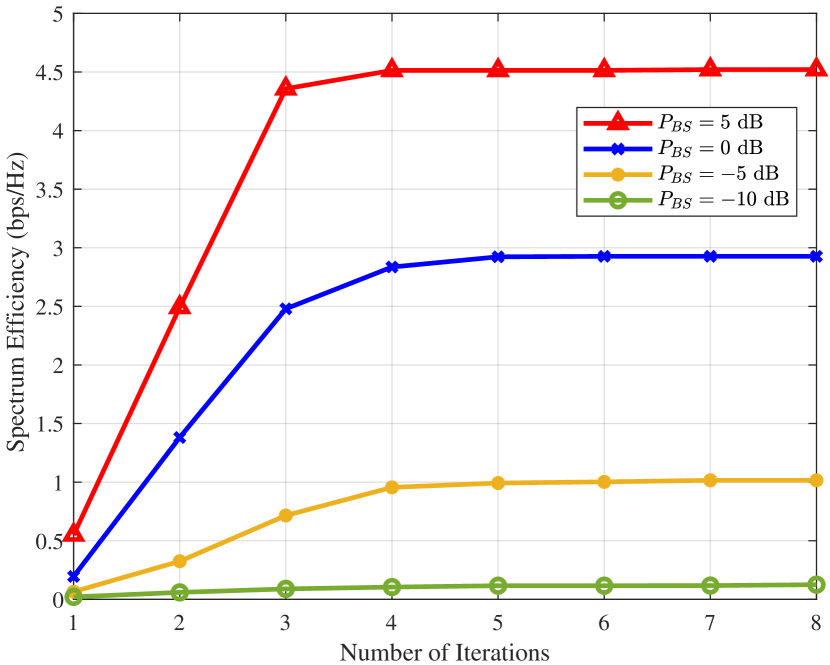
- The maximum gradient search and SDP relaxation methods for RIS beamforming precoder design yield high-quality solutions with fast convergence and strong performance gains.
- The equivalence between the original non-convex problem and the relaxed SDP formulation is rigorously proven, ensuring that the optimal solution can be recovered under rank-one conditions.
Read this paper
Open the full text in the Nubint reader and ask about any passage as you read.
Read this paper on NubintThis review was generated by AI from the original paper. Please check the paper before citing it.