
[Paper Review] Enhancing the Protein Tertiary Structure Prediction by Multiple Sequence Alignment Generation
This paper introduces MSA-Augmenter, a transformer-based generative model that enhances low-quality multiple sequence alignments (MSAs) by generating novel, evolutionarily coherent protein sequences. By augmenting shallow MSAs with de novo sequences, the method significantly improves AlphaFold2's protein tertiary structure prediction accuracy, especially for sequences with few homologs, demonstrating state-of-the-art gains on CASP14 benchmarks.
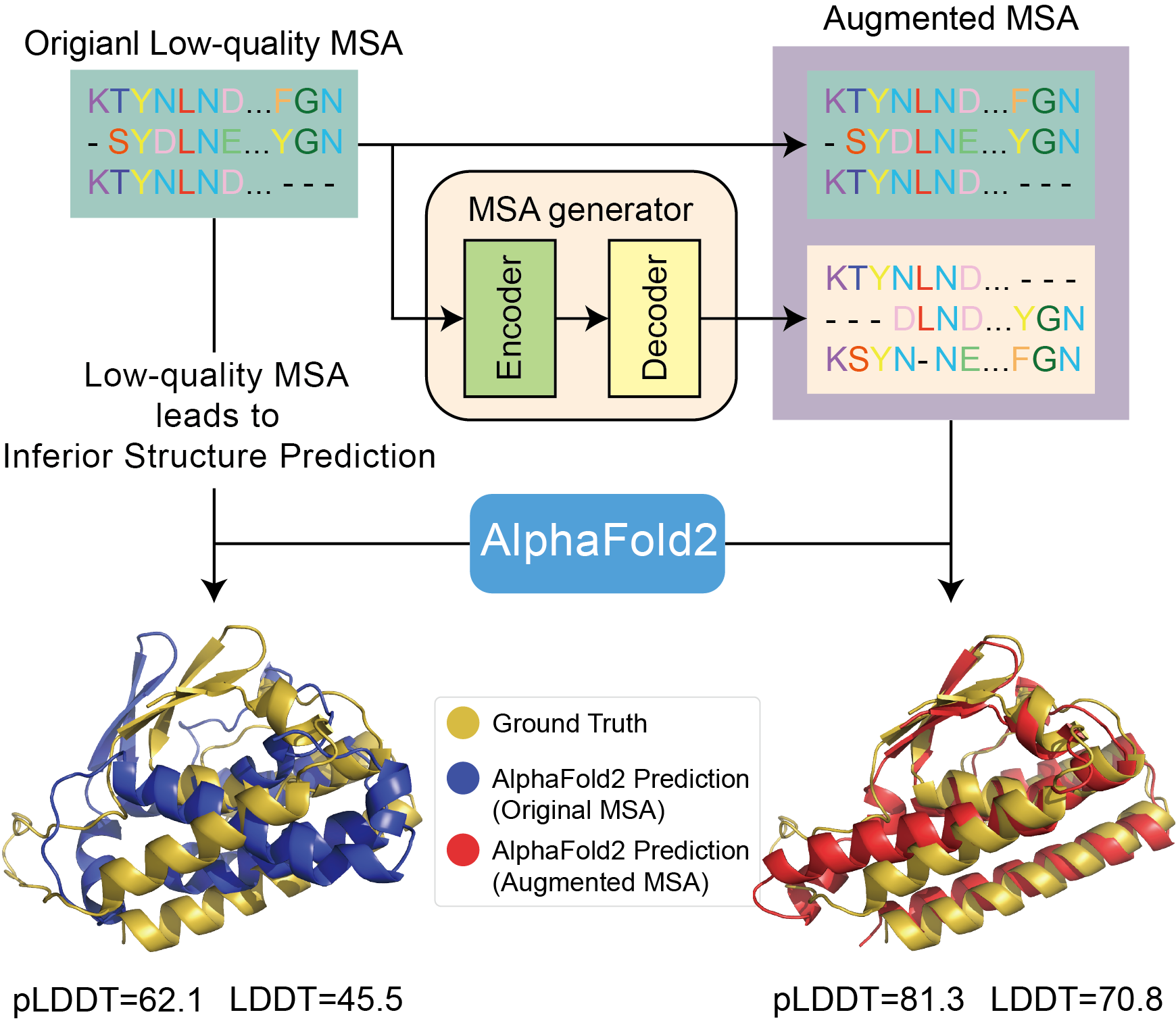
The field of protein folding research has been greatly advanced by deep learning methods, with AlphaFold2 (AF2) demonstrating exceptional performance and atomic-level precision. As co-evolution is integral to protein structure prediction, AF2's accuracy is significantly influenced by the depth of multiple sequence alignment (MSA), which requires extensive exploration of a large protein database for similar sequences. However, not all protein sequences possess abundant homologous families, and consequently, AF2's performance can degrade on such queries, at times failing to produce meaningful results. To address this, we introduce a novel generative language model, MSA-Augmenter, which leverages protein-specific attention mechanisms and large-scale MSAs to generate useful, novel protein sequences not currently found in databases. These sequences supplement shallow MSAs, enhancing the accuracy of structural property predictions. Our experiments on CASP14 demonstrate that MSA-Augmenter can generate de novo sequences that retain co-evolutionary information from inferior MSAs, thereby improving protein structure prediction quality on top of strong AF2.
Motivation & Objective
- To address the degradation in protein tertiary structure prediction accuracy when multiple sequence alignments (MSAs) are shallow due to lack of homologous sequences.
- To develop a method that generates biologically plausible, co-evolutionarily consistent protein sequences to enrich low-depth MSAs.
- To improve downstream structure prediction performance by integrating generated sequences as additional evolutionary information.
- To evaluate the effectiveness of sequence generation in enhancing MSA quality and structural prediction accuracy, particularly in challenging cases with few homologs.
- To investigate the reliability of pLDDT as a selection criterion for generated MSAs and explore better filtering strategies.
Proposed method
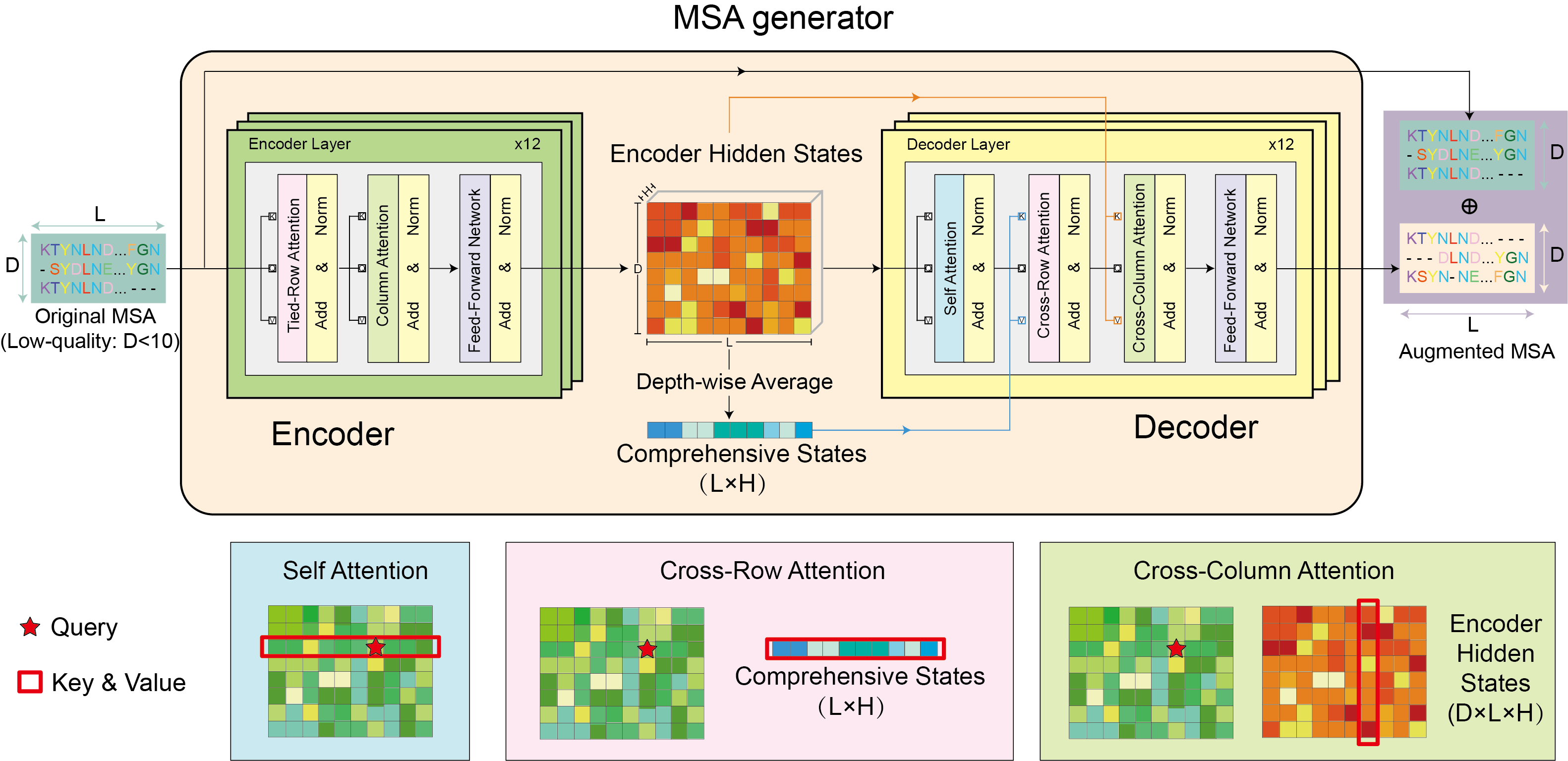
- MSA-Augmenter is a sequence-to-sequence transformer model trained to generate multiple homologous protein sequences in parallel from a single input MSA.
- The model uses protein-specific self-attention mechanisms to encode global structural and evolutionary information from the input MSA.
- It employs a masked language modeling pre-training objective on a large-scale dataset of 2 million protein MSAs to learn co-evolutionary patterns.
- Generated sequences are appended to the original MSA to create an enhanced alignment, which is then used as input to AlphaFold2 for structure prediction.
- An ensemble strategy aggregates results from multiple generations to improve robustness and selection of high-quality outputs.
- The method is evaluated using CASP14 MSAs with depth < 50, focusing on cases where AF2 performance typically degrades.
Experimental results
Research questions
- RQ1Can a generative model produce evolutionarily coherent protein sequences that enhance low-quality MSAs and improve tertiary structure prediction?
- RQ2How does the performance of MSA-Augmenter vary across MSAs of different depths, particularly in low-homology cases?
- RQ3Is the pLDDT score a reliable criterion for selecting the best augmented MSA from multiple generations?
- RQ4Can the method significantly improve AlphaFold2's performance on challenging CASP14 targets with shallow MSAs?
- RQ5What is the impact of ensemble generation and selection strategies on final prediction accuracy?
Key findings
- MSA-Augmenter significantly improves protein structure prediction accuracy on CASP14 targets with shallow MSAs, particularly for sequences with fewer than 10 homologs.
- The method achieved a mean LDDT improvement of 25.27 on T1093-D1 (depth 2), demonstrating strong enhancement on the most challenging cases.
- For T1096-D1 (depth 7), the LDDT score improved by 9.27 points after augmentation, indicating consistent gains on low-depth MSAs.
- The study reveals that pLDDT is an unreliable selection criterion, as it often correlates inversely with actual LDDT improvement, with some cases showing decreased performance despite high pLDDT scores.
- When selecting the best MSA based on ground-truth LDDT (not pLDDT), the method showed untapped potential, suggesting that better filtering strategies could further improve results.
- The model’s performance is most effective on very shallow MSAs (depth < 10), with diminishing returns on moderately deep MSAs (10 < depth < 50), likely due to distribution shift from pre-training data.
Read this paper
Open the full text in the Nubint reader and ask about any passage as you read.
Read this paper on NubintThis review was generated by AI from the original paper. Please check the paper before citing it.