
[Paper Review] Envisioning the Future of Cyber Security in Post-Quantum Era: A Survey on PQ Standardization, Applications, Challenges and Opportunities
This paper provides a comprehensive survey on post-quantum cryptography (PQC), analyzing NIST-standardized and finalist PQC schemes across lattice-based, hash-based, code-based, isogeny-based, and multivariate cryptography. It evaluates security, performance, side-channel resilience, and standardization metrics, concluding that application-specific PQC designs are essential due to conflicting requirements across domains like IoT, blockchain, and machine learning.
The rise of quantum computers exposes vulnerabilities in current public key cryptographic protocols, necessitating the development of secure post-quantum (PQ) schemes. Hence, we conduct a comprehensive study on various PQ approaches, covering the constructional design, structural vulnerabilities, and offer security assessments, implementation evaluations, and a particular focus on side-channel attacks. We analyze global standardization processes, evaluate their metrics in relation to real-world applications, and primarily focus on standardized PQ schemes, selected additional signature competition candidates, and PQ-secure cutting-edge schemes beyond standardization. Finally, we present visions and potential future directions for a seamless transition to the PQ era.
Motivation & Objective
- To analyze the state of post-quantum cryptography (PQC) standardization, focusing on NIST’s selection process and evaluation metrics.
- To assess the security, performance, and side-channel vulnerabilities of standardized and finalist PQC schemes.
- To identify the challenges and requirements for transitioning legacy systems (e.g., smart grids, IoT, blockchain) to PQC.
- To explore application-specific PQC needs in domains like machine learning, blockchain, and embedded systems.
- To project future research directions for crypto-agility and secure migration to the post-quantum era.
Proposed method
- Conducted a systematic analysis of NIST PQC finalists and selected alternative schemes, evaluating their mathematical foundations and constructional designs.
- Evaluated security properties using formal analysis of hard problems (e.g., Learning With Errors, code-based problems, SIKE), including quantum attack resistance.
- Assessed implementation efficiency and side-channel vulnerabilities through performance benchmarks and side-channel countermeasure integration.
- Mapped evaluation metrics (e.g., key size, signature size, runtime) to real-world application constraints in IoT, blockchain, and ML.
- Proposed a framework for application-specific PQC adoption, emphasizing crypto-agility and early migration to mitigate SNDL threats.
- Explored non-conventional PQC approaches such as Raccoon, a side-channel resistant lattice-based signature inspired by Dilithium.
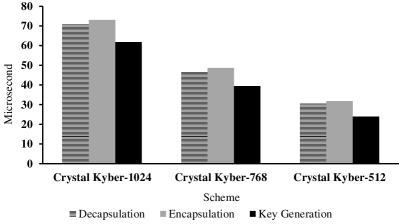
Experimental results
Research questions
- RQ1What are the key differences in security, performance, and side-channel resilience among NIST-standardized PQC schemes?
- RQ2How do application-specific requirements (e.g., size, speed, privacy) in IoT, blockchain, and machine learning systems conflict with general-purpose PQC standards?
- RQ3To what extent can side-channel resistance be integrated into PQC schemes from the design phase rather than as a post-implementation patch?
- RQ4What are the implications of the store-now-decrypt-later (SNDL) attack for long-term data confidentiality, and how urgent is the migration to PQC?
- RQ5Is a single standardized PQC scheme feasible for all real-world applications, or is application-specific PQC development inevitable?
Key findings
- NIST’s standardization process has selected lattice-based schemes like Kyber (KEM) and Dilithium (signatures) as primary candidates due to their balance of security and efficiency.
- Side-channel attacks remain a critical threat to PQC implementations, and schemes designed with side-channel resistance from the outset (e.g., Raccoon) show improved efficiency over hardened existing schemes.
- The store-now-decrypt-later (SNDL) attack poses a severe risk to long-term data confidentiality, necessitating urgent migration to PQC even before large-scale quantum computers exist.
- No single PQC scheme satisfies all requirements across diverse applications: IoT prioritizes low cost and energy, blockchain demands compact signatures, and ML requires strong privacy-preserving primitives.
- Standardization of general-purpose PQC is necessary but insufficient; specialized PQC competitions and application-specific schemes are likely to emerge post-standardization.
- Crypto-agility—enabling rapid migration to new cryptosystems—is essential and should be prioritized to ensure long-term system resilience in the post-quantum era.
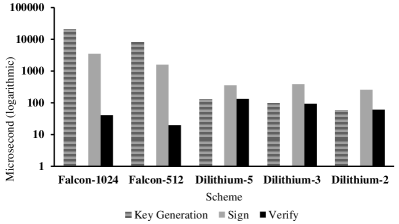
Read this paper
Open the full text in the Nubint reader and ask about any passage as you read.
Read this paper on NubintThis review was generated by AI from the original paper. Please check the paper before citing it.