
[Paper Review] Equalization Loss v2: A New Gradient Balance Approach for Long-tailed Object Detection
This paper proposes Equalization Loss v2 (EQL v2), a novel gradient-guided re-weighting mechanism that dynamically balances positive and negative gradients during end-to-end training for long-tailed object detection. By equalizing the gradient ratio per category, EQL v2 achieves state-of-the-art performance on LVIS and Open Images, surpassing both end-to-end and decoupled training methods with 4–7.3 AP gains, especially boosting rare category AP by 17–22 points.
Recently proposed decoupled training methods emerge as a dominant paradigm for long-tailed object detection. But they require an extra fine-tuning stage, and the disjointed optimization of representation and classifier might lead to suboptimal results. However, end-to-end training methods, like equalization loss (EQL), still perform worse than decoupled training methods. In this paper, we reveal the main issue in long-tailed object detection is the imbalanced gradients between positives and negatives, and find that EQL does not solve it well. To address the problem of imbalanced gradients, we introduce a new version of equalization loss, called equalization loss v2 (EQL v2), a novel gradient guided reweighing mechanism that re-balances the training process for each category independently and equally. Extensive experiments are performed on the challenging LVIS benchmark. EQL v2 outperforms origin EQL by about 4 points overall AP with 14-18 points improvements on the rare categories. More importantly, it also surpasses decoupled training methods. Without further tuning for the Open Images dataset, EQL v2 improves EQL by 7.3 points AP, showing strong generalization ability. Codes have been released at https://github.com/tztztztztz/eqlv2
Motivation & Objective
- Address the persistent performance gap between end-to-end and decoupled training in long-tailed object detection.
- Identify imbalanced gradients between positive and negative samples as the core issue in existing end-to-end methods like Equalization Loss (EQL).
- Develop a gradient-guided re-weighting mechanism that independently balances training for each category to achieve equal learning efficiency.
- Achieve state-of-the-art performance on long-tailed benchmarks without requiring additional fine-tuning stages.
- Demonstrate strong generalization across datasets like LVIS and Open Images with minimal hyperparameter tuning.
Proposed method
- Model object detection as a set of independent sub-tasks, one per category, to enable category-specific gradient balancing.
- Introduce a gradient ratio indicator that tracks the accumulated positive-to-negative gradient ratio per category during training.
- Apply a sigmoid-like mapping function to dynamically re-weight positive and negative gradients based on the current gradient ratio, favoring under-trained categories.
- Use a simple, uniform re-weighting rule across all categories, ensuring equal treatment and stable optimization.
- Integrate the re-weighting mechanism directly into the classification loss, enabling end-to-end training without extra stages.
- Tune hyperparameters μ (threshold for high gradient ratio) and γ (sensitivity to imbalance) to optimize balance and robustness.
Experimental results
Research questions
- RQ1Why do existing end-to-end methods like Equalization Loss (EQL) still underperform compared to decoupled training in long-tailed detection?
- RQ2To what extent does gradient imbalance between positive and negative samples affect model learning in long-tailed settings?
- RQ3Can a dynamic, category-specific gradient re-weighting mechanism improve end-to-end training without requiring additional fine-tuning stages?
- RQ4Does a unified re-weighting rule based on gradient ratio lead to better generalization across diverse long-tailed datasets?
- RQ5Can an end-to-end method surpass decoupled training paradigms in long-tailed object detection?
Key findings
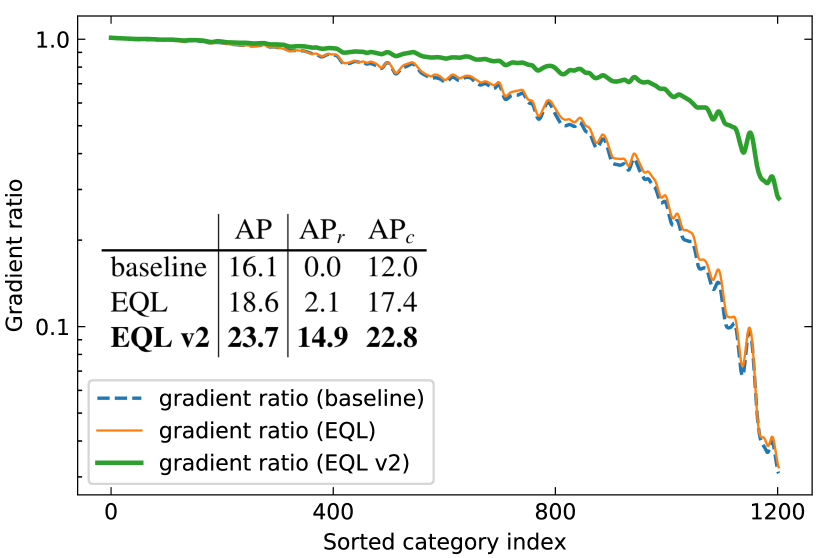
- On the LVIS benchmark, EQL v2 improves overall AP by 6 points over the baseline and 4 points over the original EQL, with a 17–20 point gain on rare categories.
- EQL v2 achieves 52.6 mAP on Open Images, a 9.5 point improvement over the baseline and 7.3 points over EQL, with a 22.3 point gain on the rarest category group.
- EQL v2 outperforms all existing methods, including state-of-the-art decoupled training approaches, on the challenging LVIS dataset.
- The model maintains strong generalization: with the same hyperparameters used on LVIS, EQL v2 achieves 55.6 mAP on Open Images using a ResNet-101 backbone.
- Ablation studies confirm that μ = 0.9 and γ = 12 provide optimal balance, with higher μ values improving performance and γ being robust within a reasonable range.
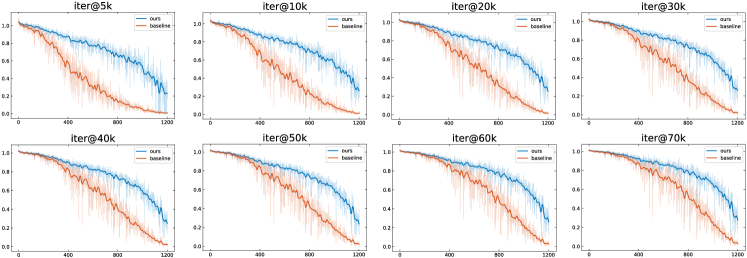
- The gradient ratio visualization shows EQL v2 achieves a much more balanced gradient distribution across categories than baseline or EQL, especially for rare classes.
Read this paper
Open the full text in the Nubint reader and ask about any passage as you read.
Read this paper on NubintThis review was generated by AI from the original paper. Please check the paper before citing it.