
[Paper Review] ESGReveal: An LLM-based approach for extracting structured data from ESG reports
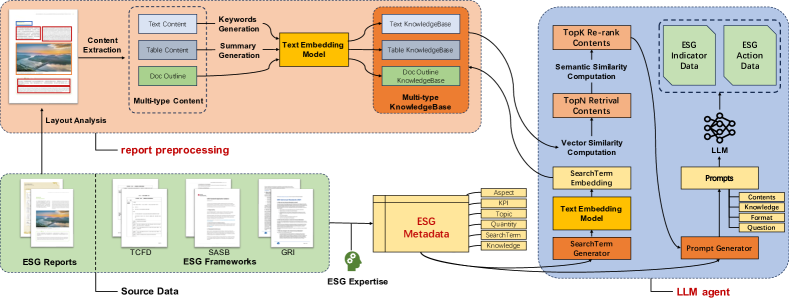
ESGReveal is a retrieval-augmented LLM framework that extracts structured ESG data from corporate reports using a tripartite architecture: ESG metadata, report preprocessing, and LLM agent modules. It achieved 76.9% accuracy in data extraction and 83.7% in disclosure analysis using GPT-4, significantly outperforming baselines and revealing low disclosure rates (69.5% for environmental, 57.2% for social) across 166 Hong Kong-listed companies.
ESGReveal is an innovative method proposed for efficiently extracting and analyzing Environmental, Social, and Governance (ESG) data from corporate reports, catering to the critical need for reliable ESG information retrieval. This approach utilizes Large Language Models (LLM) enhanced with Retrieval Augmented Generation (RAG) techniques. The ESGReveal system includes an ESG metadata module for targeted queries, a preprocessing module for assembling databases, and an LLM agent for data extraction. Its efficacy was appraised using ESG reports from 166 companies across various sectors listed on the Hong Kong Stock Exchange in 2022, ensuring comprehensive industry and market capitalization representation. Utilizing ESGReveal unearthed significant insights into ESG reporting with GPT-4, demonstrating an accuracy of 76.9% in data extraction and 83.7% in disclosure analysis, which is an improvement over baseline models. This highlights the framework's capacity to refine ESG data analysis precision. Moreover, it revealed a demand for reinforced ESG disclosures, with environmental and social data disclosures standing at 69.5% and 57.2%, respectively, suggesting a pursuit for more corporate transparency. While current iterations of ESGReveal do not process pictorial information, a functionality intended for future enhancement, the study calls for continued research to further develop and compare the analytical capabilities of various LLMs. In summary, ESGReveal is a stride forward in ESG data processing, offering stakeholders a sophisticated tool to better evaluate and advance corporate sustainability efforts. Its evolution is promising in promoting transparency in corporate reporting and aligning with broader sustainable development aims.
Motivation & Objective
- To address the lack of publicly available, detailed ESG disclosure databases that consolidate metrics across companies and industries.
- To improve the accuracy and consistency of ESG data extraction from unstructured reports using advanced LLMs and retrieval-augmented generation (RAG).
- To evaluate and benchmark the performance of different LLMs in ESG-specific data extraction and analysis tasks.
- To identify gaps in ESG reporting transparency by analyzing disclosures across 12 industries on the Hong Kong Stock Exchange.
- To establish a scalable, adaptable framework for systematic ESG data extraction that supports stakeholder decision-making and regulatory oversight.
Proposed method
- The ESGReveal framework integrates Large Language Models (LLMs) with Retrieval Augmented Generation (RAG) to enhance context-aware data extraction from ESG reports.
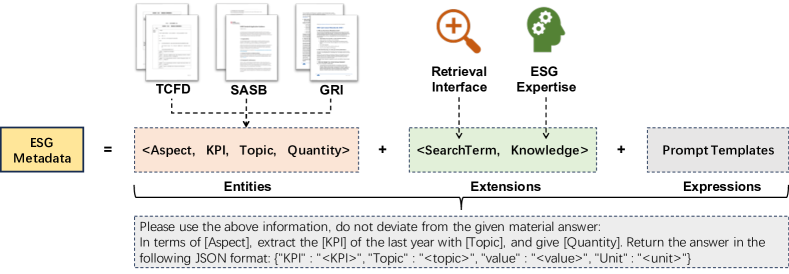
- It employs an ESG metadata module that maps diverse ESG reporting standards (e.g., GRI, SASB) into structured extraction commands using LLM-powered semantic understanding.
- A report preprocessing module parses and structures raw ESG reports into machine-readable formats, enabling efficient retrieval and indexing.
- The LLM agent module performs context-aware extraction of numerical and textual ESG indicators using RAG-enhanced prompts grounded in domain-specific knowledge.
- The system uses GPT-4 and other LLMs to perform data extraction and disclosure analysis, with performance evaluated against human-annotated benchmarks.
- The framework supports multi-standard adaptability through an extensible metadata schema and dynamic retrieval of relevant ESG criteria from reference databases.
Experimental results
Research questions
- RQ1How effective is an LLM-based RAG framework in extracting structured ESG data from unstructured corporate reports?
- RQ2What is the comparative performance of different LLMs (e.g., GPT-3.5, GPT-4) in ESG data extraction and disclosure analysis tasks?
- RQ3To what extent do companies across different industries disclose environmental, social, and governance metrics, and what patterns emerge?
- RQ4How does the ESG metadata module improve LLM performance in multi-standard ESG reporting environments?
- RQ5What are the key limitations of current LLM-based ESG extraction systems, particularly regarding non-textual data like charts and images?
Key findings
- GPT-4 achieved 76.9% accuracy in structured data extraction and 83.7% in disclosure analysis, outperforming baseline models by over 20%.
- The ESG metadata module improved GPT-4’s performance by 2.5 percentage points and GPT-3.5’s by 9.9 percentage points in ESG analytical tasks.
- Environmental data disclosure averaged 69.5%, while social data disclosure averaged 57.2%, indicating significant room for improvement in corporate transparency.
- The overall ESG disclosure rate across industries did not exceed 80%, highlighting systemic gaps in reporting completeness.
- Common ESG actions were identified across sectors, including 'reducing emissions' and 'promoting digital health', with sector-specific actions such as 'green finance' in financials and 'sustainable supply chains' in industrials.
- The framework demonstrated strong adaptability across 12 industries and 166 companies listed on the Hong Kong Stock Exchange, enabling cross-industry benchmarking.
Read this paper
Open the full text in the Nubint reader and ask about any passage as you read.
Read this paper on NubintThis review was generated by AI from the original paper. Please check the paper before citing it.