
[Paper Review] Evidence for multiple nucleosynthetic processes from carbon enhanced metal-poor stars in the Carina dwarf spheroidal galaxy
This study presents the largest high-resolution abundance analysis of carbon-enhanced metal-poor (CEMP) stars in a dwarf spheroidal galaxy, identifying six CEMP stars in Carina dSph. It reveals multiple nucleosynthetic processes: one CEMP-no star with low neutron-capture elements and five CEMP-s/r/s stars with enhanced s- and r-process elements, with neutron-capture patterns best matched by i-process yields from metal-poor AGB models, supporting the i-process as a key origin of CEMP-r/s stars' abundance patterns.
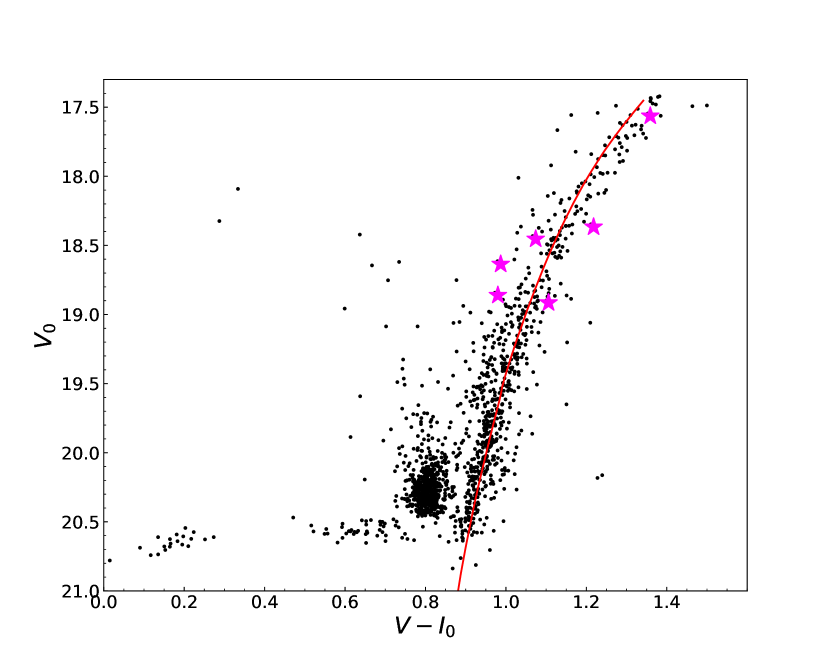
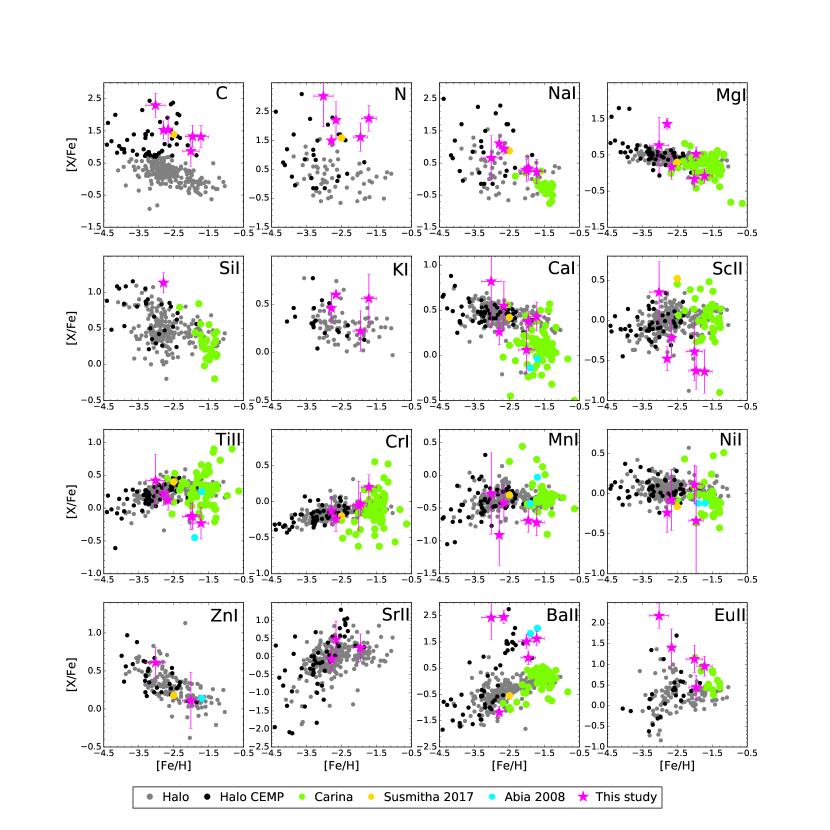
Context: Carbon Enhanced Metal-Poor (CEMP) stars ($\mathrm{[C/Fe]} > 0.7$) are known to exist in large numbers at low metallicity in the Milky Way halo and are important tracers of early Galactic chemical evolution. However, very few such stars have been identified in the classical dwarf spheroidal (dSph) galaxies, and detailed abundances, including neutron-capture element abundances, have only been reported for 12 stars. Aims: We aim to derive detailed abundances of six CEMP stars identified in the Carina dSph and compare the abundances to CEMP stars in other dSph galaxies and the Milky Way halo. This is the largest sample of CEMP stars in a dSph galaxy analysed to date. Methods: 1D LTE elemental abundances are derived via equivalent width and spectral synthesis using high-resolution spectra of the six stars obtained with the MIKE spectrograph at Las Campanas Observatory. Results: Abundances or upper limits are derived for up to 27 elements from C to Os in the six stars. The analysis reveals one of the stars to be a CEMP-no star with very low neutron-capture element abundances. In contrast, the other five stars all show enhancements in neutron-capture elements in addition to their carbon enhancement, classifying them as CEMP-$s$ and -$r/s$ stars. The six stars have similar $α$ and iron-peak element abundances as other stars in Carina, except for the CEMP-no star, which shows enhancement in Na, Mg, and Si. We explore the absolute carbon abundances ($A( m C)$) of CEMP stars in dSph galaxies and find similar behaviour as is seen for Milky Way halo CEMP stars, but highlight that CEMP-$r/s$ stars primarily have very high $A( m C)$ values. We also compare the neutron-capture element abundances of the CEMP-$r/s$ stars in our sample to recent $i$-process yields, which provide a good match to the derived abundances.
Motivation & Objective
- To determine detailed elemental abundances of CEMP stars in the Carina dSph, a galaxy with limited prior CEMP studies.
- To compare the abundance patterns of CEMP stars in Carina to those in the Milky Way halo and other dSph galaxies.
- To investigate the origin of neutron-capture element enhancements in CEMP stars, particularly the role of the i-process.
- To assess whether CEMP- r/s stars in dSphs share the same nucleosynthetic pathways as those in the Milky Way halo.
- To explore the absolute carbon abundance trends in dSph CEMP stars and their implications for early galaxy evolution.
Proposed method
- High-resolution spectroscopy using the MIKE spectrograph on the 6.5m Magellan telescopes at Las Campanas Observatory.
- 1D LTE abundance analysis via equivalent width and spectral synthesis for up to 27 elements from C to Os.
- Comparison of observed neutron-capture element patterns to recent i-process yields from metal-poor low-mass AGB models (Choplin et al. 2022).
- Scaling of i-process yields to match stellar Ba and Eu abundances, with adjustments for the average deviation from Ba to Dy.
- Derivation of absolute carbon abundances (A(C)) and comparison across CEMP subtypes and metallicity.
- Classification of stars into CEMP-no, CEMP-s, and CEMP-r/s based on [Ba/Fe], [Eu/Fe], and [Ba/Eu] ratios.
Experimental results
Research questions
- RQ1Do CEMP stars in the Carina dSph exhibit similar abundance patterns to those in the Milky Way halo?
- RQ2What nucleosynthetic processes are responsible for the observed neutron-capture element enhancements in CEMP stars in Carina?
- RQ3Can the i-process reproduce the observed abundance patterns in CEMP-r/s stars in Carina?
- RQ4How do the absolute carbon abundances (A(C)) of CEMP stars in dSphs compare to those in the Milky Way halo?
- RQ5Do CEMP- r/s stars in dSphs show distinct abundance signatures that distinguish them from CEMP-s stars?
Key findings
- One of the six CEMP stars is classified as a CEMP-no star with [Ba/Fe] < 0.0 and low neutron-capture element abundances.
- The other five stars are CEMP-s or CEMP-r/s stars, showing enhancements in both carbon and neutron-capture elements.
- The CEMP- r/s stars have absolute carbon abundances (A(C)) > 7.5, placing them in the highest A(C) range among CEMP stars.
- The neutron-capture element abundance patterns of the CEMP- r/s stars show a good match to i-process yields from metal-poor AGB models, particularly for elements from Ba to Dy.
- The i-process models slightly underproduce carbon compared to observed values, with predicted logε(C) values of 9.26–9.29 versus observed corrected values of 7.24–7.80.
- The CEMP-no star shows significant enhancements in Na, Mg, and Si, a feature also seen in some halo CEMP-no stars, suggesting common nucleosynthetic origins.
Read this paper
Open the full text in the Nubint reader and ask about any passage as you read.
Read this paper on NubintThis review was generated by AI from the original paper. Please check the paper before citing it.