
[Paper Review] Evidence of a log scaling law for political persuasion with large language models
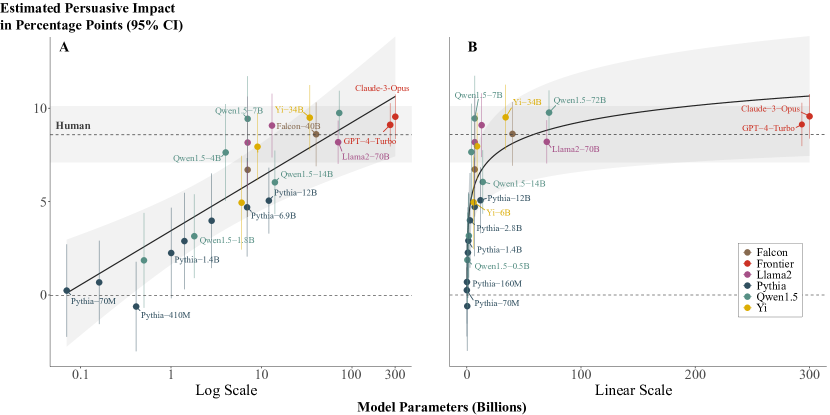
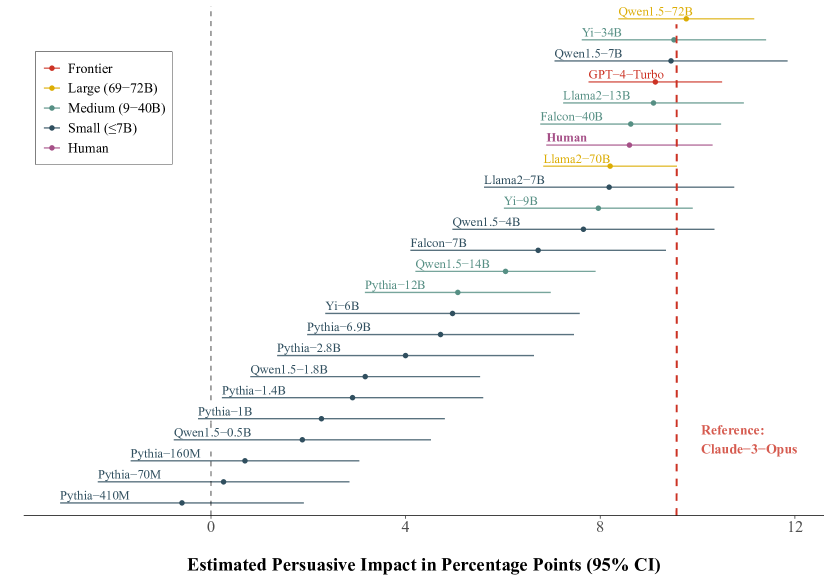
This study investigates the scaling of political persuasiveness in large language models (LLMs) through a large-scale randomized survey experiment with 25,982 participants. It finds evidence of a log scaling law: persuasiveness increases sharply at first but diminishes with model size, such that current frontier models like GPT-4-Turbo and Claude-3-Opus are only marginally more persuasive than much smaller models (e.g., Qwen1.5-7B), and this advantage is largely due to improved task completion rather than inherent persuasive capability.
Large language models can now generate political messages as persuasive as those written by humans, raising concerns about how far this persuasiveness may continue to increase with model size. Here, we generate 720 persuasive messages on 10 U.S. political issues from 24 language models spanning several orders of magnitude in size. We then deploy these messages in a large-scale randomized survey experiment (N = 25,982) to estimate the persuasive capability of each model. Our findings are twofold. First, we find evidence of a log scaling law: model persuasiveness is characterized by sharply diminishing returns, such that current frontier models are barely more persuasive than models smaller in size by an order of magnitude or more. Second, mere task completion (coherence, staying on topic) appears to account for larger models' persuasive advantage. These findings suggest that further scaling model size will not much increase the persuasiveness of static LLM-generated messages.
Motivation & Objective
- To understand how model size affects the political persuasiveness of LLM-generated messages in real-world human populations.
- To assess whether current frontier LLMs significantly outperform smaller models in persuading people on political issues.
- To investigate whether increased persuasiveness with model scaling is due to improved coherence, on-topic adherence, and argumentation (task completion) rather than inherent persuasive features.
- To provide empirical data on the scaling of persuasive capabilities in LLMs, which is critical for forecasting risks and designing mitigation strategies.
Proposed method
- Generated 720 persuasive messages across 10 U.S. political issues using 24 open-weight LLMs spanning 0.07B to 72B parameters, with fine-tuning on instruction-following data to ensure consistency.
- Conducted a large-scale randomized survey experiment with N = 25,982 participants, assigning them to receive messages from specific models or to control (no message) or human-written message conditions.
- Measured persuasive impact via a four-question battery on a 0–100 scale assessing support for the assigned issue stance, adjusting for political party, ideology, and political knowledge using OLS regression.
- Used a random-effects meta-analysis with a block-diagonal variance-covariance matrix to estimate the association between model size (log of parameter count) and persuasive effect, accounting for correlated estimates within each political issue.
- Defined 'task completion' as the proportion of messages that are coherent, grammatically correct, on-topic, and clearly argue for the assigned stance, and analyzed its role in explaining persuasiveness gains.
- Centered the log of model parameter count to improve interpretability and used random effects for intercept and parameter count across messages, models, and issues to allow for heterogeneity in treatment effects.
Experimental results
Research questions
- RQ1Does the persuasiveness of LLM-generated political messages scale linearly or logarithmically with model size?
- RQ2Are current frontier models like GPT-4-Turbo and Claude-3-Opus significantly more persuasive than smaller models such as Qwen1.5-7B?
- RQ3To what extent is the increased persuasiveness of larger models attributable to improved task completion (coherence, on-topic relevance, argument clarity)?
- RQ4Is there evidence of diminishing returns in persuasiveness as model size increases, suggesting a scaling law for political persuasion?
Key findings
- The study provides evidence of a log scaling law: persuasiveness increases sharply at first but diminishes with further model scaling, indicating diminishing returns beyond a certain size.
- Claude-3-Opus and GPT-4-Turbo are not significantly more persuasive than the much smaller Qwen1.5-7B model, suggesting that frontier models offer only marginal gains over smaller models.
- The primary driver of increased persuasiveness in larger models is improved task completion—coherence, grammar, on-topic relevance, and argument clarity—rather than inherent persuasive features.
- Current frontier models already achieve the highest possible score on task completion, indicating that further gains in persuasiveness from scaling model size are unlikely.
- The meta-analysis shows that the coefficient on the log of parameter count is small and not significantly different from zero, supporting the conclusion that larger size does not substantially improve persuasiveness beyond what is achieved through task completion.
- The study finds that static, non-targeted LLM-generated messages can have a significant persuasive impact equivalent to human-written messages, highlighting the risk of misuse in political contexts.
Read this paper
Open the full text in the Nubint reader and ask about any passage as you read.
Read this paper on NubintThis review was generated by AI from the original paper. Please check the paper before citing it.