
[Paper Review] Ewald-based Long-Range Message Passing for Molecular Graphs
This paper proposes Ewald message passing, a Fourier-space message passing scheme that replaces distance-based message passing with frequency-based filtering to capture long-range interactions like electrostatics and van der Waals forces in molecular graphs. It improves energy prediction accuracy by 10–16% on OC20 and OE62 datasets without architectural changes, outperforming baselines and effectively learning long-range physics often missed by standard MPNNs.
Neural architectures that learn potential energy surfaces from molecular data have undergone fast improvement in recent years. A key driver of this success is the Message Passing Neural Network (MPNN) paradigm. Its favorable scaling with system size partly relies upon a spatial distance limit on messages. While this focus on locality is a useful inductive bias, it also impedes the learning of long-range interactions such as electrostatics and van der Waals forces. To address this drawback, we propose Ewald message passing: a nonlocal Fourier space scheme which limits interactions via a cutoff on frequency instead of distance, and is theoretically well-founded in the Ewald summation method. It can serve as an augmentation on top of existing MPNN architectures as it is computationally inexpensive and agnostic to architectural details. We test the approach with four baseline models and two datasets containing diverse periodic (OC20) and aperiodic structures (OE62). We observe robust improvements in energy mean absolute errors across all models and datasets, averaging 10% on OC20 and 16% on OE62. Our analysis shows an outsize impact of these improvements on structures with high long-range contributions to the ground truth energy.
Motivation & Objective
- To address the limitation of message passing neural networks (MPNNs) in capturing long-range physical interactions such as electrostatics and van der Waals forces due to distance-based message passing.
- To develop a computationally efficient, architecture-agnostic method that integrates into existing MPNNs to improve learning of long-range interactions.
- To demonstrate that frequency-domain message passing via Ewald summation provides a theoretically grounded and effective alternative to distance-cutoff-based message passing.
- To validate the method's robustness across diverse molecular structures, including periodic (OC20) and aperiodic (OE62) systems.
- To show that the improvement is specifically due to better modeling of long-range contributions, not general inductive bias or architectural gains.
Proposed method
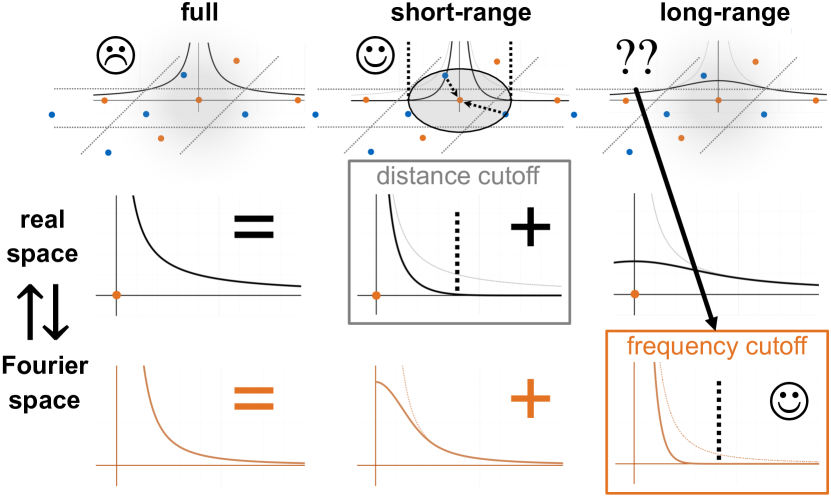
- Ewald message passing replaces distance-based message passing with a Fourier-space scheme that limits interactions via a frequency cutoff instead of spatial distance.
- It leverages the Ewald summation method to decompose long-range interactions into short-range (real space) and long-range (Fourier space) components, with the latter computed via a frequency-truncated sum.
- The method is implemented as a plug-in module that can be added to any existing MPNN architecture without modifying its core design.
- Messages are computed in Fourier space using a learned basis of frequency components, enabling efficient computation of slowly decaying interactions like Coulombic forces.
- The approach maintains computational efficiency by using a fixed number of frequency components, independent of system size.
- It is compatible with both periodic and aperiodic molecular graphs and integrates seamlessly with existing GNN message-passing layers.
Experimental results
Research questions
- RQ1Can a frequency-domain message passing scheme effectively capture long-range physical interactions in molecular graphs where distance-based MPNNs fail?
- RQ2Does Ewald message passing improve energy prediction accuracy across diverse molecular datasets, including periodic and aperiodic structures?
- RQ3How does the performance gain of Ewald message passing compare to architectural modifications or hyperparameter tuning in baseline models?
- RQ4To what extent do the improvements stem from better modeling of long-range contributions such as electrostatics and dispersion forces?
- RQ5Is the method computationally efficient and scalable, with minimal runtime and parameter overhead?
Key findings
- Ewald message passing reduces energy mean absolute error (MAE) by an average of 10% on the OC20 dataset and 16% on the OE62 dataset across all tested baseline models.
- The method achieves consistent improvements across all four baseline models (SchNet, PaiNN, DimeNet++, GemNet-dT), indicating broad applicability and robustness.
- On OE62, Ewald message passing recovers the effects of the DFT-D3 dispersion correction, confirming its ability to model long-range interactions like van der Waals forces.
- The improvement is most pronounced in structures with high long-range energy contributions, demonstrating targeted learning of non-local physics.
- The method incurs only a moderate runtime increase (up to ~270% on OE62), but the performance gain cannot be replicated by any tested baseline configuration, including larger models or extended cutoffs.
- The cost-performance tradeoff favors Ewald message passing, as it provides significant accuracy gains with minimal architectural or computational overhead.
Read this paper
Open the full text in the Nubint reader and ask about any passage as you read.
Read this paper on NubintThis review was generated by AI from the original paper. Please check the paper before citing it.