
[Paper Review] Exciton states in monolayer MoSe2 and MoTe2 probed by upconversion spectroscopy
This study uses upconversion spectroscopy in hexagonal boron nitride-encapsulated monolayer MoSe2 and MoTe2 to resolve previously elusive excited exciton states, achieving sub-1.5 meV linewidths. The authors identify a resonant exciton-exciton Auger scattering mechanism as the origin of upconversion, enabling bias-controlled access to excitonic states up to 200 meV above the ground state, with direct confirmation via reflectivity and photoluminescence excitation spectroscopy.
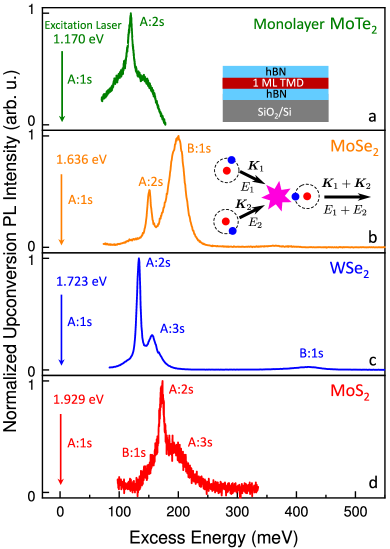
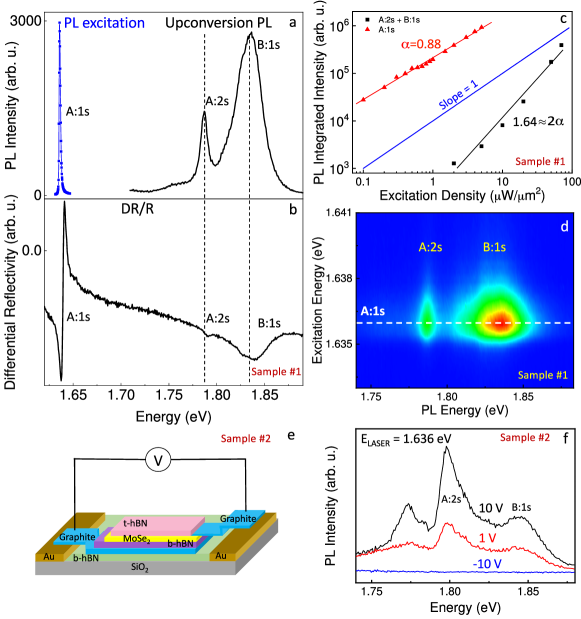
Transitions metal dichalcogenides (TMDs) are direct semiconductors in the atomic monolayer (ML) limit with fascinating optical and spin-valley properties. The strong optical absorption of up to 20 % for a single ML is governed by excitons, electron-hole pairs bound by Coulomb attraction. Excited exciton states in MoSe$_2$ and MoTe$_2$ monolayers have so far been elusive due to their low oscillator strength and strong inhomogeneous broadening. Here we show that encapsulation in hexagonal boron nitride results in emission line width of the A:1$s$ exciton below 1.5 meV and 3 meV in our MoSe$_2$ and MoTe$_2$ monolayer samples, respectively. This allows us to investigate the excited exciton states by photoluminescence upconversion spectroscopy for both monolayer materials. The excitation laser is tuned into resonance with the A:1$s$ transition and we observe emission of excited exciton states up to 200 meV above the laser energy. We demonstrate bias control of the efficiency of this non-linear optical process. At the origin of upconversion our model calculations suggest an exciton-exciton (Auger) scattering mechanism specific to TMD MLs involving an excited conduction band thus generating high energy excitons with small wave-vectors. The optical transitions are further investigated by white light reflectivity, photoluminescence excitation and resonant Raman scattering confirming their origin as excited excitonic states in monolayer thin semiconductors.
Motivation & Objective
- To resolve the long-elusive excited exciton states in monolayer MoSe2 and MoTe2, which are obscured by inhomogeneous broadening and low oscillator strength in conventional measurements.
- To demonstrate that hexagonal boron nitride (hBN) encapsulation significantly narrows excitonic linewidths, enabling high-resolution spectroscopy of excited states.
- To identify the microscopic mechanism behind upconversion in transition metal dichalcogenide monolayers, particularly the role of exciton-exciton scattering.
- To establish a non-linear optical technique—upconversion spectroscopy—for probing the full excitonic spectrum, including states beyond the ground state.
- To validate the origin of upconversion signals through complementary techniques such as white light reflectivity and photoluminescence excitation (PLE) spectroscopy.
Proposed method
- Employed resonant photoluminescence upconversion spectroscopy using a tunable Ti:sapphire laser tuned to the A:1s exciton transition in hBN-encapsulated monolayer MoSe2 and MoTe2.
- Achieved sub-1.5 meV linewidths (1.5 meV in MoSe2, 3 meV in MoTe2) via hBN encapsulation, enabling resolution of fine excitonic features.
- Used white light reflectivity and photoluminescence excitation (PLE) spectroscopy to independently confirm the energy positions of upconverted emission peaks.
- Developed a theoretical model based on exciton-exciton Auger scattering involving an excited conduction band, with matrix elements derived from effective mass and k·p theory.
- Calculated the Auger recombination rate using a many-body approach, incorporating energy conservation, momentum distribution, and exchange interactions.
- Modeled the upconversion process as a resonant two-exciton scattering event where one exciton annihilates and transfers energy and momentum to create a higher-energy exciton with small wavevector.
Experimental results
Research questions
- RQ1What causes the upconversion emission observed in resonantly excited monolayer MoSe2 and MoTe2, and what is the underlying physical mechanism?
- RQ2Why are excited exciton states in MoSe2 and MoTe2 difficult to observe in standard photoluminescence, and how can they be accessed?
- RQ3How does hBN encapsulation enable the observation of previously unresolved excitonic states in these 2D semiconductors?
- RQ4To what extent can the efficiency of the upconversion process be controlled via external electrical gating?
- RQ5What is the role of Coulomb interaction and band structure in enabling efficient exciton-exciton scattering in monolayer TMDs?
Key findings
- hBN encapsulation reduces the linewidth of the A:1s exciton to below 1.5 meV in MoSe2 and 3 meV in MoTe2, enabling high-resolution spectroscopy.
- Upconversion spectroscopy reveals excited exciton states up to 200 meV above the excitation energy, confirming the presence of A:2s and B:1s states in both materials.
- The upconversion process is efficiently controlled by applied gate voltage, demonstrating tunability of the non-linear optical response.
- The origin of upconversion is identified as a resonant exciton-exciton Auger scattering process involving an excited conduction band, which efficiently generates high-energy, low-momentum excitons.
- Theoretical modeling confirms that strong Coulomb interaction and resonant coupling to excited bands enhance the Auger scattering rate, making it dominant over other relaxation pathways.
- The measured Auger recombination time is estimated at ~25 ps under typical conditions (T = 4 K, nX = 10^9 cm⁻²), consistent with the observed upconversion efficiency.
Read this paper
Open the full text in the Nubint reader and ask about any passage as you read.
Read this paper on NubintThis review was generated by AI from the original paper. Please check the paper before citing it.