
[Paper Review] Explaining Tree Model Decisions in Natural Language for Network Intrusion Detection
This paper proposes Large Language Model Decision Tree Explanations (LLM-DTE), a method that uses LLMs to generate natural language explanations for decision tree-based network intrusion detection systems, making them accessible to non-experts. LLM-DTE significantly outperforms rule-based explanations in human evaluations, achieving 39.5% higher quiz scores and superior ratings in readability, quality, and use of background knowledge.
Network intrusion detection (NID) systems which leverage machine learning have been shown to have strong performance in practice when used to detect malicious network traffic. Decision trees in particular offer a strong balance between performance and simplicity, but require users of NID systems to have background knowledge in machine learning to interpret. In addition, they are unable to provide additional outside information as to why certain features may be important for classification. In this work, we explore the use of large language models (LLMs) to provide explanations and additional background knowledge for decision tree NID systems. Further, we introduce a new human evaluation framework for decision tree explanations, which leverages automatically generated quiz questions that measure human evaluators' understanding of decision tree inference. Finally, we show LLM generated decision tree explanations correlate highly with human ratings of readability, quality, and use of background knowledge while simultaneously providing better understanding of decision boundaries.
Motivation & Objective
- To address the challenge of making decision tree-based network intrusion detection (NID) systems interpretable to users without machine learning expertise.
- To generate natural language explanations that include background knowledge about feature importance and decision boundaries, beyond simple rule extraction.
- To develop a novel human evaluation framework for assessing explanation quality using automatically generated counterfactual quiz questions.
- To evaluate whether LLM-generated explanations improve user understanding compared to traditional rule-based explanations in NID contexts.
Proposed method
- Construct a decision tree model trained on network traffic data to classify traffic as benign or malicious.
- Extract path and structural information from the decision tree for a given input to trace the decision path.
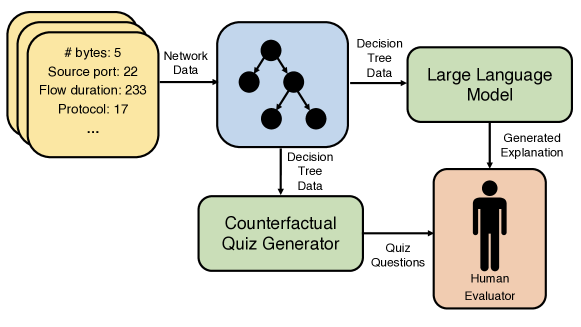
- Design a prompt for a large language model (LLM) that includes task description, feature definitions, tree structure, node thresholds, class distributions, and input feature values.
- Instruct the LLM to generate a natural language explanation of why the decision tree classified the input as benign or malicious, using simple, non-technical language.
- Automatically generate counterfactual quiz questions based on rule-based templates to test human evaluators’ understanding of the explanation.
- Conduct human evaluations with 10 participants—half with ML backgrounds, half with security backgrounds—comparing LLM-DTE and rule-based explanations on quiz performance and qualitative ratings.
Experimental results
Research questions
- RQ1Can LLM-generated natural language explanations improve user understanding of decision tree-based network intrusion detection decisions compared to rule-based explanations?
- RQ2To what extent do LLM-generated explanations incorporate background knowledge about feature relevance and decision boundaries?
- RQ3How effective is a quiz-based human evaluation framework in measuring the quality of decision tree explanations?
- RQ4Do LLM-generated explanations achieve higher readability, quality, and background knowledge utilization than rule-based explanations?
Key findings
- LLM-DTE explanations achieved a mean quiz score of 17.3 out of 25, representing a 39.5% improvement over rule-based explanations, which scored 12.4 out of 25.
- Human evaluators rated LLM-DTE explanations as highly readable 15% more often than rule-based explanations, with 42% of LLM-DTE explanations rated as high readability compared to 30% for rule-based.
- LLM-DTE explanations were rated as high quality 52% of the time, compared to 30% for rule-based explanations, indicating a nearly twofold improvement in perceived quality.
- LLM-DTE explanations were rated as high in background knowledge usage 52% of the time, compared to only 30% for rule-based explanations, reflecting a 70% relative increase in perceived contextual relevance.
- The human evaluation framework using automatically generated quiz questions demonstrated strong correlation with qualitative preferences, validating its use for assessing explanation effectiveness.
- Despite performance gains, LLM-DTE generation is slower and more expensive than rule-based methods, and explanation quality degrades with increasing decision tree depth due to longer input prompts.
Read this paper
Open the full text in the Nubint reader and ask about any passage as you read.
Read this paper on NubintThis review was generated by AI from the original paper. Please check the paper before citing it.