
[Paper Review] Exploring Dual-task Correlation for Pose Guided Person Image Generation
This paper proposes a Dual-task Pose Transformer Network (DPTN) for pose-guided person image generation by introducing a source-to-source reconstruction task as an auxiliary learning signal. By sharing weights between the source-to-target and source-to-source branches and using a Pose Transformer Module (PTM) to exploit dual-task correlation, DPTN enhances texture transfer and generates more realistic images with 9.79M parameters, outperforming SOTA on PSNR and LPIPS.
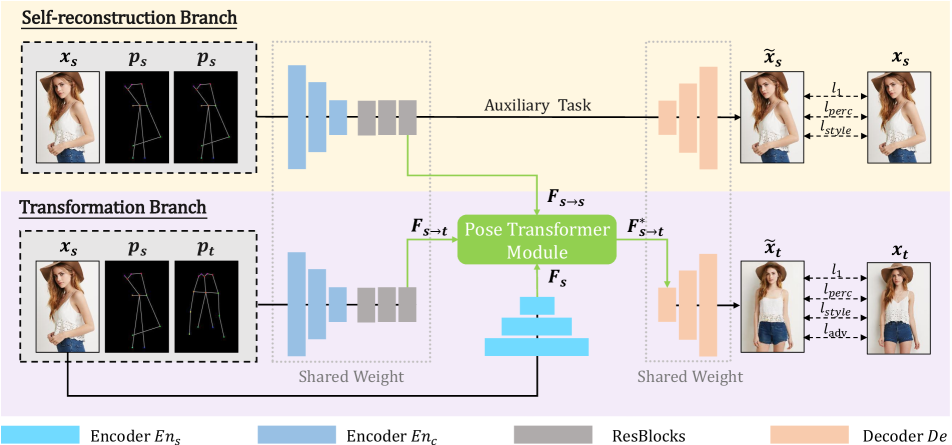
Pose Guided Person Image Generation (PGPIG) is the task of transforming a person image from the source pose to a given target pose. Most of the existing methods only focus on the ill-posed source-to-target task and fail to capture reasonable texture mapping. To address this problem, we propose a novel Dual-task Pose Transformer Network (DPTN), which introduces an auxiliary task (i.e., source-to-source task) and exploits the dual-task correlation to promote the performance of PGPIG. The DPTN is of a Siamese structure, containing a source-to-source self-reconstruction branch, and a transformation branch for source-to-target generation. By sharing partial weights between them, the knowledge learned by the source-to-source task can effectively assist the source-to-target learning. Furthermore, we bridge the two branches with a proposed Pose Transformer Module (PTM) to adaptively explore the correlation between features from dual tasks. Such correlation can establish the fine-grained mapping of all the pixels between the sources and the targets, and promote the source texture transmission to enhance the details of the generated target images. Extensive experiments show that our DPTN outperforms state-of-the-arts in terms of both PSNR and LPIPS. In addition, our DPTN only contains 9.79 million parameters, which is significantly smaller than other approaches. Our code is available at: https://github.com/PangzeCheung/Dual-task-Pose-Transformer-Network.
Motivation & Objective
- Address the ill-posed nature of source-to-target pose transfer in person image generation, which often leads to unrealistic textures and artifacts.
- Improve texture mapping fidelity during large pose changes, where existing methods fail to preserve source appearance details.
- Stabilize training of the source-to-target generator by introducing a self-reconstruction auxiliary task (source-to-source) with shared weights.
- Enhance feature refinement in the source-to-target branch by explicitly modeling fine-grained correlation between dual-task features.
- Develop a lightweight yet effective architecture that achieves state-of-the-art performance with significantly fewer parameters than prior methods.
Proposed method
- Propose a Siamese-structured DPTN with two branches: a source-to-source self-reconstruction branch and a source-to-target transformation branch.
- Share partial weights between the two branches to enable knowledge distillation from the easier source-to-source task to the harder source-to-target task.
- Design a Pose Transformer Module (PTM) with Context Augment Blocks (CABs) and Texture Transfer Blocks (TTBs) to model cross-task feature correlation.
- Use multi-head cross-attention (MHCA) in PTM to align features from the source-to-source and source-to-target branches at the pixel level.
- Integrate the refined features from PTM into the source-to-target branch to improve texture detail generation.
- Train the full network with separate loss functions: L1 loss for reconstruction and perceptual loss for realism, optimizing both branches jointly.
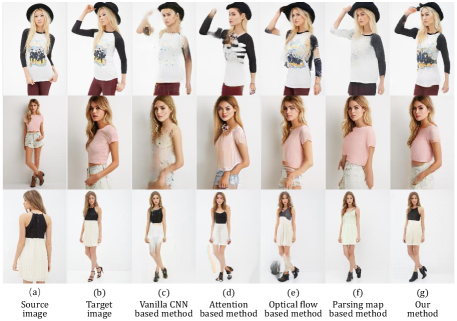
Experimental results
Research questions
- RQ1Can introducing a source-to-source self-reconstruction task as an auxiliary learning signal improve the performance and stability of pose-guided person image generation?
- RQ2How does modeling fine-grained correlation between features from dual tasks enhance texture transfer and detail preservation in generated images?
- RQ3To what extent does dual-task learning stabilize training and prevent mode collapse in the source-to-target generation task?
- RQ4Can a lightweight architecture with only 9.79 million parameters outperform larger SOTA models in both quantitative and qualitative metrics?
- RQ5Does the proposed Pose Transformer Module (PTM) effectively guide texture transmission from source to target while maintaining geometric consistency?
Key findings
- The full DPTN model achieves a PSNR of 19.1492 and LPIPS of 0.1957 on the DeepFashion dataset, outperforming all ablation variants and SOTA methods.
- The ablation study shows that removing the dual-task learning (w/o DTL) leads to unstable training and heavy artifacts, confirming its role in training stability.
- Removing the PTM results in blurred images due to poor texture mapping, demonstrating PTM’s critical role in transferring source appearance details.
- The model without CABs fails to integrate source-to-source knowledge effectively, leading to unrealistic patterns in generated images.
- Eliminating the encoder (w/o En_s) causes loss of fine-grained texture cues, proving its importance in supplying source texture information to PTM.
- The full model achieves the best FID score of 11.4664 on DeepFashion, and the learning curve shows continued improvement with dual-task learning, unlike single-task training which collapses after 130 epochs.
Read this paper
Open the full text in the Nubint reader and ask about any passage as you read.
Read this paper on NubintThis review was generated by AI from the original paper. Please check the paper before citing it.