
[Paper Review] Exploring Edge TPU for Network Intrusion Detection in IoT
This paper evaluates Google's Edge TPU for deploying deep learning-based network intrusion detection systems (NIDS) at the IoT edge, comparing it with an ARM Cortex-A53 CPU across inference time, energy efficiency, and classification performance. Surprisingly, the Cortex-A53 outperforms the Edge TPU for very small models, while the Edge TPU excels beyond a critical model size—specifically, when models exceed the on-chip memory capacity, revealing a bi-modal performance behavior critical for edge AI deployment decisions.
This paper explores Google's Edge TPU for implementing a practical network intrusion detection system (NIDS) at the edge of IoT, based on a deep learning approach. While there are a significant number of related works that explore machine learning based NIDS for the IoT edge, they generally do not consider the issue of the required computational and energy resources. The focus of this paper is the exploration of deep learning-based NIDS at the edge of IoT, and in particular the computational and energy efficiency. In particular, the paper studies Google's Edge TPU as a hardware platform, and considers the following three key metrics: computation (inference) time, energy efficiency and the traffic classification performance. Various scaled model sizes of two major deep neural network architectures are used to investigate these three metrics. The performance of the Edge TPU-based implementation is compared with that of an energy efficient embedded CPU (ARM Cortex A53). Our experimental evaluation shows some unexpected results, such as the fact that the CPU significantly outperforms the Edge TPU for small model sizes.
Motivation & Objective
- To evaluate the practicality of deploying deep learning-based NIDS on resource-constrained IoT edge devices.
- To investigate the trade-offs between inference speed, energy efficiency, and detection accuracy on Edge TPU and a general-purpose embedded CPU.
- To determine the optimal model size and neural architecture for efficient deployment on Edge TPU in IoT security workloads.
- To identify the performance bottlenecks of Edge TPU, particularly related to on-chip memory limitations.
Proposed method
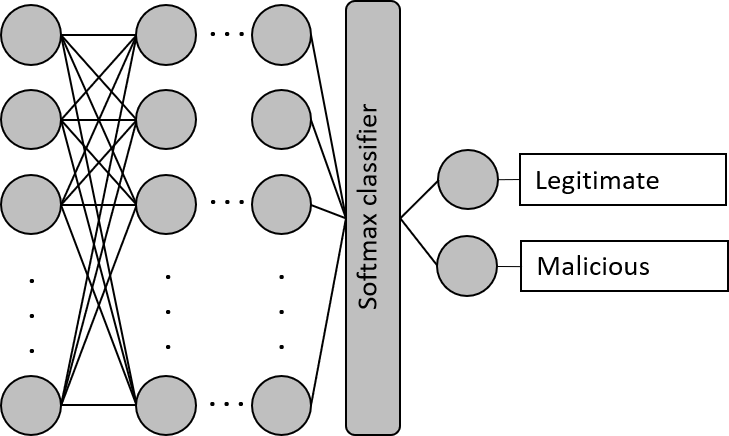
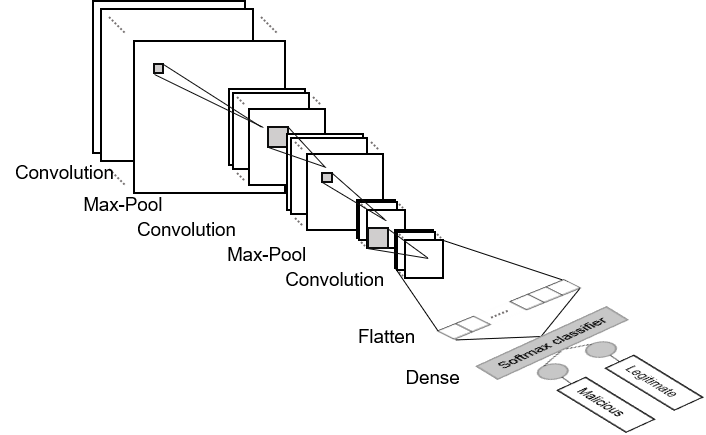
- The study implements two deep neural network architectures—feedforward and convolutional neural networks (CNNs)—in scaled model sizes for NIDS.
- Neural network models are trained and evaluated on a public IoT benchmark dataset to assess intrusion detection performance.
- Inference is executed on both Edge TPU and ARM Cortex-A53 platforms, with performance measured in inference time, energy consumption, and classification accuracy.
- Model sizes are systematically varied to explore the impact of model complexity on hardware efficiency, particularly around the 8000 KiB on-chip memory threshold.
- Energy efficiency is calculated as the ratio of classification performance to energy consumption, enabling cross-platform comparison.
- The bi-modal behavior of Edge TPU is analyzed by observing performance shifts when model parameters exceed on-chip memory capacity and require off-chip memory access.
Experimental results
Research questions
- RQ1How does the inference time of Edge TPU compare to ARM Cortex-A53 for small and large deep learning models in NIDS?
- RQ2What is the energy efficiency of Edge TPU versus Cortex-A53 across varying model sizes?
- RQ3At what model size does Edge TPU begin to outperform Cortex-A53 in terms of energy efficiency and inference speed?
- RQ4How does the on-chip memory capacity of Edge TPU influence its performance, and what is the threshold at which off-chip memory access degrades efficiency?
- RQ5Does the choice of neural network architecture (feedforward vs. CNN) significantly affect the performance and energy efficiency on Edge TPU?
Key findings
- For very small model sizes, the ARM Cortex-A53 outperforms the Edge TPU in both inference time and energy efficiency, contrary to expectations.
- The Edge TPU becomes more energy efficient than the Cortex-A53 once model sizes exceed approximately 8000 KiB, the on-chip memory capacity.
- Beyond the 8000 KiB threshold, the relative performance advantage of Edge TPU diminishes due to increased off-chip memory access, revealing a bi-modal performance behavior.
- The CNN architecture is 8 to 10 times more energy efficient than the feedforward architecture on the Edge TPU across all model sizes.
- Energy efficiency on both platforms declines with increasing model size, but Edge TPU maintains a significant advantage for large models.
- The performance of Edge TPU is highly sensitive to model size relative to on-chip memory, indicating that model size must be carefully tuned for optimal deployment.
Read this paper
Open the full text in the Nubint reader and ask about any passage as you read.
Read this paper on NubintThis review was generated by AI from the original paper. Please check the paper before citing it.