
[Paper Review] Exploring the baryonic effect signature in the Hyper Suprime-Cam Year 3 cosmic shear two-point correlations on small scales: the $S_8$ tension remains present
This study analyzes Hyper Suprime-Cam Year 3 cosmic shear two-point correlations down to 0.28 arcminutes to test for baryonic feedback effects as a solution to the $S_8$ tension. Using the DarkEmulator2 nonlinear matter power spectrum and a flexible baryonic model, it finds no significant baryonic signature and only up to 5% suppression at $k \sim 1~h~{\rm Mpc}^{-1}$, insufficient to resolve the $S_8$ tension.
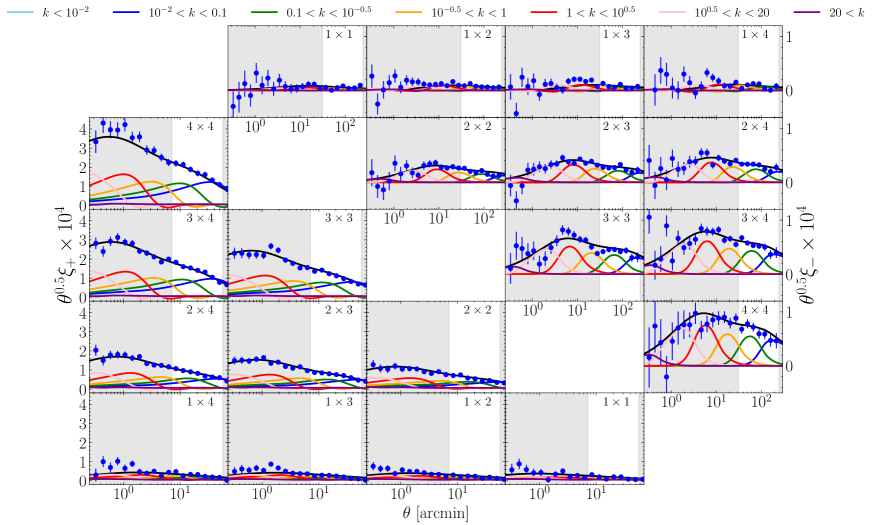
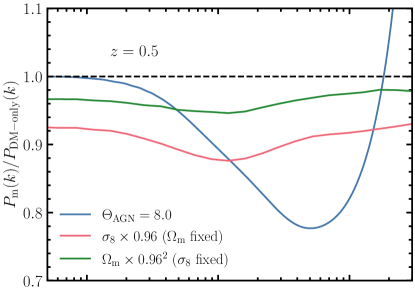
The baryonic feedback effect is considered as a possible solution to the so-called $S_8$ tension indicated in cosmic shear cosmology. The baryonic effect is more significant on smaller scales, and affects the cosmic shear two-point correlation functions (2PCFs) with different scale- and redshift-dependencies from those of the cosmological parameters. In this paper, we use the Hyper Suprime-Cam Year 3 (HSC-Y3) data to measure the cosmic shear 2PCFs ($ξ_{\pm}$) down to 0.28 arcminutes, taking full advantage of the high number density of source galaxies in the deep HSC data, to explore a possible signature of the baryonic effect. While the published HSC analysis used the cosmic shear 2PCFs on angular scales, which are sensitive to the matter power spectrum at $k\lesssim 1~h{ m Mpc}^{-1}$, the smaller scale HSC cosmic shear signal allows us to probe the signature of matter power spectrum up to $k\simeq 20~h{ m Mpc}^{-1}$. Using the accurate emulator of the nonlinear matter power spectrum, DarkEmulator2, we show that the dark matter-only model can provide an acceptable fit to the HSC-Y3 2PCFs down to the smallest scales. In other words, we do not find any clear signature of the baryonic effects or do not find a systematic shift in the $S_8$ value with the inclusion of the smaller-scale information as would be expected if the baryonic effect is significant. Alternatively, we use a flexible 6-parameter model of the baryonic effects, which can lead to both enhancement and suppression in the matter power spectrum compared to the dark matter-only model, to perform the parameter inference of the HSC-Y3 2PCFs. We find that the small-scale HSC data allow only a fractional suppression of up to 5 percent in the matter power spectrum at $k\sim 1~h{ m Mpc}^{-1}$, which is not sufficient to reconcile the $S_8$ tension.
Motivation & Objective
- Investigate whether baryonic feedback effects leave a detectable signature in cosmic shear two-point correlations (ξ±) on small angular scales.
- Assess if baryonic physics can resolve the $S_8$ tension by suppressing power in the matter power spectrum at high $k$.
- Use high-precision HSC-Y3 data down to 0.28 arcminutes to probe nonlinear scales up to $k \sim 20~h~{\rm Mpc}^{-1}$.
- Test the viability of dark matter-only models versus flexible baryonic models in fitting the small-scale cosmic shear signal.
- Explore the utility of $\xi_-$ and scale-cuts in $\xi_{\pm}$ for monitoring baryonic features and constraining cosmology simultaneously.
Proposed method
- Measure cosmic shear two-point correlation functions (ξ₊, ξ₋) from HSC-Y3 data down to 0.28 arcminutes using high-source galaxy density.
- Employ the DarkEmulator2 to accurately model the nonlinear matter power spectrum across $k \lesssim 20~h~{\rm Mpc}^{-1}$.
- Fit the observed ξ± with a dark matter-only model and a flexible 6-parameter baryonic feedback model that allows both suppression and enhancement.
- Perform Bayesian parameter inference using the HSC-Y3 cosmic shear likelihood to constrain cosmological and baryonic parameters.
- Evaluate the sensitivity of $\xi_-$ on scales < few arcminutes to baryonic features, and use scale-cuts in $\xi_{\pm}$ to decouple baryonic effects from cosmological constraints.
- Use the emulator to propagate baryonic feedback effects into the predicted shear correlation functions with high accuracy.
Experimental results
Research questions
- RQ1Does the HSC-Y3 cosmic shear data on small scales (≤0.28 arcmin) show a detectable signature of baryonic feedback effects in the matter power spectrum?
- RQ2Can baryonic feedback suppress the matter power spectrum sufficiently at $k \sim 1~h~{\rm Mpc}^{-1}$ to resolve the $S_8$ tension?
- RQ3Is the dark matter-only model still consistent with the small-scale cosmic shear measurements, or is a baryonic component required?
- RQ4Can $\xi_-$ on sub-arcminute scales be used as a diagnostic tool for baryonic effects if present?
- RQ5To what extent can scale cuts in $\xi_{\pm}$ allow simultaneous constraints on cosmological parameters and baryonic feedback?
Key findings
- The dark matter-only model provides an acceptable fit to the HSC-Y3 cosmic shear 2PCFs down to 0.28 arcminutes, indicating no strong baryonic signature.
- No systematic shift in the $S_8$ value is observed when including small-scale data, suggesting baryonic effects do not resolve the $S_8$ tension.
- A flexible baryonic feedback model allows only a maximum of 5% suppression in the matter power spectrum at $k \sim 1~h~{\rm Mpc}^{-1}$, insufficient to reconcile the $S_8$ tension.
- The $\xi_-$ correlation function on scales smaller than a few arcminutes is sensitive to baryonic features and can serve as a monitor for such effects.
- Scale-cuts in $\xi_{\pm}$ enable simultaneous constraints on cosmological parameters and baryonic feedback, improving model separation.
- The HSC-Y3 data, though intermediate, already constrain baryonic feedback at the 5% level at $k \sim 1~h~{\rm Mpc}^{-1}$, with room for improvement in the final data release.
Read this paper
Open the full text in the Nubint reader and ask about any passage as you read.
Read this paper on NubintThis review was generated by AI from the original paper. Please check the paper before citing it.