
[Paper Review] Exploring the $H_0$ tension and the evidence of dark sector interaction from 2D BAO measurements
This paper investigates interacting dark energy (IDE) models using transverse (2D) Baryon Acoustic Oscillation (BAO) measurements combined with Planck-CMB data, finding that 2D BAO data favor higher Hubble constant values ($H_0 = 73.4 \pm 0.88$ km/s/Mpc) compared to traditional 3D BAO analyses. The joint analysis provides strong statistical evidence (>3σ) that the IDE model resolves the $H_0$ tension with local distance ladder measurements.
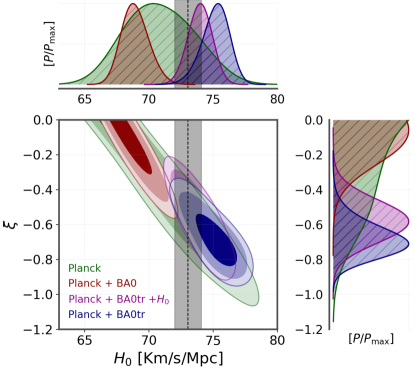
We explore observational constraints on a cosmological model with an interaction between dark energy (DE) and dark matter (DM), using a compilation of 15 measurements of the 2D BAO (i.e., transversal) scale in combination with Planck-CMB data, to explore the parametric space of a class of interacting DE models. We find that 2D BAO measurements can generate different observational constraints compared to the traditional approach of studying the matter clustering in the 3D BAO measurements. Contrary to the observations for the $Λ$CDM and IDE models when analyzed with Planck-CMB + 3D BAO data, we note that Planck-CMB + 2D BAO data favor high values of the Hubble constant $H_0$. From the joint analysis with Planck-CMB + 2D BAO + Gaussian prior on $H_0$, we find $H_0 = 73.4 \pm 0.88$ km/s/Mpc. We conclude that the $H_0$ tension is solved in the IDE model with strong statistical evidence (more than 3$σ$) for the IDE cosmologies.
Motivation & Objective
- To assess the impact of 2D BAO measurements on cosmological constraints in models beyond $\Lambda$CDM, particularly interacting dark energy (IDE) models.
- To investigate whether 2D BAO data—less dependent on fiducial cosmologies—yield different constraints than traditional 3D BAO analyses.
- To test whether the $H_0$ tension can be resolved in IDE models when using 2D BAO data in combination with Planck-CMB and local $H_0$ priors.
- To evaluate the robustness of 2D BAO data in constraining the coupling parameter between dark energy and dark matter in IDE frameworks.
Proposed method
- The study uses a compilation of 15 transverse (2D) BAO measurements, which are angular-scale projections of the sound horizon at the baryon drag epoch, independent of 3D geometry assumptions.
- It combines 2D BAO data with Planck-CMB observations to constrain a class of interacting dark energy (IDE) models with a constant coupling between dark energy and dark matter.
- The analysis employs a joint likelihood framework using Planck-CMB, 2D BAO, and a Gaussian prior on $H_0$ from the SH0ES distance ladder to test model consistency.
- The coupling parameter in the IDE model is varied to explore its impact on $H_0$ and $S_8$, with constraints derived via Markov Chain Monte Carlo sampling.
- The method avoids fiducial cosmology dependencies by focusing on angular clustering on redshift shells, reducing model bias in distance reconstruction.
- The results are cross-checked with an alternative 2D BAO sample from Menote & Marra (2022), confirming robustness of the main findings.
Experimental results
Research questions
- RQ1Does using 2D BAO data instead of 3D BAO data lead to significantly different constraints in interacting dark energy models compared to $\Lambda$CDM?
- RQ2Can the $H_0$ tension be resolved in IDE models when 2D BAO data are used in combination with Planck-CMB and local $H_0$ priors?
- RQ3How does the 2D BAO approach affect the inferred value of $H_0$ in IDE models, and does it favor higher values consistent with SH0ES?
- RQ4What is the impact of 2D BAO data on the $S_8$ tension in IDE cosmologies, and does it improve agreement with weak lensing and galaxy clustering data?
- RQ5How robust are the results when alternative 2D BAO samples are used, and what does this imply for the reliability of 2D BAO as a probe in non-$\Lambda$CDM models?
Key findings
- The joint analysis of Planck-CMB and 2D BAO data favors a higher Hubble constant, yielding $H_0 = 73.4 \pm 0.88$ km/s/Mpc when combined with a Gaussian prior on $H_0$.
- Unlike 3D BAO analyses, which favor lower $H_0$ values in $\Lambda$CDM and IDE models, 2D BAO data consistently favor higher $H_0$ values in the IDE framework.
- The $H_0$ tension is resolved in the IDE model with strong statistical evidence, exceeding 3$\sigma$ significance, when using Planck-CMB + 2D BAO + $H_0$ prior.
- The 2D BAO data set alone lacks sufficient power to constrain the full parameter space, but its inclusion significantly shifts constraints toward higher $H_0$ values in IDE models.
- The difference in constraints between 3D and 2D BAO is more pronounced in IDE models than in $\Lambda$CDM, highlighting the sensitivity of 2D BAO to non-standard dynamics.
- The $S_8$ value in the IDE model is higher than in $\Lambda$CDM and is consistent with weak lensing and galaxy clustering data within error bars, though the model-dependence of $S_8$ limits definitive conclusions on the $S_8$ tension.

Read this paper
Open the full text in the Nubint reader and ask about any passage as you read.
Read this paper on NubintThis review was generated by AI from the original paper. Please check the paper before citing it.