
[Paper Review] Face De-occlusion using 3D Morphable Model and Generative Adversarial Network
This paper proposes a 3DMM-conditioned GAN framework for face de-occlusion that leverages 3D morphable model priors to reconstruct high-fidelity, photorealistic face images from severely occluded inputs. By combining global and local discriminators with a generator guided by 3DMM geometry and semantics, the method achieves robust de-occlusion across diverse poses, lighting, and occlusion types, enabling accurate 3D face reconstruction and attribute editing.
In recent decades, 3D morphable model (3DMM) has been commonly used in image-based photorealistic 3D face reconstruction. However, face images are often corrupted by serious occlusion by non-face objects including eyeglasses, masks, and hands. Such objects block the correct capture of landmarks and shading information. Therefore, the reconstructed 3D face model is hardly reusable. In this paper, a novel method is proposed to restore de-occluded face images based on inverse use of 3DMM and generative adversarial network. We utilize the 3DMM prior to the proposed adversarial network and combine a global and local adversarial convolutional neural network to learn face de-occlusion model. The 3DMM serves not only as geometric prior but also proposes the face region for the local discriminator. Experiment results confirm the effectiveness and robustness of the proposed algorithm in removing challenging types of occlusions with various head poses and illumination. Furthermore, the proposed method reconstructs the correct 3D face model with de-occluded textures.
Motivation & Objective
- Address the challenge of photorealistic face de-occlusion in real-world images with severe occlusions such as glasses, masks, and hands.
- Overcome limitations of existing methods that rely on constrained conditions like low-resolution, grayscale, or aligned images.
- Enable accurate 3D face reconstruction by restoring occluded textures using a deep generative model with 3DMM priors.
- Facilitate face attribute editing by allowing manipulation of 3DMM coefficients post-de-occlusion.
- Develop a large-scale, diverse dataset of synthesized face images with semantically placed occlusions for training and evaluation.
Proposed method
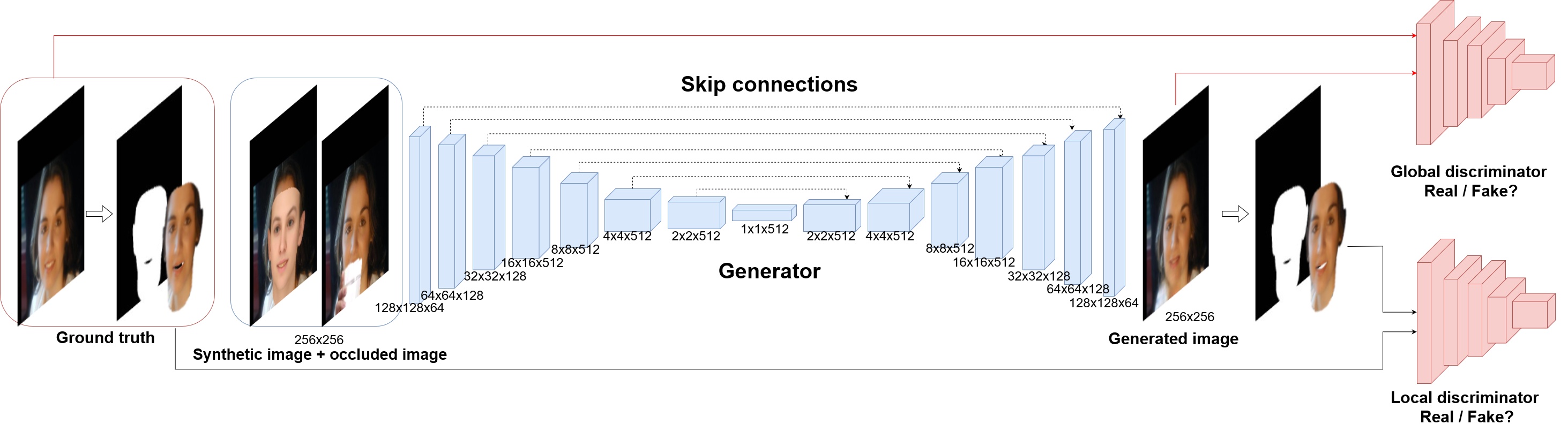
- Propose a conditional GAN framework where the generator is conditioned on 3DMM parameters to guide de-occlusion with geometric and semantic priors.
- Integrate a global discriminator to ensure overall image coherence and a local discriminator focused on the face region, informed by 3DMM-based face alignment.
- Use 3DMM to extract shape, texture, and pose parameters, which are used as input to the generator to guide the synthesis of missing facial regions.
- Train the model using a combination of adversarial loss, perceptual loss, and reconstruction loss to ensure high-fidelity output.
- Leverage 300W-3D and AFLW2000-3D datasets to synthesize a large-scale training set with diverse occlusions placed using facial landmarks.
- Apply 3DMM-based fitting and shape-from-shading (SfS) to reconstruct detailed 3D face geometry from de-occluded images.
Experimental results
Research questions
- RQ1Can a 3DMM-conditioned GAN effectively restore photorealistic facial textures from severely occluded images with complex poses and lighting?
- RQ2How does incorporating 3DMM as a geometric and semantic prior improve de-occlusion performance compared to standard GANs?
- RQ3To what extent does the proposed method enhance the quality of 3D face reconstruction when applied to occluded input images?
- RQ4Can the de-occluded output be used for downstream tasks such as face attribute editing via 3DMM coefficient manipulation?
- RQ5How does the combination of global and local discriminators improve visual fidelity and detail recovery compared to single-discriminator setups?
Key findings
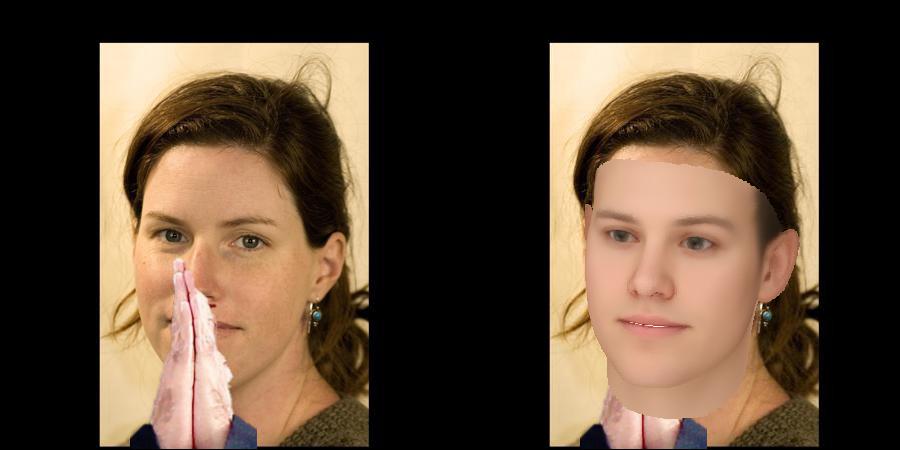
- The proposed method successfully removes diverse occlusions—including glasses, masks, and hands—across real and synthetic images with varying head poses and lighting.
- Visual comparisons show that the model with both global and local discriminators produces the most realistic results, with sharp details in eyes and natural skin texture.
- 3D face reconstruction from de-occluded images yields significantly cleaner and more accurate geometry compared to reconstruction from occluded inputs, which suffer from noise and artifacts.
- The 3D face model reconstructed with de-occluded textures exhibits correct shape and surface details, demonstrating the effectiveness of the method for 3D reconstruction pipelines.
- Face attribute editing is feasible by modifying 3DMM coefficients: changing expression coefficients leads to realistic, controllable face generation from the same occluded input.
- Ablation studies confirm that removing 3DMM priors or discriminators leads to noisy or unrealistic outputs, validating the necessity of each component in the framework.
Read this paper
Open the full text in the Nubint reader and ask about any passage as you read.
Read this paper on NubintThis review was generated by AI from the original paper. Please check the paper before citing it.