
[Paper Review] Fast and Robust Early-Exiting Framework for Autoregressive Language Models with Synchronized Parallel Decoding
This paper proposes the Fast and Robust Early-Exiting (FREE) framework for autoregressive language models, which uses a shallow-deep module and synchronized parallel decoding to accelerate inference without performance degradation. By replacing state copying with synchronized decoding and employing a Beta mixture model for adaptive confidence threshold estimation, FREE achieves significant speedups—up to 1.65× faster than full models—while maintaining generation quality across diverse tasks and model sizes.
To tackle the high inference latency exhibited by autoregressive language models, previous studies have proposed an early-exiting framework that allocates adaptive computation paths for each token based on the complexity of generating the subsequent token. However, we observed several shortcomings, including performance degradation caused by a state copying mechanism or numerous exit paths, and sensitivity to exit confidence thresholds. Consequently, we propose a Fast and Robust Early-Exiting (FREE) framework, which incorporates a shallow-deep module and a synchronized parallel decoding. Our framework enables faster inference by synchronizing the decoding process of the current token with previously stacked early-exited tokens. Furthermore, as parallel decoding allows us to observe predictions from both shallow and deep models, we present a novel adaptive threshold estimator that exploits a Beta mixture model to determine suitable confidence thresholds. We empirically demonstrated the superiority of our proposed framework on extensive generation tasks.
Motivation & Objective
- To address high inference latency in autoregressive language models due to sequential autoregressive decoding.
- To overcome performance degradation caused by state copying and excessive exit paths in existing early-exiting frameworks.
- To eliminate the need for manual tuning of confidence thresholds by introducing an adaptive threshold estimator.
- To enable faster, robust, and scalable inference across diverse models and sequence lengths.
- To maintain high generation quality while significantly reducing computational cost.
Proposed method
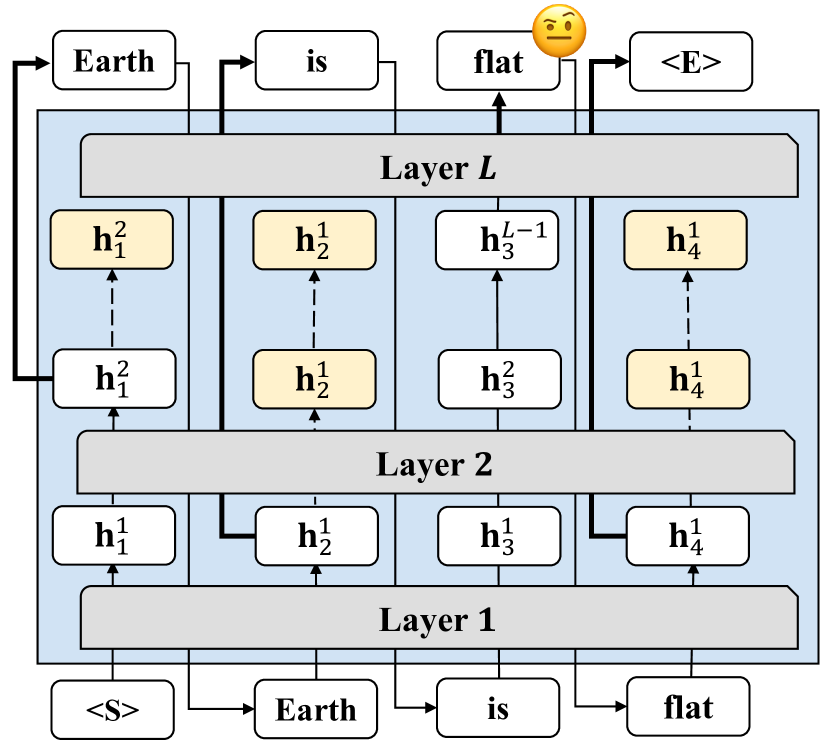
- Introduces a shallow-deep module that splits computation into a shallow model (early layers) and a deep model (full layers), enabling early exit at two designated points.
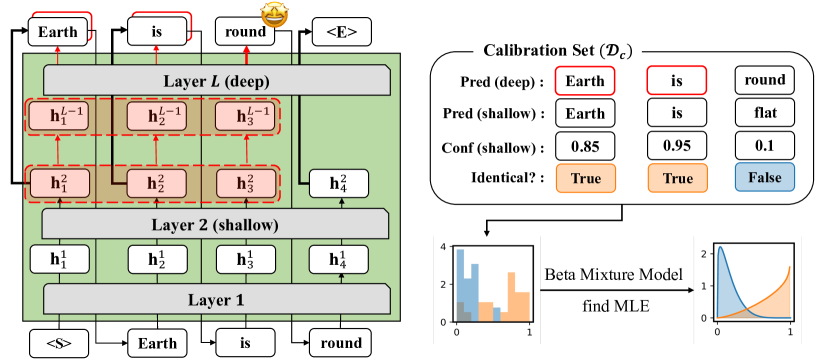
- Employs synchronized parallel decoding to align the decoding of current tokens with previously exited tokens, avoiding reliance on approximated key/value states.
- Replaces state copying with actual attention computation on stacked early-exited tokens, reducing performance degradation and improving accuracy.
- Proposes a Beta mixture model (BMM)-based adaptive threshold estimator that leverages confidence scores and prediction alignment between shallow and deep models to determine optimal thresholds per dataset.
- Uses parallel decoding to generate predictions from both shallow and deep models simultaneously, enabling reliable threshold estimation without additional inference cost.
- Fine-tunes the shallow model using parameter-efficient methods to reduce training overhead while maintaining performance.
Experimental results
Research questions
- RQ1Can a two-path early-exiting framework with synchronized parallel decoding reduce inference latency without performance degradation?
- RQ2How does synchronized decoding compare to state copying in terms of accuracy and speed for long sequences and large models?
- RQ3Can a data-driven, adaptive threshold estimator based on confidence score distributions eliminate the need for manual threshold tuning?
- RQ4To what extent does the FREE framework maintain generation quality across diverse NLP tasks and model sizes?
- RQ5How does the framework perform under human-like evaluation metrics compared to full models?
Key findings
- The FREE framework achieves up to 1.65× speedup over the full model on the CNN/DailyMail summarization task while maintaining ROUGE-L scores of 40.99 compared to 41.09 for the full model.
- Human-like evaluation using GPT-3.5-turbo showed no significant performance drop: scores were [4.68, 3.84, 3.84, 3.72] for FREE versus [4.73, 3.83, 3.87, 3.77] for the full model across four dimensions.
- The win count in pairwise comparison was nearly equal (101 vs. 99), indicating comparable human preference between FREE and full model.
- The adaptive threshold estimator based on the Beta mixture model effectively determined optimal thresholds per dataset, eliminating the need for manual tuning.
- Synchronized parallel decoding outperformed state copying in accuracy, especially on larger models and longer sequences, reducing performance degradation.
- Refinement methods that rely on deep model correction showed minimal performance gains at the cost of increased latency, suggesting they are ill-suited for integration into early-exiting frameworks.
Read this paper
Open the full text in the Nubint reader and ask about any passage as you read.
Read this paper on NubintThis review was generated by AI from the original paper. Please check the paper before citing it.