
[Paper Review] Fast Model Debias with Machine Unlearning
This paper proposes Fast Model Debiasing (FMD), a novel framework that identifies, evaluates, and removes bias in pre-trained models using counterfactual data and influence functions, enabling efficient debiasing with minimal parameter updates and no access to original training data. FMD achieves state-of-the-art fairness with significantly reduced computational cost and bias, even when unlearning only the top layers of a model.
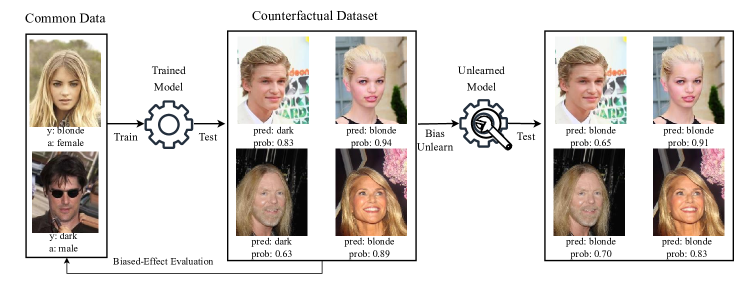
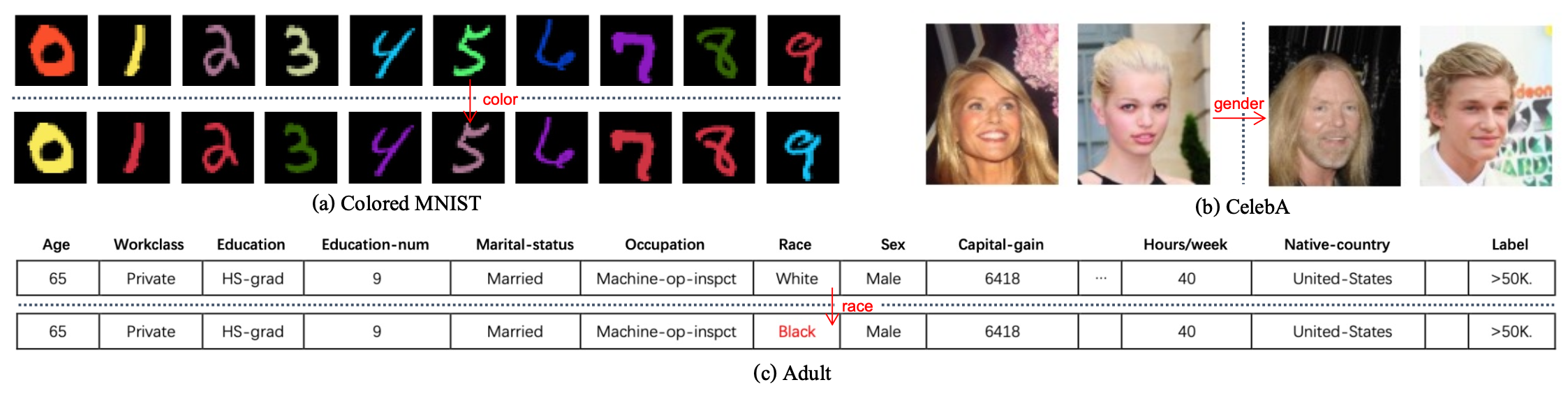
Recent discoveries have revealed that deep neural networks might behave in a biased manner in many real-world scenarios. For instance, deep networks trained on a large-scale face recognition dataset CelebA tend to predict blonde hair for females and black hair for males. Such biases not only jeopardize the robustness of models but also perpetuate and amplify social biases, which is especially concerning for automated decision-making processes in healthcare, recruitment, etc., as they could exacerbate unfair economic and social inequalities among different groups. Existing debiasing methods suffer from high costs in bias labeling or model re-training, while also exhibiting a deficiency in terms of elucidating the origins of biases within the model. To this respect, we propose a fast model debiasing framework (FMD) which offers an efficient approach to identify, evaluate and remove biases inherent in trained models. The FMD identifies biased attributes through an explicit counterfactual concept and quantifies the influence of data samples with influence functions. Moreover, we design a machine unlearning-based strategy to efficiently and effectively remove the bias in a trained model with a small counterfactual dataset. Experiments on the Colored MNIST, CelebA, and Adult Income datasets along with experiments with large language models demonstrate that our method achieves superior or competing accuracies compared with state-of-the-art methods while attaining significantly fewer biases and requiring much less debiasing cost. Notably, our method requires only a small external dataset and updating a minimal amount of model parameters, without the requirement of access to training data that may be too large or unavailable in practice.
Motivation & Objective
- To address the high cost and impracticality of retraining or labeling biases in large-scale models.
- To identify and quantify bias in pre-trained models without requiring access to original training data.
- To develop a post-processing debiasing method that achieves superior fairness with minimal performance degradation and low computational cost.
- To enable effective debiasing using only a small external dataset of counterfactual samples.
Proposed method
- FMD constructs factual and counterfactual sample pairs to explicitly identify biased attributes by observing prediction shifts under attribute variation.
- It extends influence functions to quantify the impact of individual training samples on model bias, enabling precise identification of harmful training examples.
- A Newton-step-based unlearning mechanism is applied to remove biased correlations by updating only a small number of model parameters.
- An alternative unlearning strategy uses external counterfactual pairs to avoid dependency on original training data, enhancing practicality.
- The method focuses on fine-tuning only the top MLP layers of pre-trained models, minimizing computational overhead.
- It leverages machine unlearning to efficiently eliminate bias while preserving model accuracy.
Experimental results
Research questions
- RQ1Can we identify bias in a pre-trained model without access to the original training data or extensive labeling?
- RQ2How can we quantify the influence of individual training samples on model bias?
- RQ3Can we effectively remove bias using only a small external dataset of counterfactual examples?
- RQ4Does unlearning via parameter updates on a few layers outperform full retraining or post-processing in fairness and accuracy?
- RQ5Can the framework generalize to large language models and diverse fairness metrics?
Key findings
- On the Colored MNIST dataset with bias severity 0.99, FMD achieved 83.49% accuracy and bias (Co) of 0.1438, outperforming EqOdd (82.71% accuracy, 0.5991 Co) and CEqOdd (83.22% accuracy, 0.4469 Co).
- For the Adult Income dataset, FMD reduced bias (De) to 0.0367 under the race attribute, compared to 0.1825 for Reject and 0.7288 for EqOdd.
- FMD achieved a bias (Co) of 0.0019 on the gender attribute, significantly lower than CEqOdd (0.0047) and EqOdd (0.0247).
- The method required only 0.0389 seconds for unlearning on the gender attribute, far less than the 14.42 seconds needed by Reject.
- Abllation showed that updating only the last two MLP layers yielded the highest accuracy (83.49%) on Colored MNIST, while three-layer fine-tuning degraded performance.
- Performance stabilized with 5,000 counterfactual samples, indicating diminishing returns beyond this threshold.
Read this paper
Open the full text in the Nubint reader and ask about any passage as you read.
Read this paper on NubintThis review was generated by AI from the original paper. Please check the paper before citing it.