
[Paper Review] Features and Peculiarities of Gate-Voltage Modulation of Spin-Orbit Interaction in FeCoB Nanomagnets: Insights into the Physical Origins of the VCMA Effect
This study reveals that gate voltage in FeCoB/MgO/Ta nanomagnets simultaneously modulates both the spin-orbit interaction strength and the demagnetization field with opposite polarity, leading to a counterbalancing effect that suppresses the Voltage-Controlled Magnetic Anisotropy (VCMA) effect. The findings indicate that optimizing the balance between these two opposing contributions could significantly enhance the VCMA response for energy-efficient spintronic devices.
The paper investigates the systematic dependencies of the anisotropy field and the strength of spin-orbit (SO) interaction on gate voltage in Ta/FeB/MgO nanomagnets. Our findings reveal an intriguing opposite polarity in the gate-voltage dependencies of the anisotropy field and the coefficient of SO interaction across all studied nanomagnets. This opposite polarity indicates that the gate-voltage modulation of spin-orbit interaction is not the primary contributor to the voltage-controlled magnetic anisotropy (VCMA) effect. Instead, the gate-voltage modulation of magnetization emerges as the most probable candidate, given its polarity aligns with the observed modulation of anisotropy. The modulation of magnetic anisotropy is influenced by two major contributions of opposite polarities, which effectively counterbalance each other and reduce the overall VCMA effect. Optimizing the balance between these contributions could potentially lead to a substantial enhancement of the VCMA effect. Our measurements did not detect any modulation of the in-plane component of spin accumulation by the gate voltage.
Motivation & Objective
- To systematically investigate how gate voltage modulates spin-orbit interaction and magnetic anisotropy in FeCoB-based nanomagnets.
- To identify the physical origins of the Voltage-Controlled Magnetic Anisotropy (VCMA) effect, particularly the role of interfacial spin-orbit coupling and demagnetization fields.
- To determine whether gate voltage influences spin accumulation or other interfacial electronic properties beyond magnetic anisotropy.
- To clarify the interplay between spin-orbit interaction and demagnetization field in shaping the VCMA response.
Proposed method
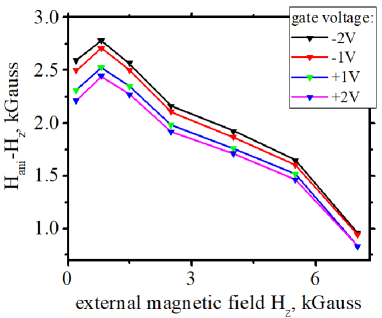
- The strength of spin-orbit interaction was quantified via the coefficient $ k_{so} $, extracted from the linear dependence of anisotropy field $ H_{ani} $ on external in-plane magnetic field $ H_z $, using $ H_{ani} - H_z $ vs. $ H_z $ fitting.
- The gate-voltage dependence of $ k_{so} $ and the intrinsic anisotropy field $ H^0_{ani} $ were measured in Ta/FeB/MgO nanomagnets under varying gate voltages.
- In-plane magnetic field components $ H_{||} $ were measured in parallel and perpendicular directions relative to the current to probe spin accumulation, with a focus on detecting gate voltage modulation.
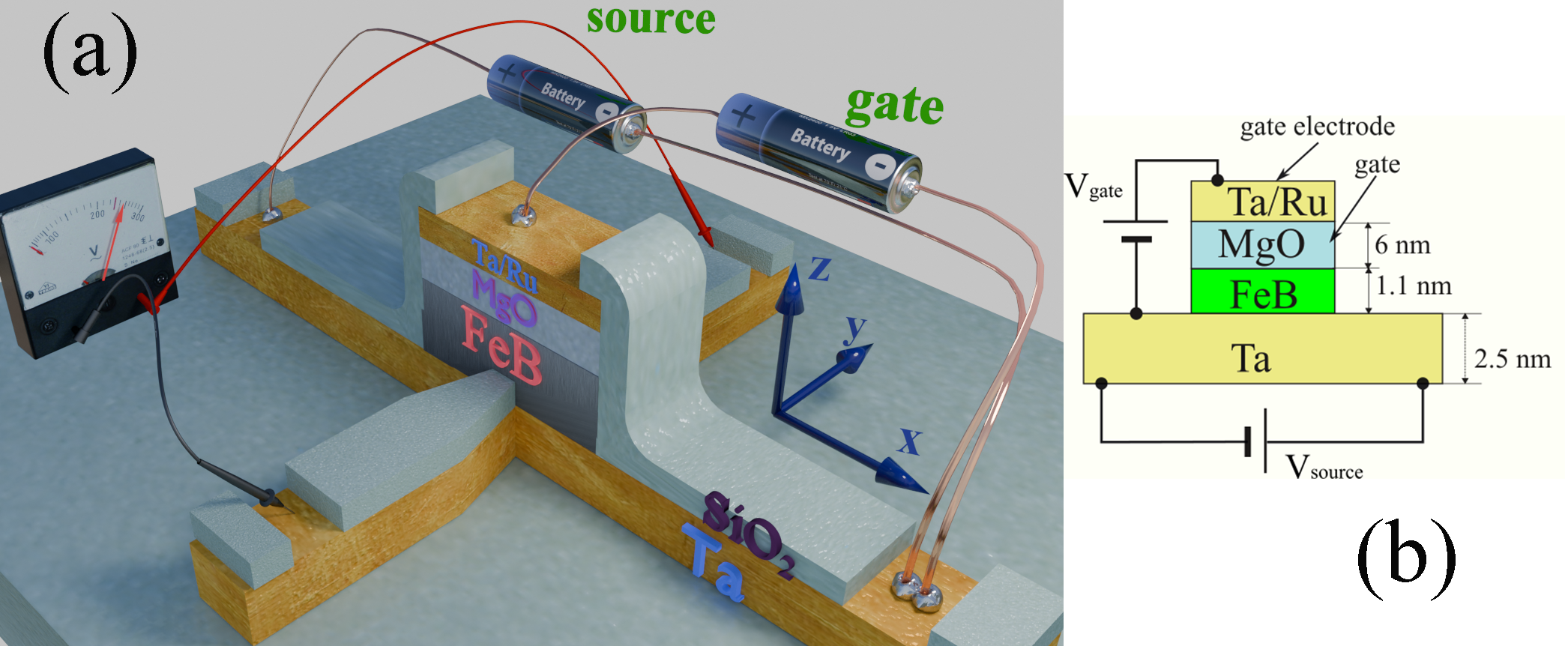
- The experimental setup enabled simultaneous measurement of $ H_{ani} $, $ k_{so} $, and $ H_{||} $ under varying gate voltage and current bias.
- Theoretical analysis linked changes in $ k_{so} $ to modifications in orbital distribution at the FeB/MgO interface due to gate-induced electric fields.
- The absence of gate voltage dependence in $ H_{||} $ was used to rule out significant modulation of spin accumulation or spin Hall effect contributions.
Experimental results
Research questions
- RQ1How does gate voltage affect the strength of spin-orbit interaction in FeB nanomagnets, as quantified by $ k_{so} $?
- RQ2What is the polarity of the gate-voltage dependence of the intrinsic anisotropy field $ H^0_{ani} $, and how does it compare to that of $ k_{so} $?
- RQ3To what extent does the demagnetization field contribute to the VCMA effect, and is it modulated by gate voltage?
- RQ4Does gate voltage influence the in-plane component of spin accumulation, as detected via $ H_{||} $?
- RQ5What are the dominant physical mechanisms responsible for the observed opposite polarity in $ k_{so} $ and $ H^0_{ani} $ under gate voltage?
Key findings
- The gate-voltage dependence of the spin-orbit interaction coefficient $ k_{so} $ and the intrinsic anisotropy field $ H^0_{ani} $ exhibit opposite polarities across all studied nanomagnets.
- Both the strength of spin-orbit interaction and the demagnetization field are effectively modulated by gate voltage, increasing with higher gate voltages.
- The opposite polarity of these two contributions leads to a counterbalancing effect that reduces the overall VCMA response.
- No measurable gate voltage dependence was observed in the in-plane magnetic field components $ H_{||} $, indicating no significant modulation of spin accumulation by the gate.
- The results suggest that the interfacial orbital redistribution under gate voltage is a key mechanism for modulating both $ k_{so} $ and the demagnetization field.
- Optimizing the balance between these two opposing contributions could lead to a substantial enhancement of the VCMA effect.
Read this paper
Open the full text in the Nubint reader and ask about any passage as you read.
Read this paper on NubintThis review was generated by AI from the original paper. Please check the paper before citing it.