
[Paper Review] Federated Generative Learning with Foundation Models
This paper proposes Federated Generative Learning (FGL), a novel federated learning framework that transmits only prompts—instead of model parameters or gradients—between clients and server. By leveraging foundation generative models like Stable Diffusion, the server synthesizes high-quality training data from these prompts, achieving superior communication efficiency, improved robustness to data heterogeneity, and stronger privacy protection, with performance surpassing FedAvg even in centralized training settings on ImageNet and DomainNet.
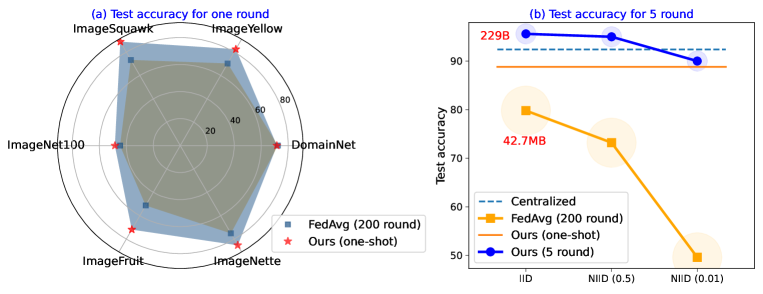
Existing approaches in Federated Learning (FL) mainly focus on sending model parameters or gradients from clients to a server. However, these methods are plagued by significant inefficiency, privacy, and security concerns. Thanks to the emerging foundation generative models, we propose a novel federated learning framework, namely Federated Generative Learning. In this framework, each client can create text embeddings that are tailored to their local data, and send embeddings to the server. Then the informative training data can be synthesized remotely on the server using foundation generative models with these embeddings, which can benefit FL tasks. Our proposed framework offers several advantages, including increased communication efficiency, robustness to data heterogeneity, substantial performance improvements, and enhanced privacy protection. We validate these benefits through extensive experiments conducted on 12 datasets. For example, on the ImageNet100 dataset with a highly skewed data distribution, our method outperforms FedAvg by 12% in a single communication round, compared to FedAvg's performance over 200 communication rounds. We have released the code for all experiments conducted in this study.
Motivation & Objective
- Address the high communication cost and privacy risks inherent in traditional federated learning, which transmits large model parameters or gradients.
- Overcome data heterogeneity challenges in federated learning by decoupling model training from raw data distribution shifts.
- Enable collaborative model training in data-sensitive domains (e.g., healthcare) where raw data cannot be shared due to privacy or ownership constraints.
- Leverage the capabilities of foundation generative models to synthesize high-quality training data from minimal, privacy-preserving prompts.
- Develop a new paradigm in federated learning that shifts from parameter/gradient exchange to prompt-based knowledge transfer, improving efficiency and security.
Proposed method
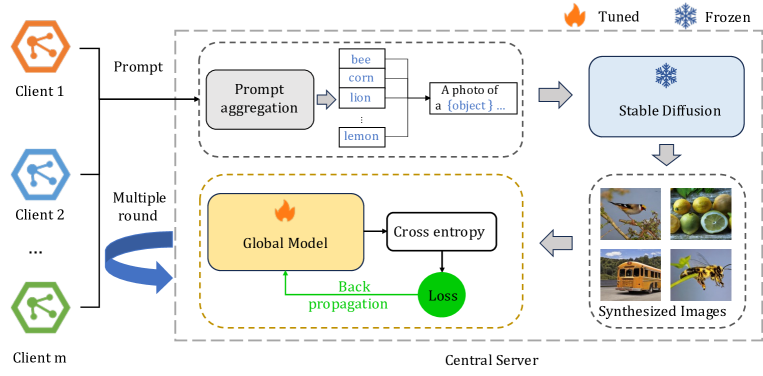
- Clients transmit only text prompts describing their local training data to the server, minimizing communication overhead.
- The server aggregates prompts from all clients and uses a pre-trained foundation generative model (e.g., Stable Diffusion) to synthesize a comprehensive substitute training dataset.
- A global model is trained on the synthesized dataset, which retains the semantic and distributional characteristics of the original data.
- The framework operates in a single communication round, drastically reducing training rounds compared to traditional FedAvg.
- Privacy is enhanced by avoiding transmission of raw data or gradients, and by leveraging the low memorization risk of modern diffusion models.
- The method is resilient to data distribution shifts because the server synthesizes data based on aggregated prompts, not raw data distributions.
Experimental results
Research questions
- RQ1Can federated learning be effectively achieved by transmitting only prompts instead of model parameters or gradients?
- RQ2To what extent does prompt-based federated learning reduce communication cost compared to conventional methods like FedAvg?
- RQ3How does the proposed method perform under data heterogeneity and distribution shift compared to existing federated learning baselines?
- RQ4What is the privacy risk of the synthesized data, and does the framework resist membership inference attacks and data memorization?
- RQ5Can the performance of the global model trained on synthesized data match or exceed that of centralized training on real data?
Key findings
- The proposed FGL framework reduces communication cost by 99.95% compared to FedAvg using ResNet18, transmitting only 229 bytes of prompts versus 42.7MB of gradients.
- On ImageNet and DomainNet, FGL achieves performance that exceeds FedAvg and even surpasses centralized training in some settings, with a 5-round FGL result outperforming centralized training on ImageSquawk.
- FGL demonstrates robustness to data heterogeneity, as it synthesizes data from aggregated prompts without relying on raw data distributions.
- Image retrieval and similarity analysis show no significant resemblance between synthetic images and original training data, indicating minimal memorization and low privacy leakage.
- Membership inference attack results show that the output distributions of member and non-member samples in FGL are significantly more similar than in FedAvg, reducing the risk of membership inference.
- The loss and confidence metrics for training members and non-members in FGL show a smaller discrepancy than in FedAvg, confirming stronger privacy preservation.
Read this paper
Open the full text in the Nubint reader and ask about any passage as you read.
Read this paper on NubintThis review was generated by AI from the original paper. Please check the paper before citing it.