
[Paper Review] Federated Learning for Intrusion Detection System: Concepts, Challenges and Future Directions
This paper proposes federated learning (FL) as a privacy-preserving solution for intrusion detection systems (IDS), enabling decentralized training of machine learning models across edge devices without sharing raw data. It reviews FL's application in anomaly detection, identifies key challenges like data heterogeneity, poisoning attacks, and resource constraints, and proposes solutions such as hierarchical clustering, blockchain integration, and lightweight models to enhance security, accuracy, and efficiency in FL-based IDS.
The rapid development of the Internet and smart devices trigger surge in network traffic making its infrastructure more complex and heterogeneous. The predominated usage of mobile phones, wearable devices and autonomous vehicles are examples of distributed networks which generate huge amount of data each and every day. The computational power of these devices have also seen steady progression which has created the need to transmit information, store data locally and drive network computations towards edge devices. Intrusion detection systems play a significant role in ensuring security and privacy of such devices. Machine Learning and Deep Learning with Intrusion Detection Systems have gained great momentum due to their achievement of high classification accuracy. However the privacy and security aspects potentially gets jeopardised due to the need of storing and communicating data to centralized server. On the contrary, federated learning (FL) fits in appropriately as a privacy-preserving decentralized learning technique that does not transfer data but trains models locally and transfers the parameters to the centralized server. The present paper aims to present an extensive and exhaustive review on the use of FL in intrusion detection system. In order to establish the need for FL, various types of IDS, relevant ML approaches and its associated issues are discussed. The paper presents detailed overview of the implementation of FL in various aspects of anomaly detection. The allied challenges of FL implementations are also identified which provides idea on the scope of future direction of research. The paper finally presents the plausible solutions associated with the identified challenges in FL based intrusion detection system implementation acting as a baseline for prospective research.
Motivation & Objective
- Address the growing need for secure, privacy-preserving intrusion detection in distributed, heterogeneous networks due to rising data volumes and device proliferation.
- Overcome privacy and security limitations of centralized machine learning in IDS by leveraging federated learning to train models without transmitting raw data.
- Identify and analyze key challenges in implementing FL for IDS, including data non-IID distribution, model poisoning, false alarms, and resource constraints in IoT devices.
- Propose practical solutions such as blockchain for secure aggregation, digital twins for trust, and lightweight models to improve robustness and scalability of FL-based IDS.
- Establish a foundation for future research by outlining unresolved issues and potential directions in federated intrusion detection systems.
Proposed method
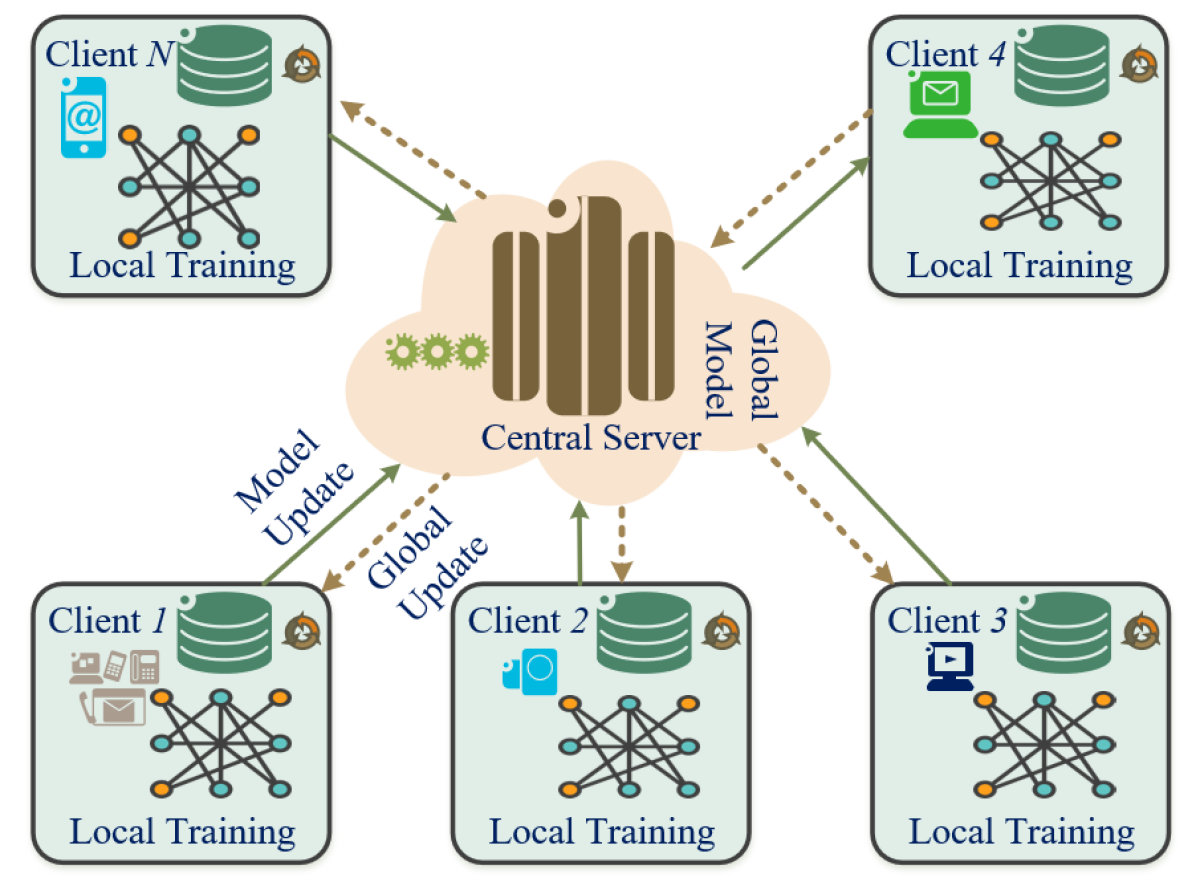
- Implement a federated learning framework where clients (edge devices) train local models on their private data and send only model parameters (weights) to a central server for global aggregation.
- Utilize local model updates and global model aggregation across multiple rounds to iteratively improve the centralized detection model without data sharing.
- Apply hierarchical clustering to group similar client model updates, reducing the impact of non-IID data and improving convergence and model homogeneity.
- Integrate blockchain technology to log and verify model updates, enabling secure, transparent, and tamper-resistant aggregation to resist poisoning attacks.
- Employ digital twin technology to simulate and validate model updates, ensuring only legitimate and intended updates are accepted during aggregation.
- Optimize resource usage in low-power IoT devices through lightweight deep learning models and efficient resource allocation techniques to support edge-based FL training.
Experimental results
Research questions
- RQ1How can federated learning be effectively applied to build privacy-preserving intrusion detection systems in distributed, heterogeneous networks?
- RQ2What are the major challenges in deploying FL-based IDS, particularly concerning data non-IID distribution, model poisoning, and false alarms?
- RQ3How do resource limitations in low-power IoT devices affect the feasibility and performance of federated intrusion detection?
- RQ4What mechanisms can enhance the security and reliability of FL-based IDS against adversarial attacks such as data poisoning and backdoor injection?
- RQ5What optimization and architectural strategies can improve convergence, reduce false positives, and ensure efficient deployment of FL in real-world IDS environments?
Key findings
- Federated learning enables high-accuracy intrusion detection without transferring sensitive data, significantly improving privacy and security over centralized learning approaches.
- Non-IID data distribution across clients leads to high model variance and convergence issues, resulting in increased false alarm rates in IDS.
- Data poisoning attacks can manipulate model updates to inject backdoors or degrade performance, threatening the integrity of the global model.
- Blockchain-based logging of model updates enhances trust and enables selective aggregation, reducing the risk of malicious updates.
- Hierarchical clustering of client model updates improves convergence and model quality by simulating data homogeneity in heterogeneous environments.
- Lightweight deep learning models and efficient resource management techniques are essential for deploying FL-based IDS on low-power IoT devices with limited computational capacity.
Read this paper
Open the full text in the Nubint reader and ask about any passage as you read.
Read this paper on NubintThis review was generated by AI from the original paper. Please check the paper before citing it.