
[Paper Review] Fermi-LAT GeV excess and muon $g-2$ in a modular $A_4$ symmetry
This paper proposes a modular $A_4$ symmetric model that simultaneously explains the Fermi-LAT GeV gamma-ray excess and the anomalous muon $g-2$ through a dark matter (DM) candidate that interacts exclusively with muons. The model achieves a sizable muon $g-2$ without lepton flavor violation by leveraging the symmetry's selection rules, and numerical scans show viable parameter regions consistent with Fermi-LAT, relic density, and $g-2$ measurements.
The recent measurement of muon anomalous magnetic dipole moment (muon $g-2$) suggests that there might exist new physics that dominantly interacts with muons. The observed gamma-ray excess from Fermi-LAT indicates that dark matter annihilates into a specific charged fermions. We propose a successful model simultaneously to explain the Fermi-LAT GeV gamma-ray excess and sizable muon $g-2$ with a modular $A_4$ symmetry. Due to nature of this symmetry, our DM only interacts with pairs of muon and we explain sizable muon $g-2$ without suffering from constraints of any lepton flavor violations. We numerically show our allowed spaces on each measurements of Fermi-LAT, relic density of DM and muon $g-2$, randomly scanning our input parameters.
Motivation & Objective
- To resolve the long-standing discrepancy in the muon anomalous magnetic moment ($g-2$) using a new physics model.
- To explain the Fermi-LAT GeV gamma-ray excess as arising from dark matter annihilation into muons.
- To construct a unified model that simultaneously accounts for both anomalies without introducing lepton flavor violation.
- To ensure dark matter stability via modular symmetry with non-zero modular weight, avoiding traditional $Z_2$-based stabilization.
- To identify viable parameter spaces that satisfy all three constraints: Fermi-LAT excess, relic density, and muon $g-2$
Proposed method
- Implementing a modular $A_4$ flavor symmetry to constrain Yukawa couplings, ensuring DM couples exclusively to muons.
- Assigning non-zero modular weights to the dark matter field to achieve stability via residual $Z_2$ symmetry at the $ au = i$ fixed point.
- Using a one-loop diagram involving a heavy charged lepton and a scalar to generate the muon $g-2$ contribution via chiral flip.
- Deriving the annihilation cross-section $\sigma v$ for $\chi\chi \to \mu^+\mu^-$ using the effective Lagrangian and matching to Fermi-LAT data.
- Computing the relic density $\Omega_{\rm DM}h^2$ using the standard thermal freeze-out formula with $x_F \approx 24$ and $g_* \approx 100$.
- Performing a random scan over parameters $y_E$, $s_E$, $m_1$, $m_2$ in the ranges $[0.01,1]$ and $[90,1000]$ GeV, respectively, to explore viable regions.
Experimental results
Research questions
- RQ1Can a single model explain both the Fermi-LAT GeV gamma-ray excess and the anomalous muon $g-2$ without introducing new flavor-changing processes?
- RQ2How does modular $A_4$ symmetry ensure that dark matter interacts only with muons, thereby suppressing lepton flavor violation?
- RQ3What parameter space allows the model to simultaneously satisfy the observed $g-2$ value, the Fermi-LAT annihilation cross-section, and the measured relic density?
- RQ4Can a dark matter candidate stabilized by modular symmetry with non-zero weight reproduce the correct thermal relic abundance?
- RQ5What is the role of the heavy charged lepton states in generating a sizable one-loop contribution to $\Delta a_\mu$?
Key findings
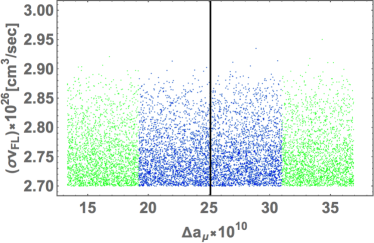
- The model successfully explains the Fermi-LAT GeV excess with an annihilation cross-section $(\sigma v)_{\rm FL} \times 10^{26} \approx 3.0 \sim 3.5$ cm³/s, consistent with the 2σ range of the observed excess.
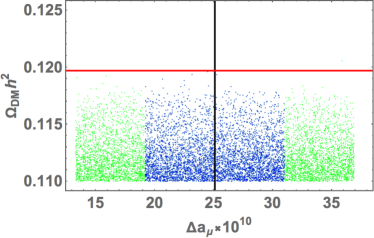
- The relic density $\Omega_{\rm DM}h^2$ is found to be within the 5σ interval $0.11 \leq \Omega_{\rm DM}h^2 \leq 0.13$, with a few points reaching the best-fit value of 0.1197.
- The model achieves a muon $g-2$ contribution $\Delta a_\mu \times 10^{10} \approx 25.1$ within the 1σ interval of the experimental value $(25.1 \pm 5.9) \times 10^{-10}$.
- The allowed parameter space shows that while no points satisfy the Fermi-LAT excess within 1σ, all points lie within the 2σ range.
- The model avoids lepton flavor violation due to the symmetry-protected selection rules, which forbid couplings to electrons or tauons.
- The dark matter mass is constrained to $m_\chi \approx 58_{-9}^{+11}$ GeV at 1σ, consistent with the Planck measurement.
Read this paper
Open the full text in the Nubint reader and ask about any passage as you read.
Read this paper on NubintThis review was generated by AI from the original paper. Please check the paper before citing it.