
[Paper Review] First Direct Observation of Collider Neutrinos with FASER at the LHC
This paper reports the first direct observation of neutrinos produced in proton-proton collisions at the LHC using the FASERν detector, which captures charged-current interactions in a tungsten-emulsion target. The experiment identifies 153⁺¹³₋₁₂ neutrino events, primarily from μ̄ₘu and μₘu interactions, with reconstructed energies exceeding 200 GeV, marking the dawn of collider neutrino physics.
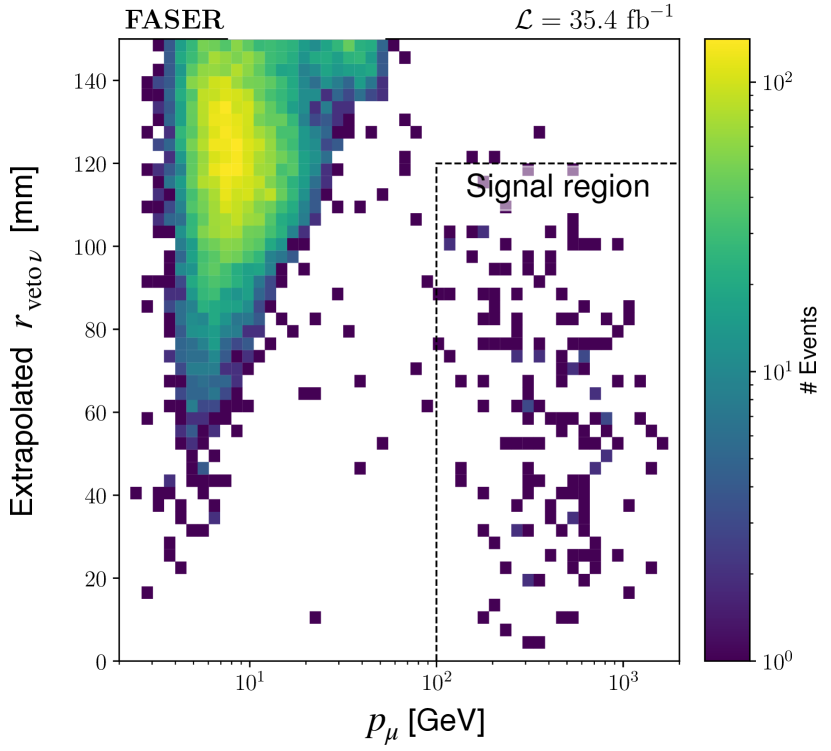
We report the first direct observation of neutrino interactions at a particle collider experiment. Neutrino candidate events are identified in a 13.6 TeV center-of-mass energy $pp$ collision data set of 35.4 fb${}^{-1}$ using the active electronic components of the FASER detector at the Large Hadron Collider. The candidates are required to have a track propagating through the entire length of the FASER detector and be consistent with a muon neutrino charged-current interaction. We infer $153^{+12}_{-13}$ neutrino interactions with a significance of 16 standard deviations above the background-only hypothesis. These events are consistent with the characteristics expected from neutrino interactions in terms of secondary particle production and spatial distribution, and they imply the observation of both neutrinos and anti-neutrinos with an incident neutrino energy of significantly above 200 GeV.
Motivation & Objective
- To directly detect neutrinos produced in high-energy proton-proton collisions at the LHC, a regime previously inaccessible to direct observation.
- To validate the existence and properties of high-energy neutrinos from QCD and electroweak processes in a collider environment.
- To establish a new experimental frontier in neutrino physics by measuring neutrino interactions at energies far exceeding those of terrestrial reactors or accelerators.
- To demonstrate the feasibility of using compact, high-granularity detectors like FASERν to study rare, high-energy neutrino interactions in a collider setting.
Proposed method
- Utilizes the FASERν detector, a dedicated neutrino subdetector installed in the FASER experiment at the LHC, composed of a tungsten-emulsion target and a scintillator tracker (IFT) for particle identification.
- Employs charged-current (CC) neutrino interactions in the tungsten target to produce detectable muons, with signal selection based on track reconstruction and cluster counting in the IFT.
- Applies a data-driven analysis strategy that relies on reconstructed track properties—such as charge-to-momentum ratio (q/pₘᵤ), polar angle (θₘᵤ), and number of IFT clusters—without requiring detailed detector simulation for signal identification.
- Compares observed distributions to Monte Carlo simulations using GENIE for neutrino interactions and to control samples of muon-like background events (n₂ category) from non-neutrino sources.
- Uses luminosity-scaled simulations to estimate signal efficiency and energy transfer, finding that >80% of incident neutrino momentum is transferred to the final-state muon.
- Employs FLUKA simulations to model muon fluence along the line-of-sight, supporting background estimation and signal validation.

Experimental results
Research questions
- RQ1Can neutrinos produced in high-energy proton-proton collisions at the LHC be directly observed using a compact, dedicated detector like FASERν?
- RQ2What are the kinematic and topological properties of collider neutrinos, and how do they distinguish from muon backgrounds in the detector?
- RQ3To what extent is the momentum of the final-state muon a reliable proxy for the incident neutrino energy in collider neutrino interactions?
- RQ4Can the FASERν detector resolve the presence of anti-neutrinos through charge-sign identification of reconstructed muon tracks?
- RQ5What is the energy scale of the observed neutrino interactions, and do they exceed the thresholds of previous neutrino experiments?
Key findings
- The FASERν experiment reports the first direct observation of neutrinos from a collider, detecting 153⁺¹³₋₁₂ events from charged-current interactions of νₘᵤ and ν̄ₘᵤ in the tungsten-emulsion target.
- The spatial distribution and track properties of the signal events—particularly the number of IFT clusters and charge-to-momentum ratio (q/pₘᵤ)—are consistent with neutrino interactions and distinct from muon-like backgrounds.
- The reconstructed charge of the muon tracks confirms the presence of anti-neutrinos, with 40 positively charged muon candidates observed, indicating ν̄ₘᵤ interactions.
- The reconstructed muon momentum implies that the incident neutrinos have energies significantly above 200 GeV, with >80% of the neutrino momentum transferred to the final-state muon on average.
- The observed signal distribution in IFT cluster count, polar angle, and q/pₘᵤ shows excellent agreement with GENIE simulations, validating the analysis strategy independently of detector simulation quality.
- The analysis strategy is robust and does not rely on detailed modeling of detector effects, enhancing confidence in the signal identification.
Read this paper
Open the full text in the Nubint reader and ask about any passage as you read.
Read this paper on NubintThis review was generated by AI from the original paper. Please check the paper before citing it.