
[Paper Review] FoodSky: A Food-oriented Large Language Model that Passes the Chef and Dietetic Examination
FoodSky is a domain-specific large language model (LLM) fine-tuned for food and dietetics, leveraging a comprehensive Chinese food corpus (FoodEarth) and novel architectures—Topic-based Selective State Space Model (TS3M) and Hierarchical Topic Retrieval Augmented Generation (HTRAG)—to enhance food-specific reasoning and generation. It achieves 67.2% and 66.4% accuracy on the Chinese National Chef Exam and National Dietetic Exam, respectively, outperforming general-purpose LLMs.
Food is foundational to human life, serving not only as a source of nourishment but also as a cornerstone of cultural identity and social interaction. As the complexity of global dietary needs and preferences grows, food intelligence is needed to enable food perception and reasoning for various tasks, ranging from recipe generation and dietary recommendation to diet-disease correlation discovery and understanding. Towards this goal, for powerful capabilities across various domains and tasks in Large Language Models (LLMs), we introduce Food-oriented LLM FoodSky to comprehend food data through perception and reasoning. Considering the complexity and typicality of Chinese cuisine, we first construct one comprehensive Chinese food corpus FoodEarth from various authoritative sources, which can be leveraged by FoodSky to achieve deep understanding of food-related data. We then propose Topic-based Selective State Space Model (TS3M) and the Hierarchical Topic Retrieval Augmented Generation (HTRAG) mechanism to enhance FoodSky in capturing fine-grained food semantics and generating context-aware food-relevant text, respectively. Our extensive evaluations demonstrate that FoodSky significantly outperforms general-purpose LLMs in both chef and dietetic examinations, with an accuracy of 67.2% and 66.4% on the Chinese National Chef Exam and the National Dietetic Exam, respectively. FoodSky not only promises to enhance culinary creativity and promote healthier eating patterns, but also sets a new standard for domain-specific LLMs that address complex real-world issues in the food domain. An online demonstration of FoodSky is available at http://222.92.101.211:8200.
Motivation & Objective
- To develop a domain-specific LLM tailored for complex food and dietetic reasoning tasks in the Chinese context.
- To address the gap in existing LLMs for culinary and nutritional applications by integrating cultural, dietary, and medical knowledge.
- To enhance fine-grained food semantics and context-aware generation through novel architecture and data curation.
- To demonstrate superior performance on standardized exams in food and dietetics compared to general-purpose LLMs.
- To provide a publicly accessible, open-source foundation model for food intelligence applications.
Proposed method
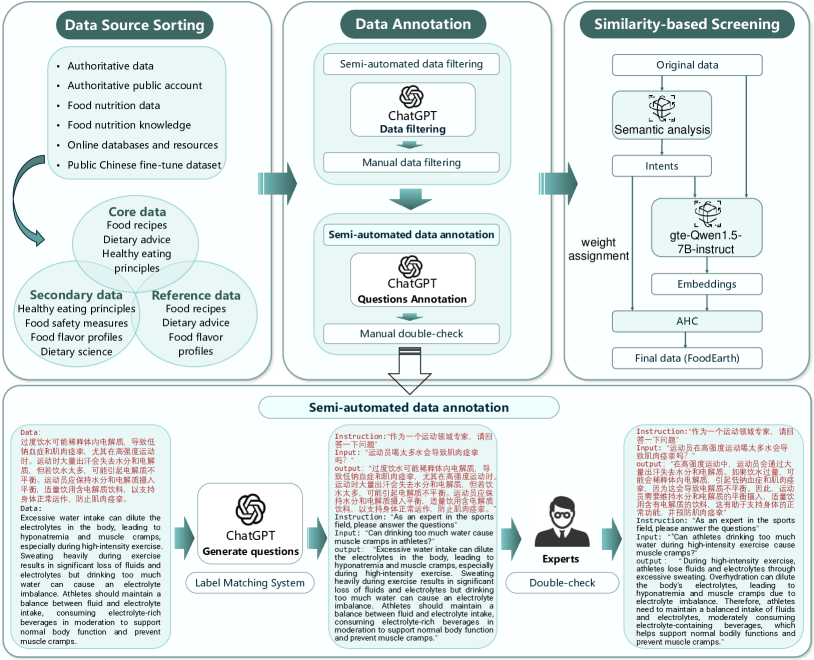
- Construction of FoodEarth, a comprehensive Chinese food corpus compiled from authoritative sources including culinary, nutritional, and medical databases.
- Design of the Topic-based Selective State Space Model (TS3M) to capture hierarchical and fine-grained food semantics through topic-aware state space mechanisms.
- Development of Hierarchical Topic Retrieval Augmented Generation (HTRAG) to retrieve relevant topic-specific knowledge before text generation, improving factual consistency and relevance.
- Instruction tuning of FoodSky using curated Chinese instruction datasets from multiple sources, including GPT-4, MOSS, and BELLE, with food-specific keyword filtering.
- Integration of retrieval-augmented generation with hierarchical topic structures to enhance reasoning over complex dietary and culinary queries.
- Evaluation on standardized national exams in chef and dietetics to benchmark real-world performance.
Experimental results
Research questions
- RQ1Can a food-specific LLM achieve expert-level performance on national culinary and dietetic examinations?
- RQ2How does topic-aware retrieval and generation improve factual accuracy and relevance in food-related reasoning tasks?
- RQ3To what extent does a curated, domain-specific corpus enhance reasoning capabilities compared to generalist LLMs?
- RQ4How does the TS3M architecture improve fine-grained semantic modeling of food and nutrition concepts?
- RQ5Can a retrieval-augmented generation framework effectively support complex, context-sensitive dietary recommendations?
Key findings
- FoodSky achieved 67.2% accuracy on the Chinese National Chef Exam, significantly outperforming general-purpose LLMs.
- FoodSky achieved 66.4% accuracy on the National Dietetic Exam, demonstrating strong performance in clinical and nutritional reasoning.
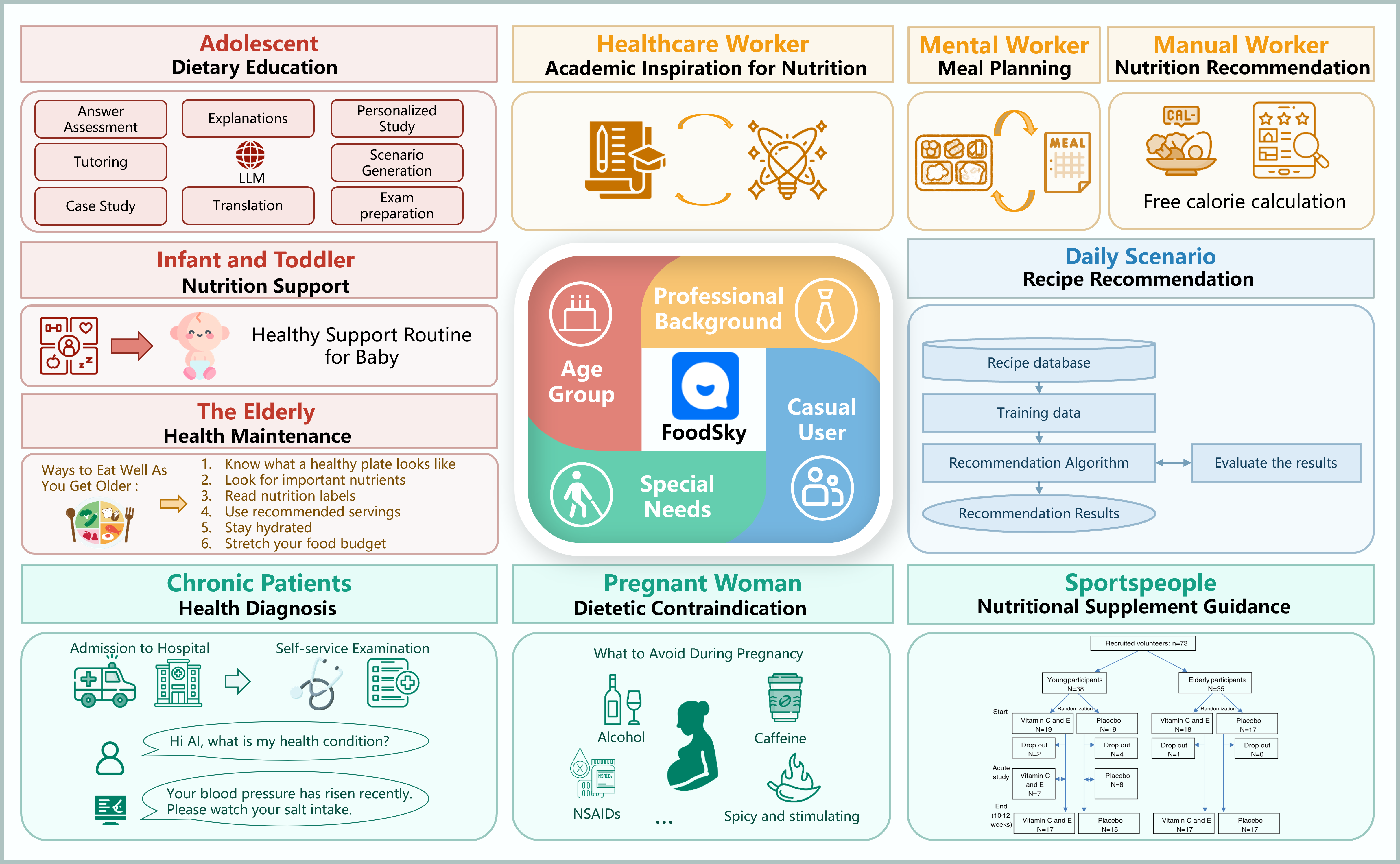
- The HTRAG mechanism improved response relevance and factual consistency across diverse user groups, including patients, pregnant women, and the elderly.
- FoodSky provided more concise and precise answers than baseline models across all user group categories in qualitative evaluations.
- The TS3M architecture enhanced modeling of fine-grained food semantics, particularly in multi-domain contexts involving cuisine, nutrition, and health.
- The model’s performance on standardized exams confirms its capability to handle complex, real-world food and dietetic reasoning tasks.
Read this paper
Open the full text in the Nubint reader and ask about any passage as you read.
Read this paper on NubintThis review was generated by AI from the original paper. Please check the paper before citing it.