
[Paper Review] Found in the Middle: Permutation Self-Consistency Improves Listwise Ranking in Large Language Models
This paper proposes permutation self-consistency, a decoding method that reduces positional bias in large language models (LLMs) during listwise ranking by shuffling input lists multiple times, generating diverse rankings, and aggregating them into a central ranking via Kemeny optimization. The method improves ranking accuracy by up to 18% on passage reranking tasks, setting a new state of the art for GPT-3.5 and LLaMA v2 (70B) without requiring model internals.
Large language models (LLMs) exhibit positional bias in how they use context, which especially complicates listwise ranking. To address this, we propose permutation self-consistency, a form of self-consistency over ranking list outputs of black-box LLMs. Our key idea is to marginalize out different list orders in the prompt to produce an order-independent ranking with less positional bias. First, given some input prompt, we repeatedly shuffle the list in the prompt and pass it through the LLM while holding the instructions the same. Next, we aggregate the resulting sample of rankings by computing the central ranking closest in distance to all of them, marginalizing out prompt order biases in the process. Theoretically, we prove the robustness of our method, showing convergence to the true ranking in the presence of random perturbations. Empirically, on five list-ranking datasets in sorting and passage reranking, our approach improves scores from conventional inference by up to 7-18% for GPT-3.5 and 8-16% for LLaMA v2 (70B), surpassing the previous state of the art in passage reranking. Our code is at https://github.com/castorini/perm-sc.
Motivation & Objective
- To address positional bias in LLMs during listwise ranking, where model outputs depend on input list order and item placement.
- To improve the consistency and robustness of black-box LLMs in ranking tasks without requiring access to model internals.
- To develop a decoding strategy that is invariant to prompt order while maintaining high ranking quality.
- To empirically validate the method across diverse list-ranking tasks, including passage reranking and sorting.
- To theoretically analyze the method's robustness to noise and convergence to the true ranking under certain conditions.
Proposed method
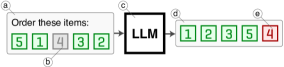
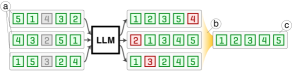
- The method generates multiple rankings by repeatedly shuffling the input list while keeping the instruction fixed, creating diverse outputs from the same LLM.
- It uses the Kemeny ranking method to compute the central ranking that minimizes the Kendall tau distance to all generated rankings.
- The aggregation process marginalizes out prompt-order biases by finding the consensus ranking across multiple shuffled inputs.
- The approach is order-invariant and does not require model fine-tuning or access to hidden representations.
- It leverages self-consistency over permutations of the input list, treating each shuffle as an independent sample.
- The method is computationally efficient and parallelizable, with aggregation time independent of the number of samples.
Experimental results
Research questions
- RQ1Can permutation self-consistency reduce positional bias in LLMs during listwise ranking tasks?
- RQ2How effective is the method in improving ranking accuracy across diverse datasets and LLMs?
- RQ3What is the impact of the number of shuffled samples on performance gain?
- RQ4Does the method maintain robustness under arbitrary noise distributions in ranking outputs?
- RQ5How does the method compare to existing approaches in terms of consistency and prompt-order invariance?
Key findings
- Permutation self-consistency improves ranking scores by up to 18% on passage reranking tasks for GPT-3.5 and up to 16% for LLaMA v2 (70B).
- The method sets a new state of the art on TREC-DL19 and TREC-DL20 passage ranking benchmarks.
- With 20 shuffled samples, the method achieves 67% of the maximum performance gain observed with 20 samples, indicating rapid convergence.
- Sampling temperature has minimal impact on performance, unlike in chain-of-thought reasoning, suggesting no need for exploration in listwise ranking.
- The method is robust to noise and converges to the true ranking under arbitrary fixed noise distributions with sufficient samples and at least one correct pair per observation.
- The Kemeny aggregation method effectively reduces positional bias, especially mitigating 'lost-in-the-middle' effects common in LLMs.
Read this paper
Open the full text in the Nubint reader and ask about any passage as you read.
Read this paper on NubintThis review was generated by AI from the original paper. Please check the paper before citing it.