
[Paper Review] Fourier Neural Operator Surrogate Model to Predict 3D Seismic Waves Propagation
This paper proposes a 3D Fourier Neural Operator (FNO) surrogate model using a U-shaped architecture (UNO) to predict seismic ground motion from 3D geological structures, mapping subsurface heterogeneity to time-series velocity outputs. Trained on 30,000 high-fidelity SEM3D simulations, the model achieves high accuracy in wave arrival times and phase prediction, with 92% of phase Goodness-of-Fit (GOF) scores above 8, despite underestimating peak amplitudes.
With the recent rise of neural operators, scientific machine learning offers new solutions to quantify uncertainties associated with high-fidelity numerical simulations. Traditional neural networks, such as Convolutional Neural Networks (CNN) or Physics-Informed Neural Networks (PINN), are restricted to the prediction of solutions in a predefined configuration. With neural operators, one can learn the general solution of Partial Differential Equations, such as the elastic wave equation, with varying parameters. There have been very few applications of neural operators in seismology. All of them were limited to two-dimensional settings, although the importance of three-dimensional (3D) effects is well known. In this work, we apply the Fourier Neural Operator (FNO) to predict ground motion time series from a 3D geological description. We used a high-fidelity simulation code, SEM3D, to build an extensive database of ground motions generated by 30,000 different geologies. With this database, we show that the FNO can produce accurate ground motion even when the underlying geology exhibits large heterogeneities. Intensity measures at moderate and large periods are especially well reproduced. We present the first seismological application of Fourier Neural Operators in 3D. Thanks to the generalizability of our database, we believe that our model can be used to assess the influence of geological features such as sedimentary basins on ground motion, which is paramount to evaluating site effects.
Motivation & Objective
- To develop a generalizable deep learning surrogate model for 3D elastic wave propagation in heterogeneous geologies.
- To overcome the limitations of traditional neural networks that cannot generalize across varying geological parameters.
- To enable efficient uncertainty quantification in seismic hazard assessment by replacing computationally expensive simulations.
- To validate the feasibility and accuracy of Fourier Neural Operators in 3D seismological problems, particularly for complex geological heterogeneities.
- To demonstrate that predicting all three velocity components simultaneously improves model generalization and performance.
Proposed method
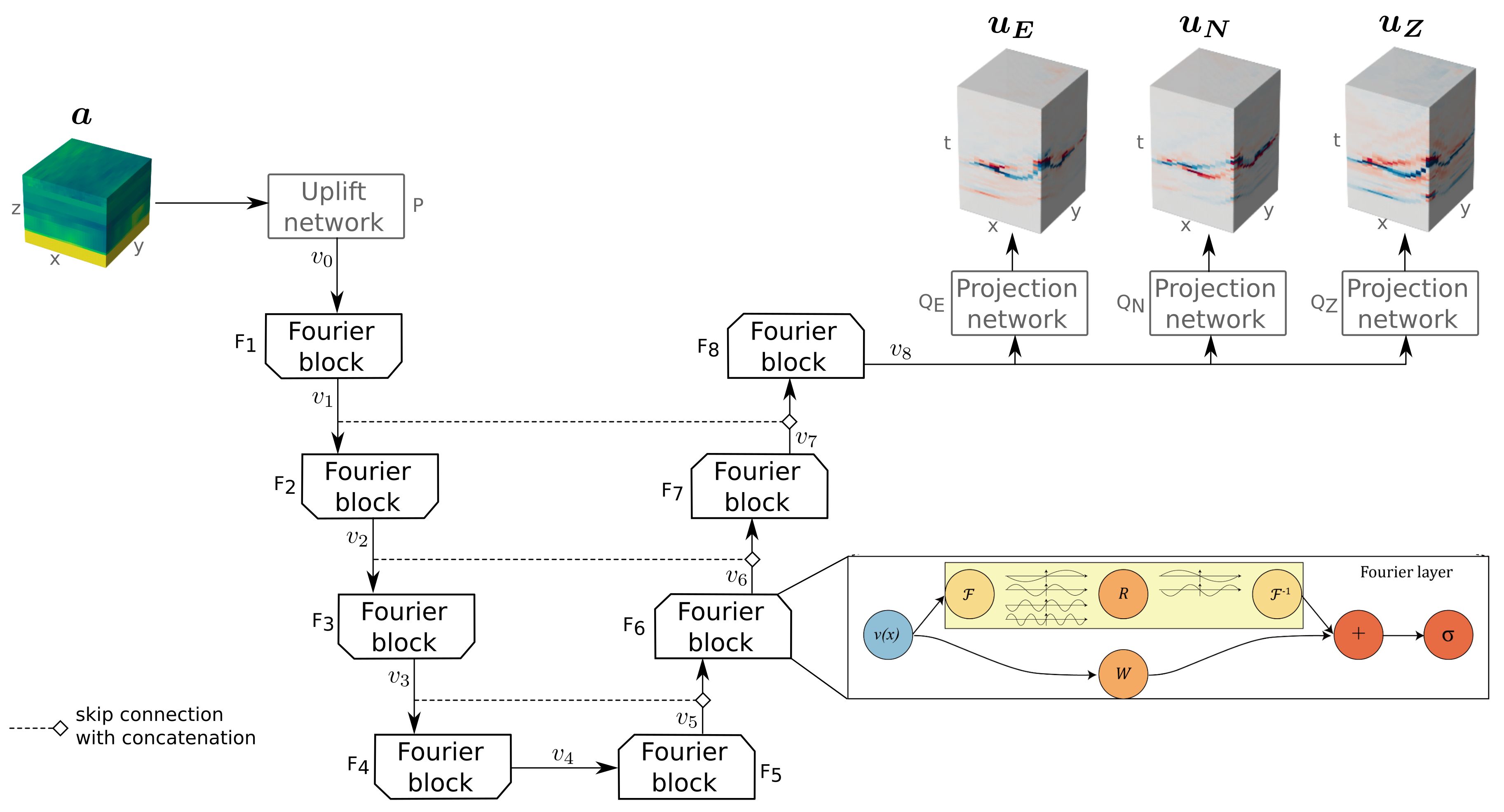
- The model uses a U-shaped Neural Operator (UNO) architecture with ten layers to learn the solution operator of the 3D elastic wave equation.
- The input is a 3D S-wave velocity field representing geological heterogeneity, and the output is 3-component ground velocity time series across multiple sensors.
- The method maps the depth dimension of the geological input to the time dimension of the output, effectively converting a 4D problem (3D space + time) into a manageable 3D input-output mapping.
- The model is trained on a dataset of 30,000 unique 3D geologies generated via random fields and simulated using the high-fidelity SEM3D spectral element code.
- The loss function is minimized using a combination of time-domain and frequency-domain regularization, with attention to phase and envelope fidelity.
- The model incorporates Fourier feature embeddings and learns to represent spatial and temporal dependencies through learned spectral convolutions in the frequency domain.
Experimental results
Research questions
- RQ1Can a Fourier Neural Operator generalize across diverse 3D geological structures to predict full 3D ground motion time series?
- RQ2How accurately can the FNO predict wave arrival times and phases in the presence of strong geological heterogeneities?
- RQ3Does predicting all three velocity components simultaneously improve model generalization compared to single-component prediction?
- RQ4To what extent does the model preserve high-frequency content, and where does it fail in amplitude representation?
- RQ5Can the surrogate model reduce computational cost while maintaining sufficient accuracy for uncertainty quantification in seismic hazard analysis?
Key findings
- The UNO model achieves a Goodness-of-Fit (GOF) score above 8 for phase prediction in 92% of sensor locations, indicating high accuracy in wave arrival time prediction.
- The envelope GOF score exceeds 6 for 95% of the time series, confirming reliable reproduction of overall signal energy and shape.
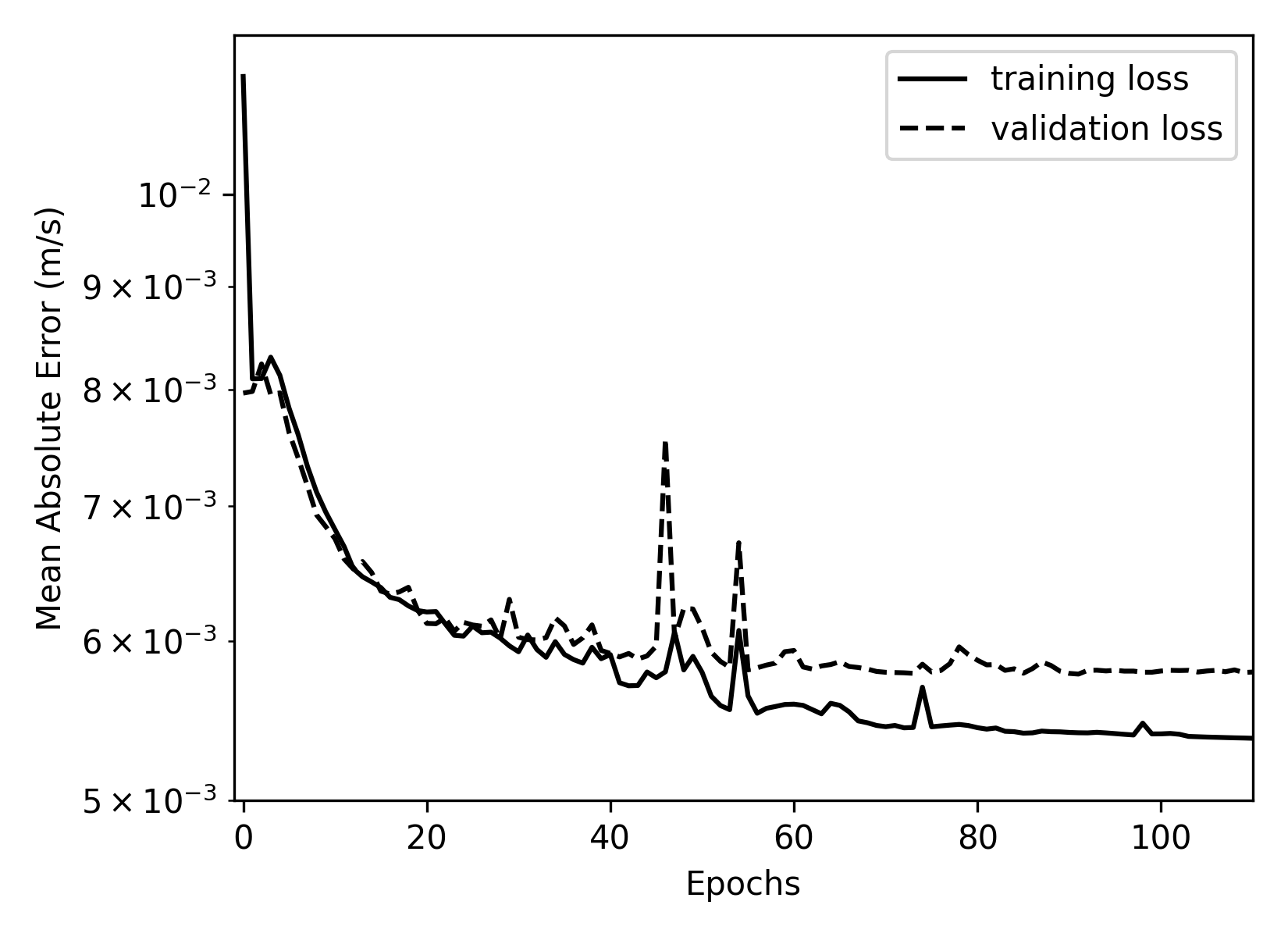
- Despite accurate phase prediction, peak amplitudes are systematically underestimated, particularly above 1 Hz, indicating limitations in high-frequency amplitude modeling.
- The amplitude decay slope in the Fourier domain closely matches the reference signal, suggesting no artificial filtering but reduced high-frequency resolution.
- Training on all three velocity components simultaneously improved generalization, likely due to increased effective training data without significant parameter growth.
- The model generalizes well to unseen geologies with strong heterogeneities, such as sedimentary basins, demonstrating potential for site effect assessment.
Read this paper
Open the full text in the Nubint reader and ask about any passage as you read.
Read this paper on NubintThis review was generated by AI from the original paper. Please check the paper before citing it.