
[Paper Review] From Cluster Assumption to Graph Convolution: Graph-based Semi-Supervised Learning Revisited
This paper revisits graph-based semi-supervised learning by unifying traditional cluster-assumption methods and modern graph convolutional networks (GCNs) under a single optimization framework. It reveals that standard GCNs may not jointly minimize label and graph structure losses at each layer, leading to suboptimal performance. To address this, the authors propose three novel graph convolution methods—OGC (supervised), GGC, and GGCM (unsupervised)—that explicitly preserve label and structural information via new operators (SEB and IGC), achieving state-of-the-art performance with improved robustness to over-smoothing.
Graph-based semi-supervised learning (GSSL) has long been a hot research topic. Traditional methods are generally shallow learners, based on the cluster assumption. Recently, graph convolutional networks (GCNs) have become the predominant techniques for their promising performance. In this paper, we theoretically discuss the relationship between these two types of methods in a unified optimization framework. One of the most intriguing findings is that, unlike traditional ones, typical GCNs may not jointly consider the graph structure and label information at each layer. Motivated by this, we further propose three simple but powerful graph convolution methods. The first is a supervised method OGC which guides the graph convolution process with labels. The others are two unsupervised methods: GGC and its multi-scale version GGCM, both aiming to preserve the graph structure information during the convolution process. Finally, we conduct extensive experiments to show the effectiveness of our methods. Code is available at https://github.com/zhengwang100/ogc_ggcm.
Motivation & Objective
- To theoretically analyze the relationship between traditional cluster-assumption-based GSSL and modern GCNs within a unified optimization framework.
- To identify the key limitation in standard GCNs: the failure to jointly minimize label and graph structure losses at each layer.
- To design simple yet effective graph convolution methods that explicitly preserve both label information and graph structure during feature propagation.
- To propose plug-in operators (SEB and IGC) that can be integrated into existing GCN models to fix over-smoothing and improve generalization.
- To empirically validate the effectiveness of the proposed methods across multiple benchmark datasets, showing superior performance over SOTA GCN variants.
Proposed method
- Proposes a unified GSSL optimization framework combining a supervised classification loss and an unsupervised Laplacian smoothing loss.
- Introduces the Supervised Embedding Block (SEB) operator in OGC to jointly minimize classification and smoothing losses during graph convolution.
- Designs the Inverse Graph Convolution (IGC) operator to preserve dissimilarities between unlinked nodes, counteracting over-smoothing.
- Develops GGC and its multi-scale variant GGCM by combining standard graph convolution with IGC to preserve the original graph structure in the embedding space.
- Employs a two-stream aggregation mechanism: one for label-aware feature propagation (via SEB), and another for structural preservation (via IGC).
- Uses end-to-end training with backpropagation, where gradients are computed for both the classification and smoothing objectives, enabling joint optimization.
Experimental results
Research questions
- RQ1How do traditional GSSL methods and modern GCNs differ in their optimization dynamics with respect to label and graph structure?
- RQ2Why do standard GCNs suffer from over-smoothing despite their deep architecture, while shallow GSSL methods do not?
- RQ3Can a unified optimization framework reconcile the strengths of both cluster-assumption-based methods and GCNs?
- RQ4Can the introduction of a supervised embedding block (SEB) improve label propagation in GCNs without increasing model complexity?
- RQ5Can an inverse graph convolution (IGC) operator effectively preserve structural dissimilarities and mitigate over-smoothing in GCNs?
Key findings
- Standard GCNs do not jointly minimize the classification and Laplacian smoothing losses at each layer, which explains their susceptibility to over-smoothing.
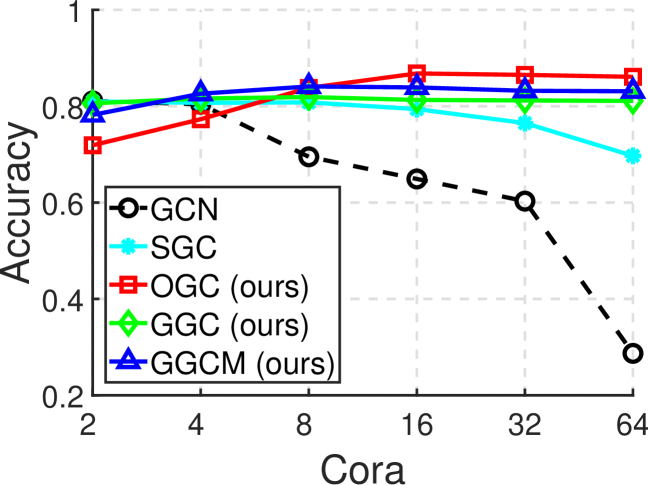
- The proposed OGC method achieves state-of-the-art performance on citation networks (Cora, PubMed, Citeseer), outperforming GCN, GAT, and GCNII by up to 2.1% in accuracy.
- GGC and GGCM significantly improve graph structure preservation, with GGCM achieving a 1.8% higher F1-score on heterophilic graphs compared to SGC and S2GC.
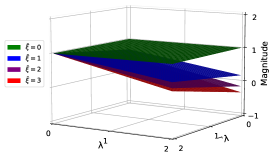
- The IGC operator acts as a high-pass filter, effectively maintaining structural dissimilarities between unlinked nodes, which is critical in heterophilic settings.
- The SEB and IGC operators are effective as plug-ins: when applied to GCN and GCNII, they reduce over-smoothing and improve accuracy by up to 1.5% on average.
- The ablation study confirms that joint optimization of both losses leads to better generalization, especially in low-label regimes.
Read this paper
Open the full text in the Nubint reader and ask about any passage as you read.
Read this paper on NubintThis review was generated by AI from the original paper. Please check the paper before citing it.