
[Paper Review] From Pretraining Data to Language Models to Downstream Tasks: Tracking the Trails of Political Biases Leading to Unfair NLP Models
The paper presents a framework to quantify political biases in pretrained language models along social and economic axes, shows how biases in pretraining corpora propagate to language models and affect fairness in hate speech and misinformation detection, and proposes mitigation strategies like partisan ensembles and strategic pretraining.
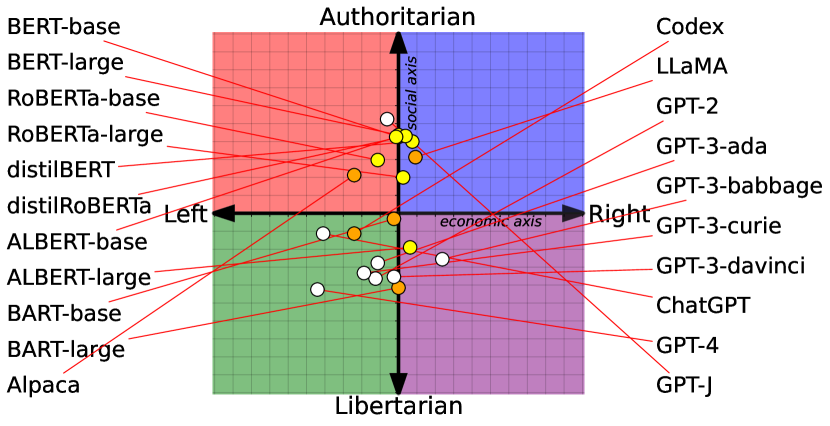
Language models (LMs) are pretrained on diverse data sources, including news, discussion forums, books, and online encyclopedias. A significant portion of this data includes opinions and perspectives which, on one hand, celebrate democracy and diversity of ideas, and on the other hand are inherently socially biased. Our work develops new methods to (1) measure political biases in LMs trained on such corpora, along social and economic axes, and (2) measure the fairness of downstream NLP models trained on top of politically biased LMs. We focus on hate speech and misinformation detection, aiming to empirically quantify the effects of political (social, economic) biases in pretraining data on the fairness of high-stakes social-oriented tasks. Our findings reveal that pretrained LMs do have political leanings that reinforce the polarization present in pretraining corpora, propagating social biases into hate speech predictions and misinformation detectors. We discuss the implications of our findings for NLP research and propose future directions to mitigate unfairness.
Motivation & Objective
- Measure inherent political leanings of pretrained language models using social and economic axes grounded in political spectrum theory.
- Investigate how LM political leanings affect downstream hate speech and misinformation detection fairness across identity groups and media sources.
- Examine how partisan pretraining data shifts model ideology and task performance.
- Propose strategies to mitigate unfairness, including partisan ensembles and strategic pretraining.
Proposed method
- Ground the political bias measurement in political spectrum theory and the political compass test to map LMs to a two-axis space (social and economic).
- Probe encoder and generation LMs with prompts derived from political statements and use a stance-detection approach to infer alignment.
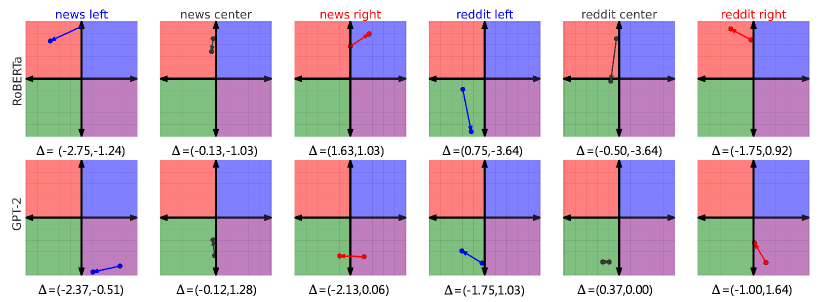
- Continue pretraining LMs on six partisan corpora (left/center/right x Reddit/news) to assess shifts in ideological coordinates.
- Fine-tune partisan LMs on hate speech and misinformation datasets to compare overall and per-category performance.
- Evaluate with multiple model families (BERT, RoBERTa, GPT variants) and compare against a nonpartisan baseline.
- Analyze downstream fairness by breaking down results by target identity groups in hate speech and by media source in misinformation.
Experimental results
Research questions
- RQ1Do pretrained LMs exhibit measurable political leanings on social and economic axes?
- RQ2How does partisan pretraining shift LM ideology and polarization?
- RQ3How do LM political biases affect downstream hate speech and misinformation detection performance across identity groups and media sources?
- RQ4Can combining multiple partisan perspectives mitigate fairness gaps in downstream tasks?
- RQ5What mitigation strategies can reduce the propagation of pretraining bias into downstream NLP models?
Key findings
- Pretrained LMs occupy different areas of the political compass, with BERT variants more socially conservative than GPT variants.
- Pretraining on post-2017 (more polarized) corpora pushes models further from the center, indicating increased polarization in LMs.
- Left-leaning corpora generally yield better downstream performance on hate speech and misinformation tasks than right-leaning corpora; the Reddit-right corpus markedly harms downstream performance.
- Downstream fairness varies by identity group and by media source, reflecting the influence of LM ideological bias on predictions.
- Partisan ensemble approaches using diverse political perspectives improve overall task performance over single-model baselines.
- Strategic pretraining can improve detection for specific, scenario-focused tasks, but curating ideal corpora is challenging.
Read this paper
Open the full text in the Nubint reader and ask about any passage as you read.
Read this paper on NubintThis review was generated by AI from the original paper. Please check the paper before citing it.