
[Paper Review] Fundamental charges for dual-unitary circuits
This paper establishes a one-to-one correspondence between width-$w$ conserved charges and width-$w$ solitons in 1+1D dual-unitary quantum circuits, showing that such charges must propagate at the effective speed of light as right- or left-moving solitons. The key result is that all conserved densities in these circuits are fundamentally tied to solitonic excitations, with explicit constructions provided via product states and fermionic Jordan-Wigner transformations, particularly in qubit systems (d=2).
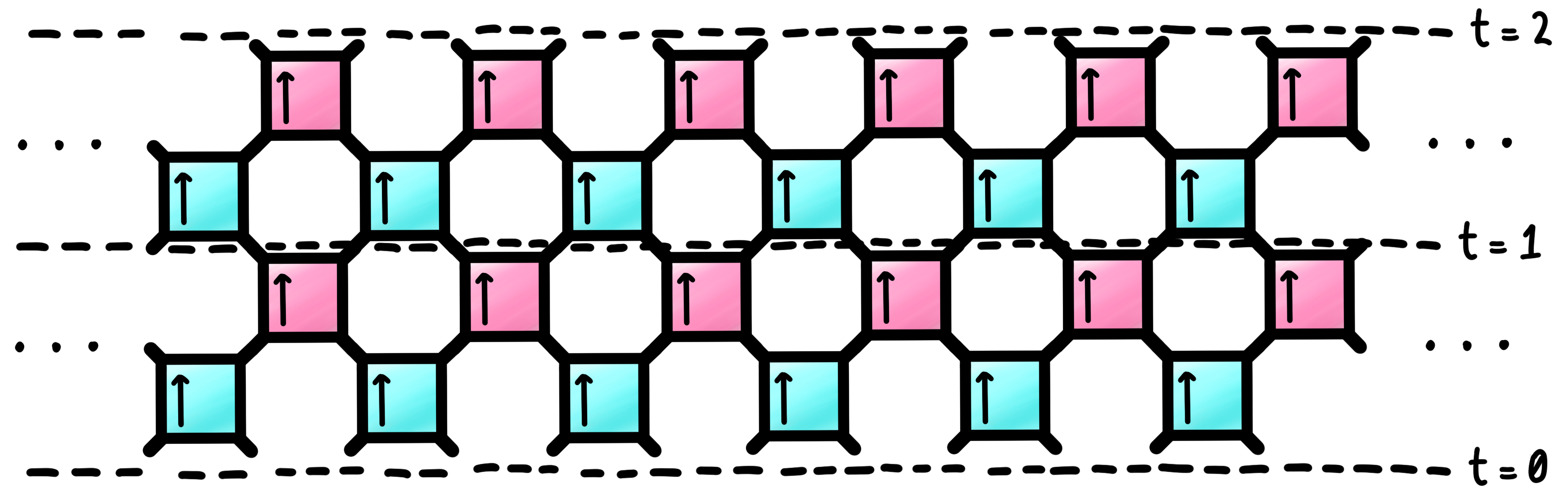
Dual-unitary quantum circuits have recently attracted attention as an analytically tractable model of many-body quantum dynamics. Consisting of a 1+1D lattice of 2-qudit gates arranged in a 'brickwork' pattern, these models are defined by the constraint that each gate must remain unitary under swapping the roles of space and time. This dual-unitarity restricts the dynamics of local operators in these circuits: the support of any such operator must grow at the effective speed of light of the system, along one or both of the edges of a causal light cone set by the geometry of the circuit. Using this property, it is shown here that for 1+1D dual-unitary circuits the set of width-$w$ conserved densities (constructed from operators supported over $w$ consecutive sites) is in one-to-one correspondence with the set of width-$w$ solitons - operators which, up to a multiplicative phase, are simply spatially translated at the effective speed of light by the dual-unitary dynamics. A number of ways to construct these many-body solitons (explicitly in the case where the local Hilbert space dimension $d=2$) are then demonstrated: firstly, via a simple construction involving products of smaller, constituent solitons; and secondly, via a construction which cannot be understood as simply in terms of products of smaller solitons, but which does have a neat interpretation in terms of products of fermions under a Jordan-Wigner transformation. This provides partial progress towards a characterisation of the microscopic structure of complex many-body solitons (in dual-unitary circuits on qubits), whilst also establishing a link between fermionic models and dual-unitary circuits, advancing our understanding of what kinds of physics can be explored in this framework.
Motivation & Objective
- To characterize the microscopic structure of many-body conserved charges in dual-unitary circuits.
- To determine whether conserved charges in dual-unitary circuits can exist beyond simple solitonic excitations.
- To explore connections between fermionic models and dual-unitary circuits via Jordan-Wigner transformations.
- To investigate whether solitons in dual-unitary circuits on qubits (d=2) are fully classified by specific product or fermionic constructions.
- To understand the implications of this charge-soliton correspondence for non-ergodic dynamics and potential applications in CFT and topological phases.
Proposed method
- Leveraging the dual-unitarity constraint, which ensures gates are unitary in both space and time directions, to enforce light-cone dynamics with ballistic operator growth.
- Using the causal structure of the brickwork circuit to show that conserved charges of width $w$ must correspond to operators that are spatially translated at the effective speed of light.
- Constructing solitons explicitly for qubit systems (d=2) via products of smaller solitons, demonstrating their role as conserved densities.
- Introducing a second construction method based on Jordan-Wigner transformations, revealing a fermionic interpretation of non-product solitons.
- Applying theorems from operator dynamics and light-cone propagation to prove that all conserved charges in dual-unitary circuits are necessarily solitonic.
- Analyzing the implications of these constructions for the existence of non-ergodic dynamics and the structure of conserved quantities in finite systems.
Experimental results
Research questions
- RQ1Are all conserved charges in 1+1D dual-unitary circuits necessarily associated with solitonic excitations that propagate at the effective speed of light?
- RQ2Can all width-$w$ solitons in dual-unitary circuits on qubits (d=2) be constructed either as products of smaller solitons or via a fermionic Jordan-Wigner mapping?
- RQ3What is the role of non-product solitons in generating conserved charges, and how do they differ from product-based constructions?
- RQ4To what extent do these soliton-based conserved charges lead to non-ergodic dynamics, such as persistent correlations or Poissonian level statistics?
- RQ5Can the soliton-charge correspondence be generalized to higher-dimensional quantum circuits or used to model chiral transport in conformal field theories?
Key findings
- There is a one-to-one correspondence between width-$w$ conserved densities and width-$w$ solitons in 1+1D dual-unitary circuits, with solitons being operators that are spatially translated at the effective speed of light.
- All conserved charges in dual-unitary circuits are fundamentally restricted to right- or left-moving solitons, implying trivial dynamics for local charge densities.
- For qubit systems (d=2), solitons can be explicitly constructed as products of smaller solitons, providing a systematic way to generate conserved quantities.
- A second class of solitons exists that cannot be decomposed into products of smaller solitons but are instead naturally described as products of fermionic operators under a Jordan-Wigner transformation.
- The results suggest that in d=2 dual-unitary circuits, all solitons and hence all conserved charges may be fully classified by these two construction methods.
- The correspondence between solitons and conserved charges provides a new link between dual-unitary circuits and conformal field theories, particularly through chiral transport and edge modes.

Read this paper
Open the full text in the Nubint reader and ask about any passage as you read.
Read this paper on NubintThis review was generated by AI from the original paper. Please check the paper before citing it.