
[Paper Review] GALIP: Generative Adversarial CLIPs for Text-to-Image Synthesis
GALIP proposes a text-to-image generation framework that leverages the CLIP model in both generator and discriminator to achieve high-fidelity, fast, and controllable image synthesis. By integrating CLIP's visual understanding and domain generalization via a CLIP-based discriminator and CLIP-empowered generator, GALIP achieves state-of-the-art performance with only 3% of the training data and 6% of the parameters of large autoregressive and diffusion models, while enabling 120× faster inference and smooth latent space control.
Synthesizing high-fidelity complex images from text is challenging. Based on large pretraining, the autoregressive and diffusion models can synthesize photo-realistic images. Although these large models have shown notable progress, there remain three flaws. 1) These models require tremendous training data and parameters to achieve good performance. 2) The multi-step generation design slows the image synthesis process heavily. 3) The synthesized visual features are difficult to control and require delicately designed prompts. To enable high-quality, efficient, fast, and controllable text-to-image synthesis, we propose Generative Adversarial CLIPs, namely GALIP. GALIP leverages the powerful pretrained CLIP model both in the discriminator and generator. Specifically, we propose a CLIP-based discriminator. The complex scene understanding ability of CLIP enables the discriminator to accurately assess the image quality. Furthermore, we propose a CLIP-empowered generator that induces the visual concepts from CLIP through bridge features and prompts. The CLIP-integrated generator and discriminator boost training efficiency, and as a result, our model only requires about 3% training data and 6% learnable parameters, achieving comparable results to large pretrained autoregressive and diffusion models. Moreover, our model achieves 120 times faster synthesis speed and inherits the smooth latent space from GAN. The extensive experimental results demonstrate the excellent performance of our GALIP. Code is available at https://github.com/tobran/GALIP.
Motivation & Objective
- To address the high computational cost, slow inference, and poor controllability of large autoregressive and diffusion models in text-to-image synthesis.
- To leverage CLIP's pre-trained visual understanding and domain generalization for improved image generation efficiency and quality.
- To enable fast, controllable, and high-fidelity image synthesis by integrating CLIP into both generator and discriminator in a GAN framework.
- To reduce data and parameter requirements while maintaining performance comparable to large-scale models.
- To establish a unified generative framework that benefits from CLIP’s zero-shot transfer and complex scene understanding.
Proposed method
- Proposes a CLIP-based discriminator using a frozen CLIP-ViT image encoder and a learnable mate-discriminator (Mate-D) to assess image quality based on multi-layer CLIP features.
- Introduces a CLIP-empowered generator that uses bridge features and prompts to induce visual concepts from CLIP, enhancing feature alignment with text.
- Employs a prompt predictor (PP) to dynamically generate prompts that guide CLIP features for better generation, improving feature relevance.
- Uses early and mid-level CLIP-ViT layers (2nd, 5th, 9th) for the discriminator to preserve detailed visual understanding, avoiding late-layer generalization.
- Trains the generator and discriminator end-to-end using adversarial loss, with CLIP features serving as supervisory signals for both components.
- Applies bridge feature prediction (BFP) to align generated images with CLIP-embedded text and visual features, improving fidelity and alignment.
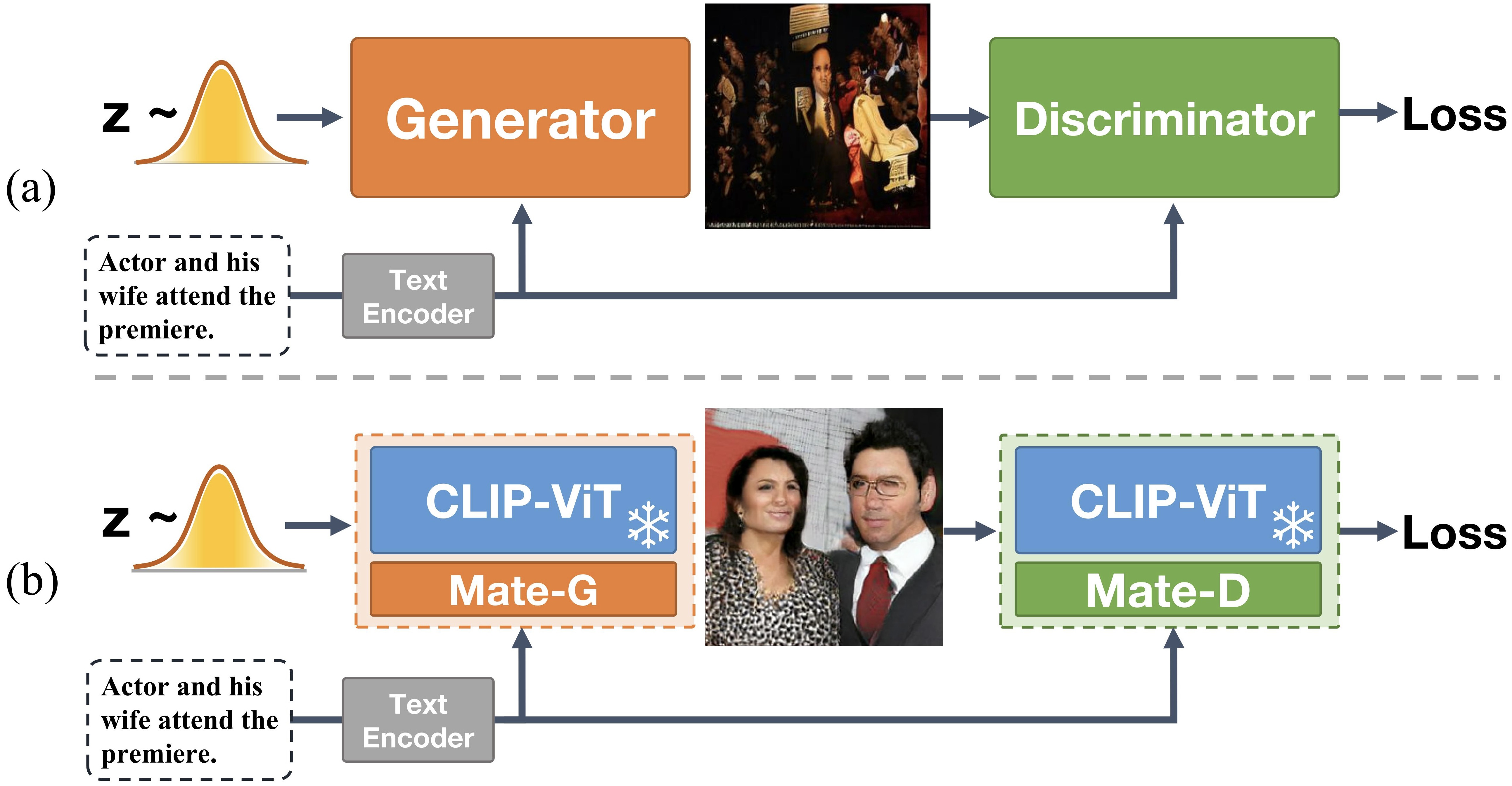
Experimental results
Research questions
- RQ1Can integrating CLIP into both generator and discriminator improve text-to-image synthesis quality while reducing data and parameter requirements?
- RQ2How does CLIP’s complex scene understanding enhance discriminator performance in distinguishing real vs. generated images?
- RQ3Can CLIP’s domain generalization ability improve zero-shot transfer and controllability in image generation?
- RQ4Does using CLIP features as intermediate supervision enable faster and more stable training than end-to-end GANs?
- RQ5What is the optimal layer selection in CLIP-ViT for discriminator and generator components to balance detail and generalization?
Key findings
- GALIP achieves a Fréchet Inception Distance (FID) of 5.85 on the COCO dataset, outperforming baseline GANs (FID: 17.31) and matching state-of-the-art models with far fewer resources.
- The CLIP-based discriminator reduces FID from 17.31 to 7.92 and increases CLIPSIM from 0.2996 to 0.3221, demonstrating improved image quality and alignment.
- The CLIP-empowered generator with Bridge-FP further reduces FID to 6.52 and boosts CLIPSIM to 0.3301, showing effective feature induction from CLIP.
- The prompt predictor (PP) reduces FID to 5.85 and increases CLIPSIM to 0.3338, proving that dynamic prompt tuning enhances feature relevance.
- GALIP achieves ~120× faster inference (0.04s per image) than Latent Diffusion Models (LDM), while using only 12M training images and 320M total parameters.
- Using only 3% of the training data and 6% of the learnable parameters of large models, GALIP matches or exceeds their performance on zero-shot FID and CLIPSIM metrics.

Read this paper
Open the full text in the Nubint reader and ask about any passage as you read.
Read this paper on NubintThis review was generated by AI from the original paper. Please check the paper before citing it.