
[Paper Review] GBDT-MO: Gradient Boosted Decision Trees for Multiple Outputs
This paper proposes GBDT-MO, a novel gradient boosted decision tree framework for multiple outputs that jointly models correlations between output variables by optimizing a shared objective gain across all outputs at each leaf. By extending second-order gradient approximation and histogram-based splitting to multi-output settings, GBDT-MO achieves superior generalization and faster training—especially with high-dimensional outputs—while enabling sparse output selection via L₀ regularization.
Gradient boosted decision trees (GBDTs) are widely used in machine learning, and the output of current GBDT implementations is a single variable. When there are multiple outputs, GBDT constructs multiple trees corresponding to the output variables. The correlations between variables are ignored by such a strategy causing redundancy of the learned tree structures. In this paper, we propose a general method to learn GBDT for multiple outputs, called GBDT-MO. Each leaf of GBDT-MO constructs predictions of all variables or a subset of automatically selected variables. This is achieved by considering the summation of objective gains over all output variables. Moreover, we extend histogram approximation into multiple output case to speed up the training process. Various experiments on synthetic and real-world datasets verify that GBDT-MO achieves outstanding performance in terms of both accuracy and training speed. Our codes are available on-line.
Motivation & Objective
- To address the limitation of standard GBDT in handling multiple outputs by ignoring correlations between output variables.
- To reduce structural redundancy in multi-output learning by jointly modeling output dependencies within a single tree.
- To develop a scalable and efficient training method for multi-output GBDT using second-order gradient approximation and histogram-based optimization.
- To enable automatic selection of relevant output subsets at each leaf via sparse split finding with L₀ constraints.
- To improve generalization and training speed compared to standard GBDT and existing multi-output approaches.
Proposed method
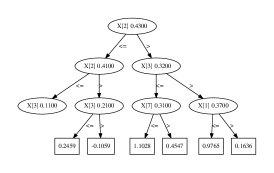
- GBDT-MO formulates a joint objective function that maximizes the sum of objective gains across all output variables during tree splitting.
- It extends second-order Taylor approximation of the loss function to the multi-output case, enabling more accurate and stable updates.
- Histogram approximation is generalized to multiple outputs, allowing efficient gradient computation and fast training by binning feature values.
- Two sparse split finding algorithms are proposed: one unrestricted and one restricted, both incorporating L₀ regularization to select relevant output subsets at each split.
- The restricted sparse algorithm improves training speed by constraining shared support between left and right child nodes.
- Diagonal Hessian approximation is used to reduce computational cost while maintaining high accuracy.
Experimental results
Research questions
- RQ1Can joint optimization of multiple outputs in GBDT improve generalization by capturing inter-output correlations?
- RQ2How does the proposed multi-output GBDT framework compare in accuracy and training speed to standard GBDT and existing multi-output methods?
- RQ3What is the impact of L₀ regularization on output subset selection and model performance in multi-output GBDT?
- RQ4How effective is the extension of histogram approximation to the multi-output setting in accelerating training?
- RQ5Does the restricted sparse split finding algorithm offer a better trade-off between performance and speed than the unrestricted variant?
Key findings
- GBDT-MO achieves better generalization than GBDT-SO and XGBoost, with lower test loss and higher accuracy despite higher training loss.
- On MNIST and Caltech101, GBDT-MO outperforms GBDT-SO in test accuracy by up to 1.2% while showing faster convergence in later rounds.
- GBDT-MO is significantly faster than GBDT-SO and XGBoost, especially when the number of outputs is large, and is slightly faster than LightGBM.
- The restricted sparse split finding algorithm achieves slightly better test performance and much faster training than the unrestricted version, particularly at high sparsity levels.
- The diagonal Hessian approximation reduces training time by ~75% on MNIST and ~88% on Yeast with minimal accuracy drop (≤0.5% on both datasets).
- With optimal sparsity factor k, the sparse GBDT-MO variant can outperform non-sparse baselines, e.g., achieving 64.1% accuracy on Caltech101 with k=64.
Read this paper
Open the full text in the Nubint reader and ask about any passage as you read.
Read this paper on NubintThis review was generated by AI from the original paper. Please check the paper before citing it.