
[Paper Review] Gender Lost In Translation: How Bridging The Gap Between Languages Affects Gender Bias in Zero-Shot Multilingual Translation
This paper investigates how language-agnostic representations and bridge language choice affect gender bias in zero-shot multilingual neural machine translation (NMT), particularly in preserving grammatical gender across gender-inflected languages. It finds that language-agnostic representations reduce masculine bias in zero-shot translation, and with highly gender-inflected bridge languages like German or Spanish, pivoting outperforms zero-shot translation in fairer gender preservation for speaker-related gender agreement.
Neural machine translation (NMT) models often suffer from gender biases that harm users and society at large. In this work, we explore how bridging the gap between languages for which parallel data is not available affects gender bias in multilingual NMT, specifically for zero-shot directions. We evaluate translation between grammatical gender languages which requires preserving the inherent gender information from the source in the target language. We study the effect of encouraging language-agnostic hidden representations on models' ability to preserve gender and compare pivot-based and zero-shot translation regarding the influence of the bridge language (participating in all language pairs during training) on gender preservation. We find that language-agnostic representations mitigate zero-shot models' masculine bias, and with increased levels of gender inflection in the bridge language, pivoting surpasses zero-shot translation regarding fairer gender preservation for speaker-related gender agreement.
Motivation & Objective
- To investigate how bridging unseen language pairs in multilingual NMT affects gender bias, especially in preserving grammatical gender.
- To compare zero-shot translation and pivot-based translation in terms of gender preservation fairness for unseen language pairs.
- To evaluate the impact of the bridge language’s gender inflection level on gender bias in both translation approaches.
- To assess whether improving translation quality via language-agnostic representations reduces gender bias in zero-shot models.
Proposed method
- The study uses multilingual neural machine translation (MNMT) models fine-tuned with techniques to encourage language-agnostic hidden representations.
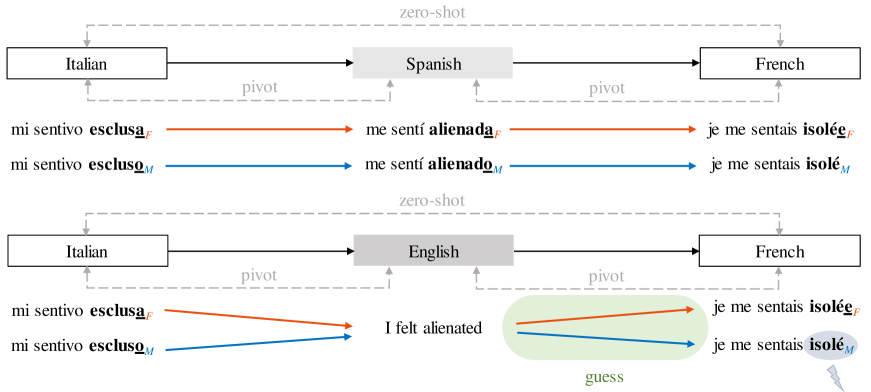
- It evaluates both zero-shot translation (direct cross-lingual transfer) and pivot-based translation (using an intermediate bridge language) for unseen language pairs.
- The bridge language is varied across English (low gender inflection), Spanish, and German (high gender inflection) to assess its influence on gender bias.
- Gender preservation is evaluated using reference translations annotated for referential and grammatical gender, focusing on pronoun agreement in target languages.
- Three model modifications are applied to enhance language-agnostic representations: adversarial training, contrastive learning, and disentangled representation learning.
- Evaluation metrics focus on gender bias by comparing masculine and feminine gender preservation rates in translation outputs.

Experimental results
Research questions
- RQ1RQ1: How do zero-shot and pivot-based translation compare regarding gender-biased outputs for zero-shot directions?
- RQ2RQ2: Does the bridge language affect the gender biases perpetuated by zero-shot and pivot-based translations?
- RQ3RQ3: Do translation quality improvements of zero-shot models reduce their gender biases?
Key findings
- Zero-shot translation outperforms pivoting in preserving the feminine gender, reducing the consistent masculine bias observed across models and approaches when using English as the bridge language.
- With highly gender-inflected bridge languages like German and Spanish, pivoting surpasses zero-shot translation in achieving more balanced gender preservation for speaker-related gender agreement.
- Language-agnostic representations significantly reduce masculine bias in zero-shot models, improving fairness in gender preservation across both genders.
- The three modifications to encourage language-agnostic representations (adversarial training, contrastive learning, disentangled learning) all improved zero-shot models’ ability to preserve both masculine and feminine gender, narrowing the performance gap.
- When bridging via English, zero-shot models with language-agnostic representations outperform pivoting in gender fairness, indicating that continuous representations better preserve gender cues than discrete pivot-based methods.
- The study reveals that the linguistic properties of the bridge language—particularly its level of gender inflection—play a crucial role in determining the fairness of gender preservation in multilingual translation.
Read this paper
Open the full text in the Nubint reader and ask about any passage as you read.
Read this paper on NubintThis review was generated by AI from the original paper. Please check the paper before citing it.