
[논문 리뷰] Geographic Location Encoding with Spherical Harmonics and Sinusoidal Representation Networks
이 논문은 구면 조화 임베딩과 Sinusoidal Representation Networks (SirenNets)을 결합한 글로벌 위치 인코더를 제시하며, 특히 극지에서 강한 성능을 보이고 SirenNets가 학습된 DFS 임베딩으로 작동한다고 주장합니다.
Learning representations of geographical space is vital for any machine learning model that integrates geolocated data, spanning application domains such as remote sensing, ecology, or epidemiology. Recent work embeds coordinates using sine and cosine projections based on Double Fourier Sphere (DFS) features. These embeddings assume a rectangular data domain even on global data, which can lead to artifacts, especially at the poles. At the same time, little attention has been paid to the exact design of the neural network architectures with which these functional embeddings are combined. This work proposes a novel location encoder for globally distributed geographic data that combines spherical harmonic basis functions, natively defined on spherical surfaces, with sinusoidal representation networks (SirenNets) that can be interpreted as learned Double Fourier Sphere embedding. We systematically evaluate positional embeddings and neural network architectures across various benchmarks and synthetic evaluation datasets. In contrast to previous approaches that require the combination of both positional encoding and neural networks to learn meaningful representations, we show that both spherical harmonics and sinusoidal representation networks are competitive on their own but set state-of-the-art performances across tasks when combined. The model code and experiments are available at https://github.com/marccoru/locationencoder.
연구 동기 및 목표
- 원격 탐사, 생태학, 역학 등과 같은 다양한 영역에서 강건한 지리 위치 표현을 촉진한다.
- 구형 지구에서 DFS 기반 임베딩으로부터 생기는 아티팩트를 다루고, 특히 극지 근처에서의 문제를 해결한다.
- 구면 조화(SH) 기반 위치 임베딩을 제안하고 이를 Sinusoidal Representation Networks(SirenNets)와 결합한다.
- 다양한 합성 및 실제 데이터셋(보간, 분류, 다변수 회귀)에 걸쳐 SH+SirenNet를 체계적으로 평가한다.
제안 방법
- 학습 가능 가중치 w_l^m와 최대 차수 L을 가진 SH 기저 함수 Y_l^m를 사용하여 전역 위치 인코딩을 정의한다(eq. 3).
- 구의 표면에서 f(λ, φ)를 SH의 가중합으로 표현하고 가중치를 신경망(선형 계층 또는 더 복잡한 네트)을 통해 학습한다.
- Sinusoidal Representation Networks(SirenNets)을 신경망 백본으로 사용하여 SH 임베딩에서의 복잡한 매핑을 학습하고 SirenNet을 학습된 DFS 임베딩으로 해석한다.
- SH와 SirenNet를 DFS 기반 임베딩(Wrap, Grid, SphereC, SphereM 등)과 여러 작업에서 비교한다.
- Analytic/pre-computed SH 구현을 제공하고 DFS 기반 접근 방식에 비한 계산 효율성을 논의한다.
실험 결과
연구 질문
- RQ1구면 조화 임베딩과 신경망이 글로벌 위치 인식 태스크에서 DFS 기반 인코딩보다 더 높은 성능을 보이는가?
- RQ2SH 임베딩과 SirenNets의 조합은 합성, 기후, 육지/해양, iNaturalist 등 다양한 데이터셋에서 다른 NN 아키텍처와 비교해 어떤 성능 차이가 나는가?
- RQ3SH 임베딩이 DFS 기반 인코딩에서 나타나는 극지 아티팩트를 줄이고 극지 예측을 개선할 수 있는가?
- RQ4대규모 SH 차수에 대한 Analytic/사전계산(pre-computed) 대 Closed-form SH 구현의 계산적 트레이드오프는 무엇인가?
주요 결과
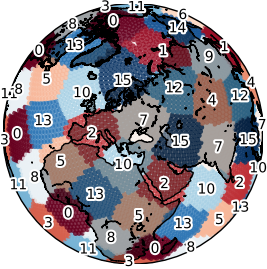
- SH 임베딩은 단순 Linear 계층을 포함한 네트워크 전반에서 안정적으로 동작하며 데이터셋 전반에서 강한 정확도를 달성한다.
- SirenNet은 일관되게 높은 성능을 제공하며 SH와 결합 시 iNaturalist 및 체커보드 데이터셋을 포함한 여러 작업에서 새로운 최첨단을 달성한다.
- SH 임베딩은 DFS 기반 인코딩에서 보이는 극지 아티팩트를 상당히 완화하고 극지 부근에서도 안정적인 성능을 유지한다.
- ERA5 다변수 보간에서 SH와 FcNet의 조합이 연구에서 최상의 결과를 보였으며 SH+SirenNet도 작업 전반에서 경쟁력 있게 성능을 발휘한다.
- SH 인코딩은 지리 데이터의 암묵적 신경 표현 학습을 가능하게 하며 전 지구적으로 정의되고 극지 친화적이며 핵심 시나리오에서 전통적 DFS 기반 접근법을 능가한다.
더 나은 연구,지금 바로 시작하세요
연구 설계부터 논문 작성까지, 연구 시간을 획기적으로 줄여보세요.
카드 등록 없음 · 무료 플랜 제공
이 리뷰는 AI가 만들고, 인간 에디터가 검토했습니다.