
[Paper Review] GigaSpeech: An Evolving, Multi-domain ASR Corpus with 10,000 Hours of Transcribed Audio
This paper introduces GigaSpeech, a large-scale, evolving, multi-domain English ASR corpus with 10,000 hours of high-quality transcribed audio from audiobooks, podcasts, and YouTube, covering read and spontaneous speech across diverse topics. It proposes a novel forced alignment and segmentation pipeline to filter low-quality transcriptions, enabling training subsets of 10h to 10,000h with word error rates capped at 0% (except XL at 4%), and provides baseline systems across major toolkits with WERs as low as 10.80% on the test set.
This paper introduces GigaSpeech, an evolving, multi-domain English speech recognition corpus with 10,000 hours of high quality labeled audio suitable for supervised training, and 40,000 hours of total audio suitable for semi-supervised and unsupervised training. Around 40,000 hours of transcribed audio is first collected from audiobooks, podcasts and YouTube, covering both read and spontaneous speaking styles, and a variety of topics, such as arts, science, sports, etc. A new forced alignment and segmentation pipeline is proposed to create sentence segments suitable for speech recognition training, and to filter out segments with low-quality transcription. For system training, GigaSpeech provides five subsets of different sizes, 10h, 250h, 1000h, 2500h, and 10000h. For our 10,000-hour XL training subset, we cap the word error rate at 4% during the filtering/validation stage, and for all our other smaller training subsets, we cap it at 0%. The DEV and TEST evaluation sets, on the other hand, are re-processed by professional human transcribers to ensure high transcription quality. Baseline systems are provided for popular speech recognition toolkits, namely Athena, ESPnet, Kaldi and Pika.
Motivation & Objective
- To address the stagnation in ASR performance due to outdated, limited-scale corpora by creating a large-scale, evolving, multi-domain speech recognition dataset.
- To develop a scalable, reliable pipeline for generating high-quality, segmented speech recognition corpora from diverse audio sources.
- To provide training and evaluation subsets of varying sizes (10h to 10,000h) with strict transcription quality control for robust model training and benchmarking.
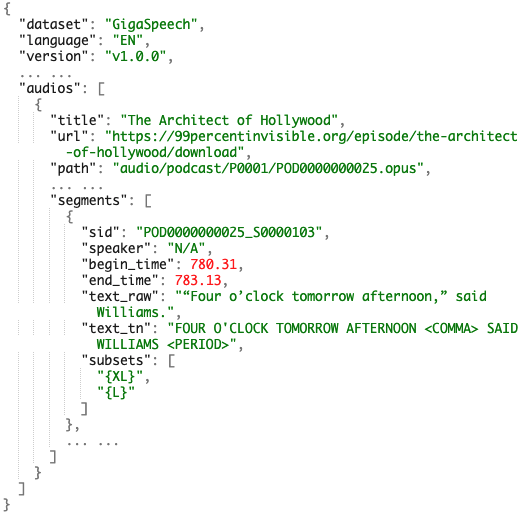
- To support end-to-end ASR training by including both original and normalized transcription pairs for post-processing.
- To enable reproducible baselines across major ASR toolkits (Kaldi, ESPnet, Athena, Pika) for fair comparison and system development.
Proposed method
- Collecting ~40,000 hours of raw audio from audiobooks, podcasts, and YouTube, covering diverse topics and speaking styles.
- Applying a novel forced alignment and segmentation pipeline to generate sentence-level audio segments with aligned transcriptions.
- Filtering out low-quality segments using a word error rate threshold: 0% for all subsets except the XL subset (capped at 4%).
- Creating five training subsets (XS to XL) with proportional distribution across audio sources and styles.
- Reprocessing the DEV and TEST sets via professional human transcribers to ensure high transcription accuracy.
- Providing baseline models in Kaldi, ESPnet, Athena, and Pika using standard architectures (e.g., conformer, RNN-T, chain models) with standardized training and decoding protocols.
Experimental results
Research questions
- RQ1Can a large-scale, multi-domain, multi-style ASR corpus with high transcription quality be systematically constructed from diverse web sources?
- RQ2How effective is the proposed forced alignment and segmentation pipeline in filtering low-quality transcriptions while preserving high-quality segments?
- RQ3To what extent does model performance improve with increasing training data size in a standardized, high-quality corpus like GigaSpeech?
- RQ4How do baseline systems across major ASR toolkits perform on the same standardized evaluation set, and what are their relative WERs?
- RQ5Can the proposed corpus and pipeline support reproducible benchmarking and facilitate progress in end-to-end ASR research?
Key findings
- The GigaSpeech XL training subset achieves a word error rate of 10.80% on the test set using the ESPnet conformer/transformer-AED model, demonstrating strong performance on a large-scale, high-quality corpus.
- The Kaldi chain model baseline achieves a WER of 14.84% on the XL subset, showing that even standard architectures benefit from the corpus’s scale and quality.
- Performance consistently improves with larger training subsets: the Kaldi baseline WER decreases from 22.59% (XS, 10h) to 14.84% (XL, 10,000h), confirming data scale benefits.
- The Pika RNN-T model achieves a WER of 12.30% on both DEV and TEST sets, indicating strong generalization on the XL subset.
- The Athena Transformer-AED model reports a WER of 12.70% on the TEST set, showing competitive performance across toolkits.
- The evaluation sets were reprocessed by professional transcribers, ensuring high transcription quality and enabling reliable benchmarking.
Read this paper
Open the full text in the Nubint reader and ask about any passage as you read.
Read this paper on NubintThis review was generated by AI from the original paper. Please check the paper before citing it.