
[Paper Review] Harnessing the Power of Adversarial Prompting and Large Language Models for Robust Hypothesis Generation in Astronomy
This study demonstrates that adversarial in-context prompting with GPT-4, augmented by a curated corpus of 1,000 Galactic Astronomy papers from NASA ADS, significantly enhances hypothesis generation quality in astronomy. By iteratively refining ideas through AI critique, the method produces innovative, contextually grounded scientific proposals that outperform baseline prompting and rival expert-level insights.
This study investigates the application of Large Language Models (LLMs), specifically GPT-4, within Astronomy. We employ in-context prompting, supplying the model with up to 1000 papers from the NASA Astrophysics Data System, to explore the extent to which performance can be improved by immersing the model in domain-specific literature. Our findings point towards a substantial boost in hypothesis generation when using in-context prompting, a benefit that is further accentuated by adversarial prompting. We illustrate how adversarial prompting empowers GPT-4 to extract essential details from a vast knowledge base to produce meaningful hypotheses, signaling an innovative step towards employing LLMs for scientific research in Astronomy.
Motivation & Objective
- To investigate whether in-context prompting with domain-specific literature improves hypothesis generation in astronomy using large language models.
- To evaluate the impact of adversarial prompting—where an AI critiques and refines another AI’s hypotheses—on the quality and innovation of generated scientific ideas.
- To assess whether low-cost prompting techniques can outperform fine-tuning by providing extensive, relevant context without requiring model retraining.
- To demonstrate that LLMs can extract and synthesize implicit knowledge from vast scientific literature to generate non-trivial, interdisciplinary research proposals.
- To establish a reproducible, accessible framework for scientific hypothesis generation in astronomy using open-source tools and publicly available data.
Proposed method
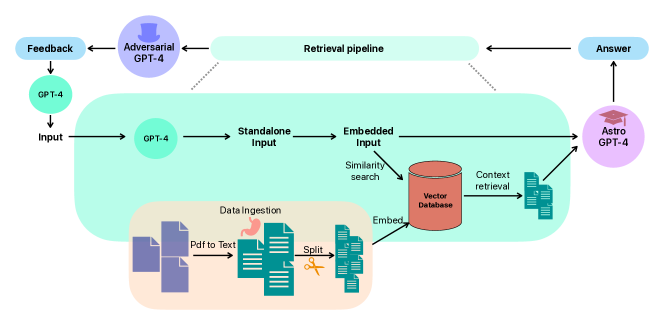
- The method employs in-context prompting by feeding GPT-4 up to 1,000 recent, peer-reviewed Galactic Astronomy papers from NASA ADS as context.
- Text chunks from the retrieved papers are embedded and filtered via similarity search and contextual compression to remove noise and retain relevance.
- A three-stage adversarial prompting pipeline is used: (1) GPT-4 generates a hypothesis, (2) a second GPT-4 model critiques it, and (3) a third GPT-4 model moderates the feedback to refine the output.
- The process is iterated multiple times (nF iterations), with each cycle improving the coherence, depth, and scientific relevance of the hypotheses.
- The method leverages Langchain to manage retrieval-augmented generation (RAG) workflows, enabling dynamic context retrieval and integration.
- Human experts evaluate the final hypotheses and critiques on quality, originality, and scientific plausibility, using a standardized scoring framework.
Experimental results
Research questions
- RQ1Can in-context prompting with a domain-specific corpus of 1,000 astronomy papers significantly improve the quality of hypothesis generation by GPT-4?
- RQ2To what extent does adversarial prompting—where hypotheses are iteratively critiqued and refined by a second LLM—enhance the innovation and scientific rigor of generated ideas?
- RQ3How does the performance of LLMs in hypothesis generation compare between naive prompting and contextually enriched prompting in astronomy?
- RQ4Can adversarial prompting compensate for the hallucination risks inherent in LLMs when applied to scientific domains with limited training data?
- RQ5To what extent can AI-generated hypotheses rival the quality of expert human scientific proposals in terms of originality and feasibility?
Key findings
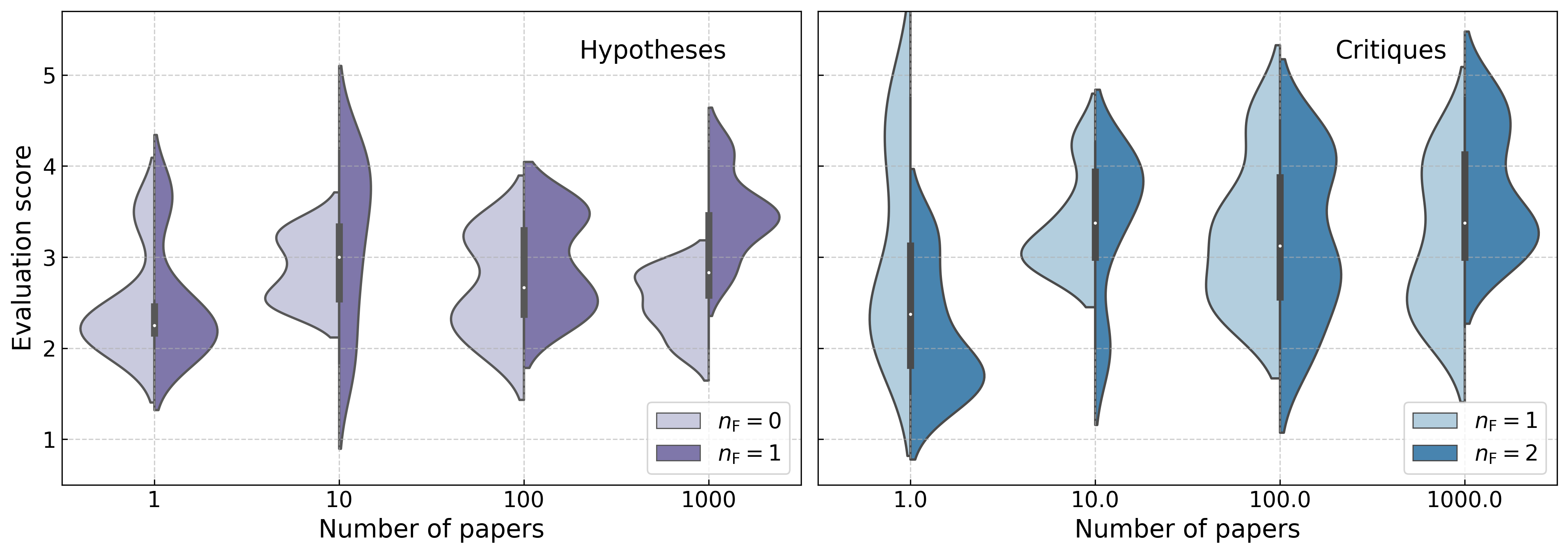
- Adversarial in-context prompting with 1,000 astronomy papers significantly improved hypothesis quality, with human experts rating the final outputs as comparable to expert-level scientific proposals.
- The iterative adversarial refinement process (nF iterations) led to substantial improvements in both the consistency and scientific depth of the generated hypotheses.
- Without adversarial prompting, GPT-4 generated hypotheses were often fragmented, factually redundant, or merely rephrased summaries of existing literature, lacking original insight.
- Critiques generated by the adversarial GPT-4 model were highly accurate and comparable in quality to those from expert human reviewers, particularly in identifying methodological weaknesses and logical gaps.
- The method demonstrated that LLMs can synthesize implicit knowledge across diverse subfields of astronomy (e.g., stellar kinematics, galaxy evolution, chemical abundances) to produce interdisciplinary research ideas.
- The study confirms that context-rich prompting can outperform fine-tuning in resource-constrained settings, offering a scalable, low-cost alternative for scientific AI applications.
Read this paper
Open the full text in the Nubint reader and ask about any passage as you read.
Read this paper on NubintThis review was generated by AI from the original paper. Please check the paper before citing it.