
[Paper Review] HASSOD: Hierarchical Adaptive Self-Supervised Object Detection
HASSOD proposes a self-supervised object detection framework that uses hierarchical adaptive clustering to discover variable numbers of objects per image and learns part-to-whole object compositions through coverage-based tree structures. By replacing multi-round self-training with a Mean Teacher framework, HASSOD achieves smoother training and state-of-the-art performance, improving Mask AP from 20.2 to 22.5 on LVIS and from 17.0 to 26.0 on SA-1B.
The human visual perception system demonstrates exceptional capabilities in learning without explicit supervision and understanding the part-to-whole composition of objects. Drawing inspiration from these two abilities, we propose Hierarchical Adaptive Self-Supervised Object Detection (HASSOD), a novel approach that learns to detect objects and understand their compositions without human supervision. HASSOD employs a hierarchical adaptive clustering strategy to group regions into object masks based on self-supervised visual representations, adaptively determining the number of objects per image. Furthermore, HASSOD identifies the hierarchical levels of objects in terms of composition, by analyzing coverage relations between masks and constructing tree structures. This additional self-supervised learning task leads to improved detection performance and enhanced interpretability. Lastly, we abandon the inefficient multi-round self-training process utilized in prior methods and instead adapt the Mean Teacher framework from semi-supervised learning, which leads to a smoother and more efficient training process. Through extensive experiments on prevalent image datasets, we demonstrate the superiority of HASSOD over existing methods, thereby advancing the state of the art in self-supervised object detection. Notably, we improve Mask AR from 20.2 to 22.5 on LVIS, and from 17.0 to 26.0 on SA-1B. Project page: https://HASSOD-NeurIPS23.github.io.
Motivation & Objective
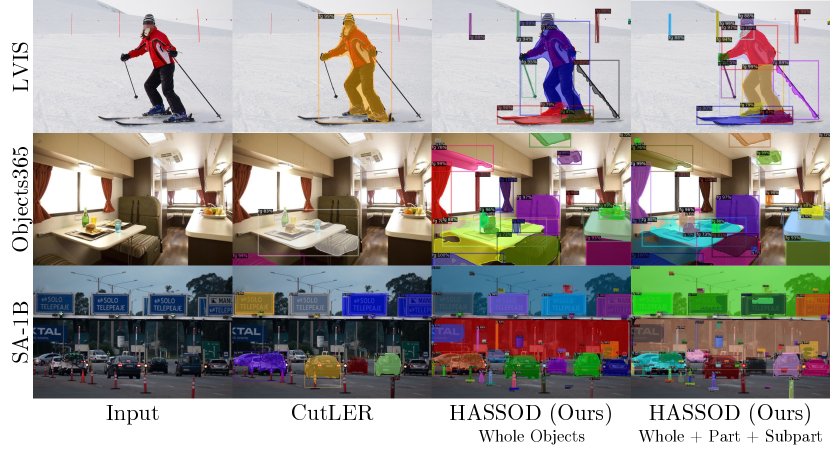
- To address the limitations of prior self-supervised object detection methods that focus on only one or few objects per image, leading to narrow object coverage.
- To enable the discovery of hierarchical object compositions—whole, part, and subpart objects—improving interpretability and detection performance.
- To eliminate inefficient multi-round self-training by adopting a smooth, adaptive training process inspired by the Mean Teacher framework.
- To improve generalization and robustness in self-supervised detection by jointly learning object masks and their compositional relationships.
Proposed method
- HASSOD employs a hierarchical adaptive clustering strategy that groups image regions into object masks using self-supervised visual representations, dynamically adjusting the clustering threshold to determine the number of objects per image.
- It constructs tree structures by analyzing coverage relations between object masks to classify them into hierarchical levels: whole objects, parts, and subparts.
- The method introduces a novel self-supervised task of hierarchical level prediction, which enhances detection performance and interpretability.
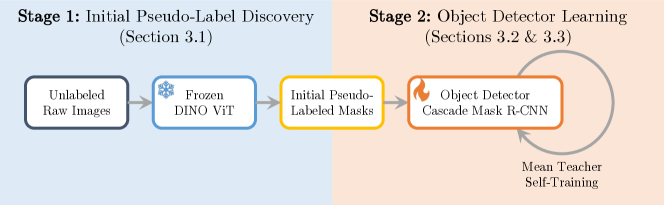
- It replaces multi-round self-training with a Mean Teacher framework, where a student model learns from a teacher model’s predictions, with adaptive weighting of learning targets for smoother optimization.
- The framework uses a frozen DINO backbone for initial pseudo-label generation, followed by end-to-end adaptation of features and detection head during training.
- Adaptive loss weighting balances initial pseudo-labels and teacher predictions, enabling curriculum learning that reduces noise impact over time.
Experimental results
Research questions
- RQ1Can self-supervised object detection be improved by discovering multiple objects per image instead of focusing on only one or few prominent ones?
- RQ2Can hierarchical composition of objects (whole, part, subpart) be learned in a self-supervised manner to improve detection and interpretability?
- RQ3Does replacing multi-round self-training with a Mean Teacher-based framework lead to more efficient and stable training in self-supervised object detection?
- RQ4Can the quality of initial pseudo-labels be improved through ensemble clustering with multiple merging thresholds?
- RQ5To what extent does hierarchical level prediction and adaptive curriculum learning enhance detection performance on open-vocabulary benchmarks?
Key findings
- HASSOD improves Mask AP from 20.2 to 22.5 on the LVIS dataset, representing a significant state-of-the-art advancement in self-supervised object detection.
- On the SA-1B dataset, HASSOD increases Mask AP from 17.0 to 26.0, demonstrating strong generalization to large-scale, open-vocabulary benchmarks.
- The combination of hierarchical adaptive clustering, hierarchical level prediction, and Mean Teacher training yields the best performance, with each component contributing 0.3–0.5 Mask AR improvement.
- Using multiple merging thresholds (0.1, 0.2, 0.4) in clustering improves pseudo-label quality, increasing AP from 1.7 to 6.1 while maintaining high recall.
- The Mean Teacher framework enables effective refinement of pseudo-labels through evolving teacher predictions, reducing reliance on noisy initial labels and improving final detection performance.
- HASSOD achieves better detection performance than prior methods like CutLER by discovering a broader range of objects and understanding their compositional structure.
Read this paper
Open the full text in the Nubint reader and ask about any passage as you read.
Read this paper on NubintThis review was generated by AI from the original paper. Please check the paper before citing it.